🍇 Sugar in Grapes Calculator
Calculate the exact grams of sugar in any serving of grapes by type, weight, or count
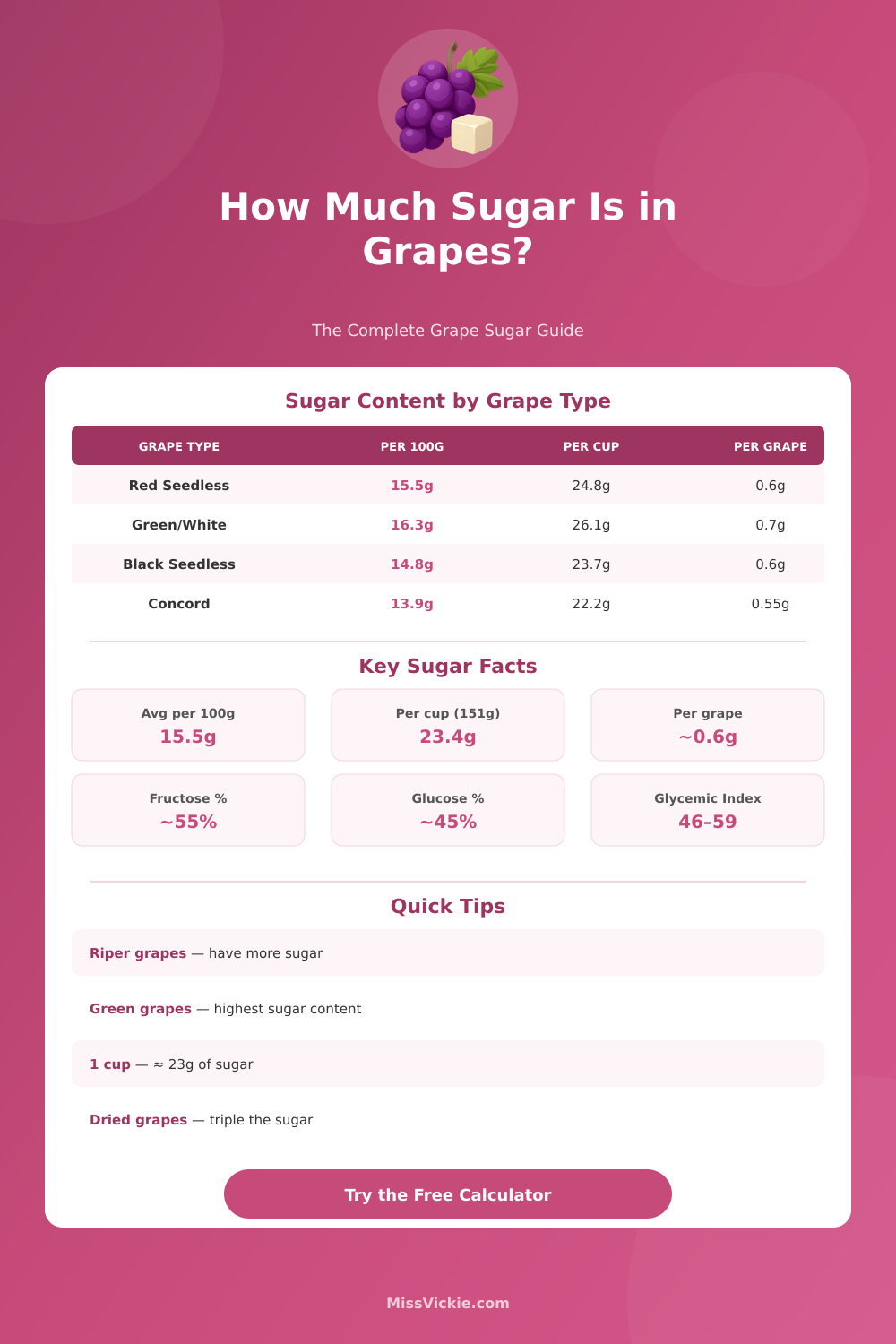
| Grape Variety | Total Sugar | Fructose | Glucose | Sucrose | Calories |
|---|---|---|---|---|---|
| Red Seedless | 15.5g | 8.1g | 7.2g | 0.2g | 67 kcal |
| Green / White Seedless | 16.3g | 8.6g | 7.5g | 0.2g | 69 kcal |
| Black Seedless | 14.8g | 7.8g | 6.8g | 0.2g | 63 kcal |
| Concord | 13.9g | 7.2g | 6.5g | 0.2g | 60 kcal |
| Muscat / Muscat Blanc | 18.1g | 9.4g | 8.4g | 0.3g | 76 kcal |
| Flame Seedless (Red) | 15.9g | 8.3g | 7.4g | 0.2g | 68 kcal |
| Cotton Candy Grapes | 18.6g | 9.7g | 8.6g | 0.3g | 79 kcal |
| Raisins (Dried Grapes) | 59.2g | 29.7g | 28.5g | 1.0g | 299 kcal |
| Serving | Weight | Approx. Grapes | Sugar (Red) | Sugar (Green) | Calories (Red) |
|---|---|---|---|---|---|
| 1 Single Grape | ~5g | 1 | 0.78g | 0.82g | 3 kcal |
| Small Snack (10 grapes) | ~50g | 10 | 7.8g | 8.2g | 34 kcal |
| 1/2 Cup | ~76g | ~15 | 11.8g | 12.4g | 51 kcal |
| 1 Cup (standard) | 151g | ~30 | 23.4g | 24.6g | 101 kcal |
| Medium Bunch | ~200g | ~40 | 31.0g | 32.6g | 134 kcal |
| Large Bunch | ~400g | ~80 | 62.0g | 65.2g | 268 kcal |
| 1/2 lb (8 oz) | 227g | ~45 | 35.2g | 37.0g | 152 kcal |
| 1 lb | 454g | ~90 | 70.4g | 74.0g | 304 kcal |
| Sugar Amount | In Teaspoons | In Tablespoons | In Ounces |
|---|---|---|---|
| 5g sugar | 1.2 tsp | 0.4 tbsp | 0.18 oz |
| 10g sugar | 2.4 tsp | 0.8 tbsp | 0.35 oz |
| 15g sugar | 3.6 tsp | 1.2 tbsp | 0.53 oz |
| 20g sugar | 4.8 tsp | 1.6 tbsp | 0.71 oz |
| 25g sugar | 6.0 tsp | 2.0 tbsp | 0.88 oz |
| 50g sugar | 12.0 tsp | 4.0 tbsp | 1.76 oz |
grapes grow on wooden vines and they are really berries that form in bunches while they mature. The history of grape growing goes very far back. We talk about around 8 000 years ago, and since then people added them to human food customs.
There is something almost poetic about them. They are sweet they fill you well and they stood for wealth and good life through cultures for thousands of years.
Grapes: History, Types, Health and Uses
The variety here is really exciting. You find red, purple, black, white and almost blue shades. In size, they differ a lot, some are tiny almost invisible, while others reach almost two inches long and weigh like a plum.
The shape also changes a lot. Some are perfectly round, others more oval. And then there is the thing about seeds: some grapes have them, others not.
The Kyoho-grape, a type of muscat, shows as especially liked, and really, it imprssses quite a lot.
Because of that big variety people sort grapes into three main groups: table grapes for fresh eating, juice grapes for juice and wine grapes for wine making. When buying, choose those that seem full and fresh with nice colour everywhere. Green marks?
That shows that they have not fully ripened. Even so, grapes do not ripen any more after you remove them from the vine, so what you choose, that you have.
In nutrition they are surprisingly light. For a three-quarter cup you need only 90 calories, without fat and without cholesterol. The sodium content is low also.
Around 32 grapes form one serving of fruit, and one cup holds about 22. They beat there weight in vitamin C and K. With fiber and potassium you get a really balanced taste that well manages the natural sugar.
grapes with dark red or purple colour have more antioxidants than the green or white. Resveratrol is present in grapes and it can help heart health, this is the element that gets a lot of attention. Moreover, phenol acids, flavonoids and anthocyanins are found here.
Those substances give antioxidant and anti-swelling benefits. If you eat them with seeds, you get more of those useful elements.
Even so, too many grapes have downsides. All those natural sugars can create problems in big amounts. The high fiber and water content causes gas and bloating if you eat too much.
In addition, undigested seeds sometimes cause bad feeling in the belly.
Fresh grapes work well as a standalone snack, tossed in salads, mixed in sauces or cooked to preserves and jellies. Frozen grapes make a surprisingly pleasant sweet; only wash, dry well, place on a plate and freeze. Roasting them in a pan with olive oil until they caramelize and burst is another good idea.
Leaves of Sultana vines wrap fillings for dolma dishes. You can also bake focaccia with grapes and rosemary or lay roasted grapes on crackers withdried cheese.
Note: grapes and raisins are poisonous for dogs, even in small amounts. One last safe tip, never put grapes in a microwave. They really can explode.