How Much Pectin for Grape Jam Calculator
Estimate powdered, liquid, low-sugar, or homemade pectin for grape jam using prepared grape amount, grape type, sugar level, acidity, set style, and batch margin.
Load a common grape jam or jelly scenario, then adjust the pectin type to match the box, pouch, or low-sugar pectin you are using.
Full Breakdown
Best with full-sugar Concord jam and a brief rolling boil.
Added near the end; useful for grape jelly and clear juice batches.
Better for reduced sugar grape spreads when label directions allow it.
Works as a concentrate estimate, but set strength varies by apple or citrus batch.
| Pectin form | Typical unit | Calculator base | Best grape use |
|---|---|---|---|
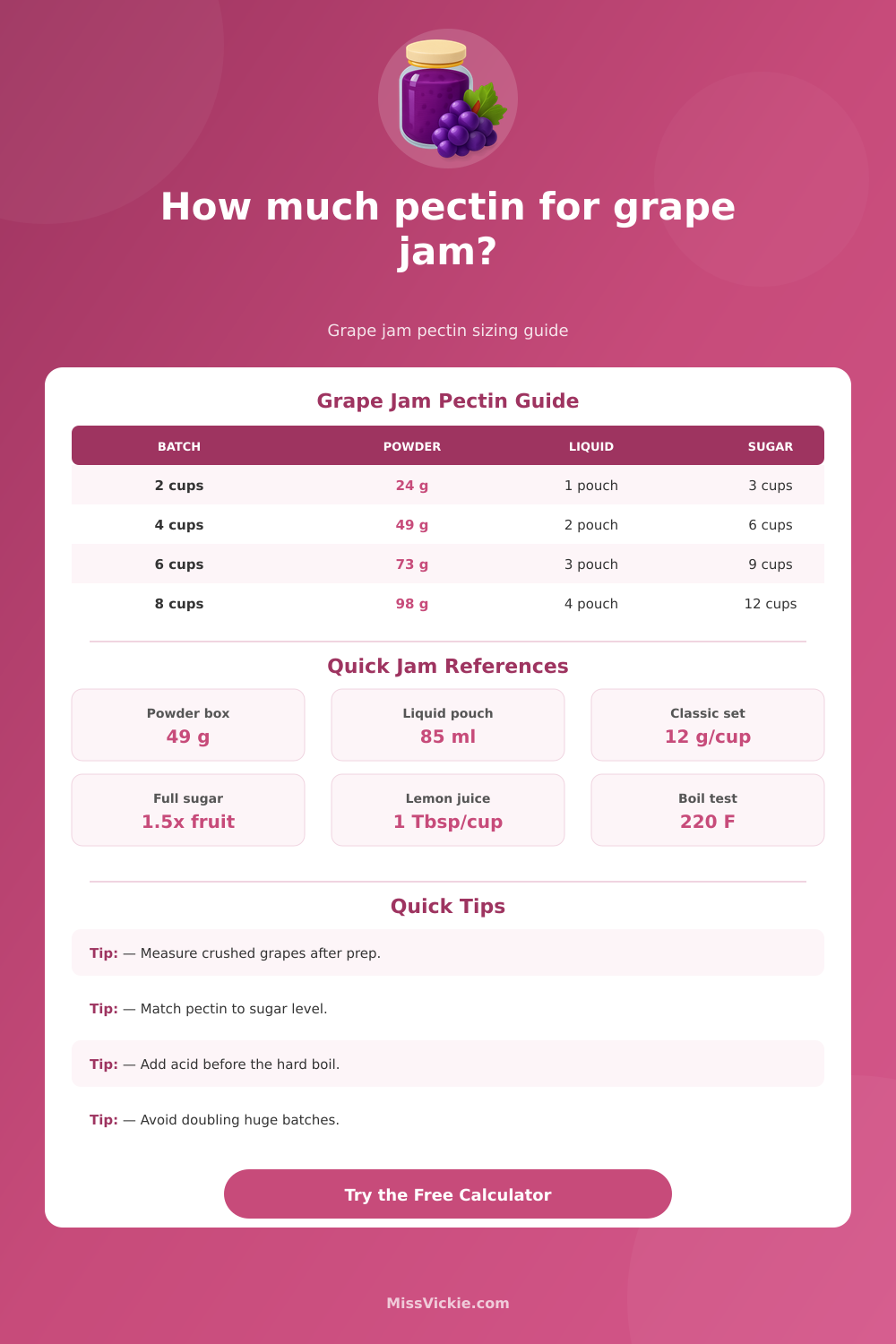
| Regular powdered pectin | 1.75 oz box, about 49 g | About 12.25 g per cup prepared fruit | Classic high-sugar jam or firm grape jelly |
| Liquid pectin | 3 fl oz pouch, about 85 ml | About 0.5 pouch per cup prepared juice or pulp | Clear grape jelly, bottled juice jelly, smooth grape spread |
| Low-sugar powdered pectin | Flexible jar or packet | About 10 g per cup, adjusted by sugar level | Reduced sugar Concord, table grape, or muscadine jam |
| No-sugar LM pectin | Powder plus calcium system | About 8 g per cup before label calcium adjustment | No-sugar or honey-sweetened grape jam |
| Homemade liquid pectin | Apple or citrus concentrate | About 4 Tbsp per cup prepared grapes | Small batches when a softer traditional set is acceptable |
| Bulk high-methoxyl pectin | Gram-scale powder | About 1.0 to 1.2 percent of finished jam weight | Precise canning batches with full sugar and acid control |
| Grape base | Natural pectin | Acid behavior | Calculator adjustment |
|---|---|---|---|
| Concord or slip-skin grapes | Medium to high from skins and underripe fruit | Usually tart enough with recipe lemon juice | Slightly lower pectin than mild table grapes |
| Extracted grape juice | Lower because skins and pulp are strained away | Needs reliable lemon juice for clean jelly set | Raises pectin and acid support |
| Muscadine or scuppernong | Moderate, with tough skins and seedy pulp | Often tangy but variable by ripeness | Uses a small firmness boost |
| Seedless table grapes | Often low, especially when very ripe | Milder flavor and lower acid | Raises pectin and lemon juice |
| Bottled unsweetened grape juice | Predictable but usually low in pulp pectin | Acid can be flatter after processing | Uses jelly-style pectin and acid margin |
| Frozen grape pulp | Similar to fresh but texture is softer | Juice release can dilute the set | Adds a small pectin cushion |
| Sugar style | Suggested sugar | Pectin match | Acid note |
|---|---|---|---|
| Full sugar classic | About 1.5 cups sugar per cup prepared grapes | Regular powdered or liquid pectin | Use recipe lemon juice to support gel and canning acidity |
| Moderate sugar | About 1 cup sugar per cup prepared grapes | Low-sugar pectin is more reliable | Increase acid slightly for table grapes or bottled juice |
| Low sugar | About 0.5 cup sugar per cup prepared grapes | Low-sugar or no-sugar pectin | Follow the pectin label for calcium or acid sequence |
| Honey or maple | About 0.4 cup sweetener per cup prepared grapes | No-sugar LM pectin usually sets better | Honey can buffer acidity, so lemon juice matters |
| No added sugar | No granulated sugar added | No-sugar pectin only | Use tested instructions for safety and storage |
| Prepared grapes | Regular powder | Liquid pectin | Typical half-pint yield |
|---|---|---|---|
| 2 cups | About 24 g, or 1/2 box | About 1 pouch | 3 to 4 jars with full sugar |
| 4 cups | About 49 g, or 1 box | About 2 pouches | 6 to 8 jars with full sugar |
| 6 cups | About 73 g, or 1 1/2 boxes | About 3 pouches | 10 to 11 jars with full sugar |
| 8 cups | About 98 g, or 2 boxes | About 4 pouches | 13 to 15 jars with full sugar |
| 10 cups | About 123 g, or 2 1/2 boxes | About 5 pouches | 16 to 18 jars with full sugar |
Making jam with grapes require you to balance the jam’s ingredient. Grape jam specificaly require a balance of pectin, sugar, and acid in order to allow the jam to set proper. If you dont find the right balance between these three ingredient, your grape jam may either be too thin to pour or too thick to eat.
Many factor will play a role in the amount of pectin you need for your jam, such as the type of grapes, the amount of sugar, and the amount of acid. The type of grape that you use will play a key role in the amount of pectin that the grapes naturaly contain. Concord grapes contains more pectin than grape varieties like seedless table grapes due to the fact that Concord grape skin and Concord underripe fruit contain pectin.
How to Use a Pectin Calculator for Grape Jam
Seedless table grapes, on the other hand, contain less pectin than Concord grape because seedless table grapes are fully ripe. Muscadine grapes and scuppernong grapes contains medium amounts of natural pectin. If you use grape varieties that contain less natural pectin than Concord grape, you will have to add more pectin packet to the jam to allow it to set.
The pectin calculator will provide you with the amount of pectin that you should add based on the type of grape that you use. The amount of sugar that you use in your jam will play a key role in the performance of the pectin. Many jam recipe use one and a half cup of sugar to one cup of prepared grapes because this ratio of sugar help the pectin to form a gel.
If you choose to use less sugar than the amount that is suggested in the recipe, you may find that your jam will not set proper. The calculator will allow you to select the style of sugar that you would like to use, and the amount of pectin that you need will be adjusted based on your selection. Acid is another ingredient that will allow the pectin to perform as it should in the jam.
If you use lemon juice in your jam, the pH of the jam will decrease. Lowering the pH of the jam will allow the pectin to perform its function. Additionally, using lemon juice will also brighten the flavor of the jam.
The tartness of the grapes that you use will determine the amount of acid that you need to add to the jam. If the grapes are very tart, they will naturally contain a lot of acid. For the other variety of grapes, the pectin calculator will have to account for the amount of acid so that you do not add too much or too little to the jam.
One more factor that will play a role in the texture of your jam is the amount of pulp and skin that you use in your jam. If you use crushed grapes, the jam will contain more natural pectin than if you use juice only to make your jam. If you make jelly from juice only, you will have less natural pectin than if you make jam with pulp from crushed grapes.
The strain-style setting on the calculator allows you to tell the calculator if you are using skins and juice or juice only in your jam recipe. This will prevent you from having to use too much or too little pectin in your jam. The size of the batch of jam that you make will play a role in the performance of the pectin.
If you are making a large batch of jam, the jam will take longer to cool. The slower cooling of the jam will weaken the set of the jam. To combat this, the pectin calculator provide a margin of pectin if you use it for large batches of jam.
Long cooking time will also affect the jam’s texture. The longer that the jam cooks, the more concentrate the jam will become. The more concentrated the jam, the less pectin that it will require.
Quick-cook jams, like freezer jams, require more pectin. The jam in freezer jams does not reach the same high temperature as jams that simmer for long periods of time. In order for the pectin to work proper in your jam, you must measure out your prepared grape.
You must measure your prepared grapes after you crush or juice the grapes. Do not measure the amount of grapes before you remove the stem and seeds from the grapes. The stems and seeds do not contain the same amount of volume as the grape fruit that the pectin need to properly set your jam.
If you use powdered pectin, add it to your jam before you hard boil the jam. Stir the powdered pectin while it is boiling to ensure that it fully dissolve in the jam. If you use liquid pectin, add the pectin to your jam near the end of the jam-making process, after the sugar reach a rolling boil.
Boil the jam for one minute at the correct temperature. While jam and jam recipe can easily be doubled, doubling the recipe will change the way in which the pectin work in the jam. The large volume of jam will reach the necessary cooking temperature differently than a small batch of jam.
To account for this, the pectin calculator include a batch-margin setting that allows for additional pectin to be accounted for if you plan to double the jam recipe. If you use homemade pectin for your jam, you will have to account for the fact that the homemade pectin behave differently than the commercial pectin that is sold in store. The pectin calculator allows for the homemade pectin to be entered as a separate category for jams that use this type of pectin.
The calculator that is made for jam recipes ask for the type of jam that you would like to make and the sweetness, firmness, and type of grape that will be used. Based on these answer, the calculator will provide you with a recommendation for the amount of pectin that you need. The calculator takes into account the variable of your jam recipe to allow you to make consistent jar of jam.