🦢 Goose portion planning
How Much Goose Per Person
Estimate whole geese, breasts, legs, confit, and pulled goose for roast dinners, holiday carving, buffet pans, sliders, and plated events using yield-aware portion math.
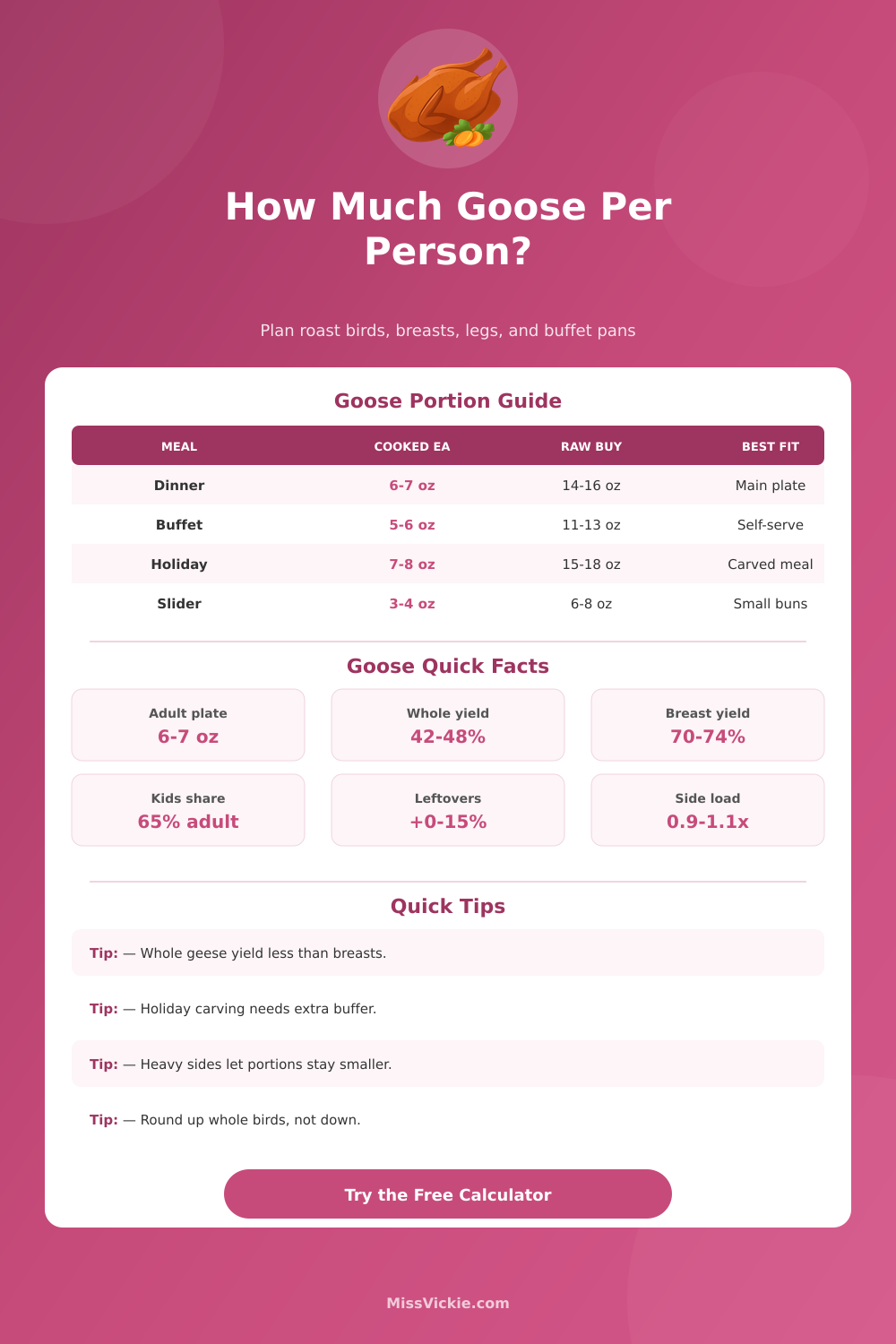
Whole roast goose delivers far less edible meat than breast packs or confit legs, so bird count climbs quickly when you want carved holiday portions and reliable leftovers.
| Occasion | Cooked Per Adult | Typical Raw Buy | Best Fit |
|---|---|---|---|
| Roast Dinner | 6.3 oz | 13 to 15 oz | Main-course goose with two to three sides |
| Holiday Carving | 7.1 oz | 15 to 18 oz | Showpiece goose with seconds and carving trim |
| Buffet Line | 5.6 oz | 11 to 13 oz | Self-serve pans with a broader side spread |
| Sliders or Buns | 3.8 oz | 6 to 8 oz | Pulled goose in small sandwich portions |
| Goose Format | Edible Yield | Default Unit | Planning Note |
|---|---|---|---|
| Whole Roast Goose | 45% | 10.5 lb bird | Classic holiday look, but bone and fat trim keep yields modest. |
| Breast-On-Bone Crown | 62% | 4.5 lb crown | Better yield than a whole goose while still carving neatly. |
| Boneless Breast Pack | 72% | 2.5 lb pack | Most efficient option for tidy plated slices. |
| Confit Legs | 64% | 3.0 lb tray | Rich dark meat with less carving waste than a whole bird. |
| Guests | Whole Goose | Breast Packs | Pulled or Stew |
|---|---|---|---|
| 4 | 1 bird | 1 to 2 packs | 2 small packs |
| 8 | 2 birds | 2 to 3 packs | 3 to 4 packs |
| 12 | 3 birds | 4 packs | 5 packs |
| 20 | 5 birds | 6 to 7 packs | 8 packs |
| Method | Recovery | Buy Factor | Best Use |
|---|---|---|---|
| Roast | 94% | 1.00x | Reliable baseline for most whole birds and crowns |
| Slow Roast | 92% | 1.02x | Extra rendering means slightly more raw buy |
| Smoke | 88% | 1.06x | Best for pulled goose, sliders, and long holds |
| Covered Stew | 100% | 0.96x | Low shrink for hash, pies, and braised dishes |
Holiday
Whole Roast
Best for carving drama. Lower yield, so round bird count up early.
Plated
Breast Packs
Higher yield and easier slicing for banquet lines or fixed plates.
Rich
Confit Legs
Darker meat feels generous, but a fatty menu may need smaller portions.
Casual
Pulled Goose
Great for buns and bowls where 3.5 to 4.5 cooked ounces is enough.
When preparing a goose for the table, the amount of edible meats that the goose will contain must be accounted for. A goose contain a significant amount of fat and bone. The fat and bone within the goose will reduce the amount of edible meat.
Consequently, the amount of edible meat from a whole goose will be approximately half of the raw weight of the goose. Thus, you must calculate the portions of the goose that will be served based off the weight of the edible meat from the goose, not the whole bird itself. The number of individuals that will eat the goose will determine the total amount of goose that must be purchased.
How Much Goose to Buy and Serve
Adults will typicaly eat approximately six ounces of cooked goose. Should the meal include children, it is likely that the portion of goose for those children will be less than six ounces of cooked goose. For instance, the portion of cooked goose for a child may be two-thirds of the amount that an adult will eat.
Additionally, the cooking method that you use to cook the goose will impact the amount of edible meat from that bird. For instance, roasted and smoked goose will contain less edible meat then goose that is cooked in a stew. The style of the meal will also impact the amount of goose that must be prepared.
For instance, if the meal is a buffet, the portion sizes of the goose may be larger than those that are served at a plated dinner. Finally, different parts of the goose will contain different amounts of edible meat. For instance, whole geese contain bones that cant be eaten.
Boneless goose breasts will contain more edible meat than whole geese because they will not lose any of the meat to the bones. Additionally, the legs of a goose are often prepared as confit, which is a dish where the cook prepares the goose leg in its own fat. Goose legs contain more fat than breasts and, therefore, will be richer in flavor.
Finally, pulled goose is another way to prepare the meat of the goose for consumption. The pulled goose meat can be prepared into small servings, such as slider. The side dishes that will be served with the goose will impact the portions of goose that should be prepared.
For instance, if the side dishes are heavy, such as mashed potatoes, the guests will become full of the sides and will eat less of the goose. Additionally, if the side dishes are light, such as salad, the guests will require more of the goose to fulfill there diets. Consequently, it is recommended to include a ten percent buffer for the amount of goose that is prepared for the meal to account for any guests who may want more food than the portion that is prepared or for guests who may not show up to the meal.
Common mistakes when preparing a meal that includes goose is not accounting for the amount of edible meat from the bird. One common mistake is to purchase whole geese based on the raw weight of the bird and to not account for the fact that the edible weight will be approximately fifty percent of the raw weight of the goose. Another common mistake is to treat goose in the same way as chicken.
Goose, however, is much fattier then chicken and the fat from the goose will make the guests feel full more quickly than the fat from the chicken. To avoid these mistakes, calculate the number of adult guests for the meal and calculate any children that will attend the meal as sixty-five percent of the amount of one adult guests. In order to understand the yield that will be produced from the goose through the cooking process, it is recommended to test the cooking method.
For instance, one can prepare a whole goose crown and roast it according to the recipe that will be used for the dinner. After the cook finishes the roasted goose crown, the amount of meat that is produced can be weighed. Knowing the weight of the edible meat from a roasted goose will allow cooks to prepare for the amount of meat that will be produced for future meals.
Additionally, the weight of the cooked meat will ensure that each guest receive an adequate portion of the goose.