
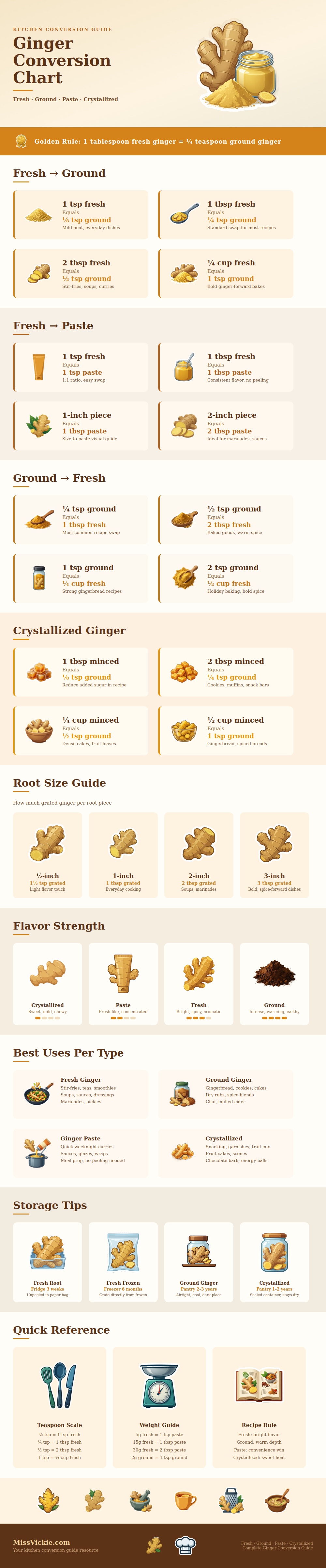
The panic sets in: “Oh no! I’m out of ginger.” You are halfway into making whatever it was. There is your recipe staring at you as you stand before the empty spot where the fresh root ought to be, and the directions call for a tablespoon of freshly grated ginger. All you have is a little jar of ground stuff that you stashed away last fall. How much is half a teaspoon? What about a whole one? Are you just guessing because it’s too late, and it will either work out or not?
Use this trusty converter chart to turn this moment of stress into a quick fix. It is not just about the amount, but also the strength. Fresh ginger is moist and bright; dried packs its heat into a concentrated dose. Knowing that pattern lets you change up quantity and set realistic expectations around how the flavor will play out in the dish.
How to Use Different Types of Ginger
Most commonly, it is a comparison between fresh and ground. One-quarter teaspoon dried is the equivalent of about one tablespoon of freshly grated. Why? Because water has been removed from the ground version, leaving just concentrated essential oils. Use equal parts, and not only will your gingerbread come out medicinal (not sweet!), but also the same holds true with all those other ingredients we swap: too little water equals intense flavor!
Here’s a breakdown in the chart for different amounts, double the fresh? Double the dry, too. Scale it up depending on what you’re making, whether it’s a big batch of gingerbread cake or curry paste. See? The ratio stays the same no matter the size of your meal.
The math is simpler when you grab some ginger paste instead, though then texture differs. Pre-grated fresh ginger, combined with oil and other preservatives to stabilize it on a shelf, are called paste. In this case, it’s typically one-to-one by volume: A tablespoon of fresh grated root equals a tablespoon of paste out of a jar or tube. That can be handy if you want to add some ginger to a quick weeknight stir-fry, and don’t feel up for peeling and grating. But as paste tends to contain stabilizing ingredients, it will behave just a little different in a sauce compared to freshly grated ginger fiber. If you’re making a big batch using a lot of ginger paste, you may find that you have to adjust amount of liquid you use slightly, to ensure it doesn’t get too cloudy or thick.
There is another level of complexity with sweet, spicy crystallized ginger. In addition to that chile kick, there’s sugar. If you’re adding minced crystallized bits according to a recipe’s instructions, you’re adding sugar too. The advice say to keep things balanced by using less sugar in your recipe. To match the heat of the ground spices, you need much more minced crystallized ginger than its volume would suggest. Why? A good part of the volume is the actual sugar coating. You use it in fruit cakes, scones, and sometimes other baked goods for sweetness and warmth. It is not meant to be a direct heat replacement for something savory. You don’t want your savory soup to suddenly become a dessert.
Storing fresh ginger properly will keep it useful and strong. Wrapped in paper, it’ll also keep in the crisper drawer for several weeks before becoming limp. And did I mention that freezing whole, unpeeled knobs is a real help if you find yourself with more than you need? No peeling required! Just grab the amount you need, grate it while still frozen (no need to defrost first)…and no garlic- or onion-smelly hands. The ground stuff needs to be stored similarly: In a cool, dry spot (like the kitchen cabinet), away from light, where its volatile oils remains intact for up to three years. Separate storage guarantees you’ve got exactly what you need, when you need it.
That’s not to say we’re blindly following any rules; on the contrary, knowing what each form adds to table is the whole point. Crystallized adds sweetness, fresh adds aroma, paste adds speed, ground adds depth. Once you understand how these things work, you no longer fret about measuring exactly; you cook confidently, secure in the knowledge that whatever you have, you’ll be able to make it work. The anxiety of using too little or too much of something dissapears and is replaced by the soothing certainty that you will figure it out with what you’ve got. Improvisation replaces sticking doggedly to a list, and the kitchen becomes a place of exploration. Pick up the jar, pour in as much as seems necessary, and then dinner’s served.