Gelatin Sheets to Packet Calculator
Convert gelatin leaves to powdered packets by bloom strength, sheet grade, sheet weight, packet grams, liquid volume, firmness goal, bloom water, batch servings, and hot or cold dessert style.
Pick a familiar dessert setup, then adjust the sheet grade, packet size, bloom strength, liquid, ingredient effects, and serving count.
Full Gelatin Conversion Breakdown
| Sheet Grade | Typical Bloom | Approx Sheet Weight | Gold Sheet Equivalent | Best Dessert Use |
|---|---|---|---|---|
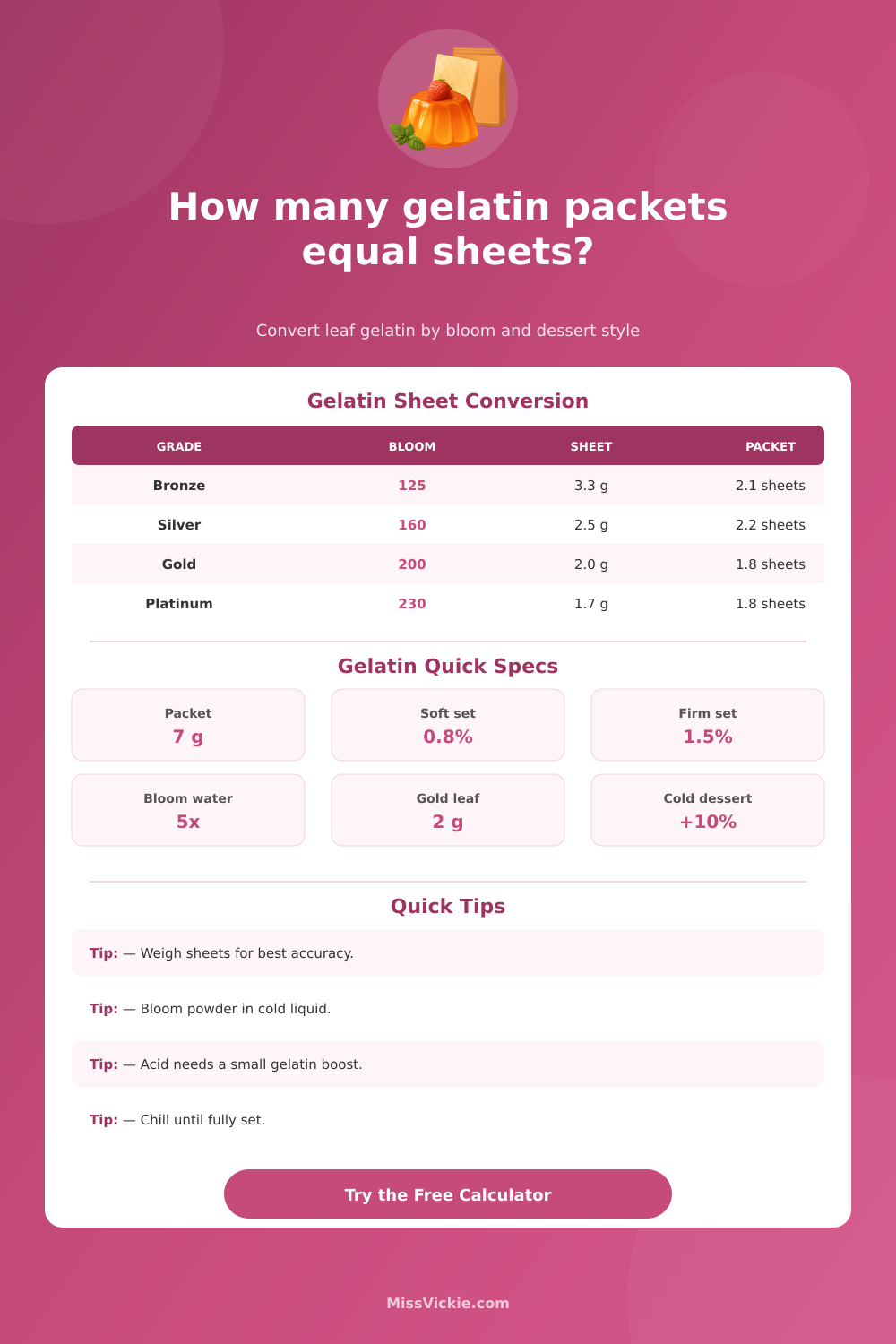
| Bronze leaf | 125 bloom | 3.3 g | About 1.03 gold sheets | General bakery work and older recipes |
| Silver leaf | 160 bloom | 2.5 g | About 1.00 gold sheet | Cream desserts, jellies, mousse fillings |
| Gold leaf | 200 bloom | 2.0 g | 1.00 gold sheet | Modern pastry recipes and clean slices |
| Platinum leaf | 230 bloom | 1.7 g | About 0.98 gold sheet | Fine pastry where low added mass matters |
| Desired Set | Gelatin Ratio | Texture Result | Packet per 500 ml | Chill Expectation |
|---|---|---|---|---|
| Soft spoonable | 0.75% to 0.95% | Custardy, delicate, not unmolded | 0.6 to 0.8 packet | 4 to 6 hours |
| Clean slice | 1.05% to 1.25% | Slices neatly but still tender | 0.8 to 1 packet | 6 hours or overnight |
| Molded set | 1.35% to 1.60% | Holds shape after unmolding | 1.1 to 1.3 packets | Overnight is best |
| Firm gummy | 2.00% to 3.00% | Chewy bar, candy, or strong gel | 1.7 to 2.5 packets | Until fully chilled |
| Recipe Base | Adjustment | Why It Matters | Calculator Effect | Kitchen Note |
|---|---|---|---|---|
| Rich dairy | Add a little | Fat softens the perceived gel | Plus 8% | Useful for panna cotta and cream mousse |
| Acid fruit | Add more | Low pH can weaken gelatin structure | Plus 12% to 22% | Avoid fresh pineapple, kiwi, papaya, and guava unless cooked |
| High sugar | Slightly less | Sugar helps bind water in the base | Minus 5% | Common in mirror glaze and syrup gels |
| Alcohol | Add more | Alcohol reduces reliable setting | Plus 18% | Keep alcohol moderate for a clean set |
| Powder Amount | Packet Fraction | Approx Teaspoons | Gold Sheets at 225 Bloom | Typical Use |
|---|---|---|---|---|
| 3.5 g | 1/2 packet | About 1 1/8 tsp | About 2 sheets | Small custards or glaze touch-ups |
| 7 g | 1 packet | About 2 1/4 tsp | About 4 sheets | Two cups of soft to medium gel |
| 10.5 g | 1 1/2 packets | About 3 1/2 tsp | About 6 sheets | Molded fruit jelly or firm insert |
| 14 g | 2 packets | About 4 1/2 tsp | About 8 sheets | Large batch or firmer set dessert |
Warm base dissolves bloomed gelatin evenly and sets predictably.
Folded cold bases need dissolved gelatin added carefully.
Citrus, berry, wine, and yogurt usually need a firmer target.
High sugar helps water control, so the gel can feel stronger.
Gelatin sheets and packets is both used for various desserts, but what if all you have is one form when the recipe calls for the other? How do the two compare and why does it matter when following a recipe that calls for sheets?
While both consist of exactly the same thing, gelatin, the form factor differ: packets tend to be stronger than sheets. Also, they will react differently to any additional ingredients you mix with them.
How to Swap Gelatin Sheets and Powder
That’s where the calculator comes in: input those factors and it’ll crunch the numbers so that you can avoid trial-and-error that causes most people to throw in another packet (or sheet) and cross their fingers.
As for gelatin, it’s just a matter of building up a network of protein strands that bind together in a lattice to catch and hold liquid as it cools down. That lattice gets stronger based off its bloom rating (shown on the pack). And that bloom rating is a property of the gelatin itself, though strength of the set depends on how much you use relative to volume of liquid being gelled. Certain other ingredients help it set, others hinder it. Certain other ingredients help it set, others hinder it.
Most sheet gelatins comes rated by grade, which will tell you both how heavy they are and what their bloom rating is likely to be. Pouches are sold by weight, usualy about seven grams. Typically they will have a higher bloom rating then the sheets home cooks generally stock. If you substitute one for the other without compensating, you alter your finished texture. You also influence whether dessert unmolds successfully.
It’s the sort of input that reflects actual kitchen action: Gelatin is always expressed as a percentage of finished product; that’s why liquid volume figures into the equation. There are also options for firmness, whether it should be sliced or spooned. There are also options for the dessert type, as cold-folded creams has less predictable results than a heated dairy base. Alcohol and fruit acids reduces gel strength, so there should of been a slight bump-up in gelatin level. And don’t forget about bloom water (you have to give the stuff time to hydrate in order to dissolve properly); there’s a reminder field for that. Sheets do all this on their own after soaking.
The adjustment factor is something most cooks learn by experience. Four gold sheets work great for setting panna cotta. But if you switch to packets, it can be too soft, particulary in a recipe that includes a bit of liqueur or lemon juice. And the calculator multiplies the number by the right amount to reflect this effect. No need to remember a chart.
And it illustrates how same number of packets behave in different ways depending on batch size. This comes into play when you’re scaling up a dessert from six portions to a sheet pan worth of entremet inserts. It lays out target gelatin percentages for various levels of firmness (and grades). And it does this because practical: You want to know how much percent gelatin you should shoot for when making a clean slice? Look it up on the table. Now you have something to go back and adjust those inputs with. And once you realize the target isn’t a specific number of packets but a ratio, its not so mysterious anymore.
But then the payoff: It makes things consistant. So whether it’s from some package of dry gelatin or another, you begin there. You tweak it in response to the sugar, the acid, the amount of liquid, and how many people will be served. Then you arrive at something which perform as the recipe asks. This allows that baking endeavor to become a repeatable thing, not just a one-off.