How Many Gelatin Sheets for Panna Cotta Calculator
Estimate gelatin sheets for panna cotta from total cream volume, serving cups, texture, bloom strength, dairy richness, sugar, acid, alcohol, mold style, and a practical setting margin.
Choose a real panna cotta scenario, then adjust the sheet type, texture, dairy blend, and serving style to match your recipe.
Formula Breakdown
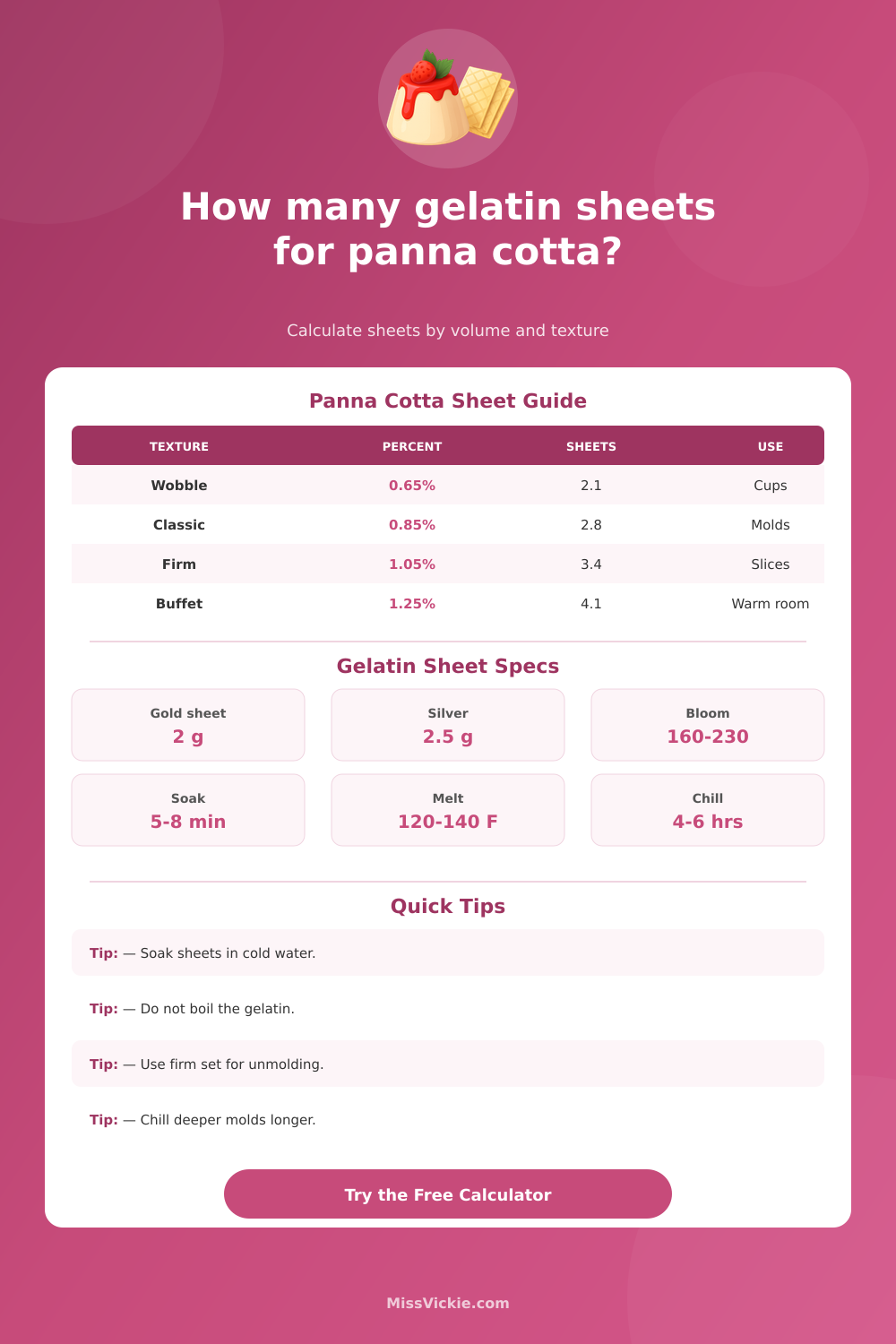
These cards use gold gelatin sheets, a classic set, and a normal cream mixture as quick planning anchors.
| Target Texture | Gelatin Percent at 200 Bloom | Best Serving Style | Kitchen Notes |
|---|---|---|---|
| Barely set wobble | 0.60% to 0.72% | Small cups or glasses | Very delicate, creamy, and spoonable; risky for unmolding. |
| Classic panna cotta | 0.78% to 0.92% | Cups or careful ramekins | Soft quiver with enough structure for most dinner service. |
| Unmolded firm | 0.98% to 1.12% | Ramekins, rings, silicone | Better release, cleaner edges, and less slumping on the plate. |
| Sliceable tray | 1.15% to 1.32% | Bars, cubes, buffet trays | Firm enough to cut; texture becomes less luxurious. |
| Warm room buffet | 1.25% to 1.45% | Events and transport | Useful for holding, but test first to avoid a bouncy dessert. |
| Sheet Grade | Typical Bloom | Common Weight | How It Changes the Count |
|---|---|---|---|
| Bronze | 125 bloom | 3.3 g to 3.5 g | Lower strength, but heavier sheets can keep count similar. |
| Silver | 160 bloom | 2.5 g | Often needs slightly more weight than gold for the same set. |
| Gold | 190 to 200 bloom | 2 g | Common pastry reference point for panna cotta recipes. |
| Platinum | 230 to 250 bloom | 1.7 g | Stronger gelatin, so the required weight drops. |
| Custom brand | Use package value | Weigh one sheet | Enter the actual sheet weight for the cleanest result. |
| Base Style | Set Feel | Calculator Factor | Practical Adjustment |
|---|---|---|---|
| Heavy cream rich | Velvety and stable | 0.96x | Fat and milk solids make the gel feel fuller. |
| Half cream, half milk | Classic balance | 1.00x | Good default for vanilla panna cotta. |
| Mostly milk | Clean but looser | 1.06x | Needs a small lift because there is less fat support. |
| Yogurt or sour cream | Thicker body | 0.97x | Natural thickness helps, but acidity may offset it. |
| Fruit puree blend | Variable | 1.12x | Puree water, acid, and enzymes can weaken the set. |
| Coconut milk or cream | Soft and fatty | 1.04x | Brands vary widely; test a small cup when possible. |
| Batch Size | Classic Gold Sheets | Unmolded Gold Sheets | Typical Chill Time |
|---|---|---|---|
| 480 ml / 2 cups | 2 to 2.5 sheets | 2.5 to 3 sheets | 4 hours |
| 720 ml / 3 cups | 3 to 3.5 sheets | 4 sheets | 4 to 5 hours |
| 950 ml / 4 cups | 4 to 4.5 sheets | 5 to 5.5 sheets | 5 hours |
| 1.5 liters / party | 6.5 to 7 sheets | 8 sheets | 6 hours |
| 2 liters / buffet | 9 to 10 sheets | 11 to 13 sheets | 6 to 8 hours |
Best when panna cotta stays in a glass and is eaten cold.
The balanced choice for a creamy wobble and clean spoonful.
Enough structure to turn out of ramekins without collapsing.
Better for slices, travel, and longer room-temperature service.
Getting the correct amount of gelatin in your panna cotta is necessary to ensure that your panna cotta holds its shape. The volume of cream that you use in your panna cotta does not merely determine the amount of gelatin that is required for your panna cotta. Other factor that can play into the amount of gelatin that is required to achieve the desired result from your panna cotta include the texture of your panna cotta, the type of dairy product that you use in your panna cotta, the other ingredients that you use in your cream mixture, and in what manner you intend to serve your panna cotta.
For instance, you may require a different amount of gelatin for an panna cotta that is to be served in a cup than you may require for a panna cotta that you intend to unmold from a ramekin and serve onto a plate. The gelatin calculator is designed to mathematicaly calculate the amount of gelatin that is required for your panna cotta once you have entered the volume of cream that you plan to use and the number of serving of panna cotta that you intend to provide. The calculator perform these calculations to eliminate your need to manually calculate the amount of gelatin that you should use for your panna cotta.
How Much Gelatin Do You Need for Panna Cotta
While the volume of cream that you use will be a starting point for the strength of the gelatin that you use, the texture of your panna cotta will change the percentage of the panna cotta that contains gelatin. For instance, a texture that is intended to be soft will require a lower percentage of panna cotta to contain gelatin than a texture that is intended to be firm for use in a buffet or as a sliced dessert. The calculator utilize a 200 bloom strength of gelatin for all of its calculations.
If you use an alternate grade of sheet gelatin, the calculator will adjust the number of sheet of gelatin that it indicates so that the strength of the gelatin is maintained in your panna cotta. The type of dairy product that are used in the panna cotta will impact the texture of the panna cotta, which impacts the amount of gelatin that should be used. For instance, if you use heavy cream rather than milk in your panna cotta, the body of the cream will impact the texture of the panna cotta in a manner that indicates that a percentage of panna cotta with a specific amount of gelatin will feel firmer with heavy cream than if it contained the same percentage of gelatin but used only milk.
Similarly, ingredient like yogurt or fruit puree will impact the texture of the panna cotta such that the amount of gelatin will need to be adjusted based off the ingredients that are used in the panna cotta. Other factor that impact the amount of gelatin that should be used in panna cotta include the sugar content of the panna cotta, the acid content of the panna cotta, and the amount of alcohol contained within the dessert. Each of these ingredient has the potential to impact the setting properties of the panna cotta, including the strength of the gelatin set.
For instance, sugar can impact the panna cotta to contain a softer set of gelatin, while acidity or alcohol can reduce the strength of the set of the panna cotta’s gelatin. The style of mold in which you plan to serve your panna cotta and the condition under which you intend to serve the panna cotta will also impact the amount of gelatin that should be used in the preparation of the panna cotta. For instance, if the panna cotta is to be served in a cup, the panna cotta may only need to have a gentle setting of the gelatin to allow it to maintain its shape while it is being served.
However, if you unmold the panna cotta from a ramekin onto a plate, it will contain more gelatin to ensure that the panna cotta maintains its shape during the removal of it from the mold. Additionally, if the panna cotta is to be served from a tray or if the panna cotta is to be provided to guest and allowed to sit at room temperature, an additional percentage of gelatin will need to be accounted for in the panna cotta creation. The serving condition that are listed in the panna cotta gelatin calculator will allow the calculator to provide the correct number of sheet of gelatin based upon the needs of the kitchen in which the panna cotta is to be prepared.
Many people make mistake when preparing panna cotta because they believe that all type of sheets of gelatin are the same. For instance, bronze sheet of gelatin are not the same as platinum sheets of gelatin, and therefore, the number of sheet of each type will not be the same for a given batch of panna cotta. The panna cotta gelatin calculator can account for these difference in strength in the sheets of gelatin, either through the selection of the specific type of gelatin that will be used, or by entering the weight of the sheet of gelatin that you will utilize in the creation of the panna cotta.
Additionally, the calculator include a margin for rounding in the number of sheet that are calculated. This accounts for the convenience of using whole sheet of gelatin rather than half sheet of gelatin, especially for the preparation of large batch of panna cotta. The preparation of the sheet of gelatin can also impact the texture of the panna cotta.
For instance, you must soak the sheets of gelatin in cold water to allow the sheets of gelatin to soften. Additionally, the sheets of gelatin should be added to warm cream while avoiding boiling the cream in which the panna cotta is to be prepared. Boiling the panna cotta after the addition of the sheet of gelatin will reduce the strength of the sheets of gelatin.
Additionally, the amount of time required for large batch or deep mold of panna cotta will be longer than for smaller batch to allow for the cold water to reach the center of the panna cotta. The reference table that are provided for the various type of panna cotta contain the ranges of amount of gelatin that can be used in the preparation of those panna cotas. The range of percentage can be used in the preparation of the panna cotta, and each type of panna cotta will have a different range of percentage of the panna cotta that will contain gelatin.
The reason that the percentage included in the reference table for the various type of panna cotta are not a single percentage of the panna cotta that contains gelatin is due to the fact that if the percentage is moved away from the middle range for that type of panna cotta, the texture of the panna cotta will change once it is removed from the refrigerator. The table reflect the amount of gelatin that should be used in relation to the types of dairy products that are used in each type of panna cotta. The batch size can impact the amount of gelatin that should be used in the preparation of panna cotta.
For instance, small batch of panna cotta allow the cooks to taste the texture of the panna cotta prior to the preparation of the larger batch of panna cotta. Additionally, if the batch size is to be large, the amount of strength of the gelatin that is used in the preparation of the panna cotta will be increased. For instance, if the batch size is to be provided to a normal dinner party, a five percent buffer in the amount of gelatin can be used.
However, if the panna cotta is to be provided to guest as part of a long-term event, a fifteen percent margin in the strength of the gelatin will be required to account for the fact that the panna cotta will be sitting out of the refrigerator. The information that is provided by the gelatin calculator should be read as a guide to the amount of gelatin that should be used in the preparation of the panna cotta. For instance, if the amount of sheet of gelatin is calculated to be an fraction of a sheet, it may be necessary to round up to the next whole sheet of gelatin.
However, if the amount is calculated to be a half sheet of gelatin, it is likely that the amount of gelatin that should be used will be that amount. The number that are calculated by the panna cotta gelatin calculator are a reflection of the number of sheet of gelatin that will be required for the type of panna cotta that is to be prepared based upon the factor that are entered into the calculator. Panna cotta require small adjustment to account for the amount of gelatin that is required to properly prepare the dessert.
However, by understanding the factor that can impact the amount of gelatin that should be used, such as the volume of cream, the texture of the panna cotta, the type of dairy product that are used, and the condition under which the panna cotta will be served, the gelatin calculator will be able to help the cooks to find the number of sheet of gelatin that will best suit the kitchen’s needs. Thus, the panna cotta recipe is relatively simple to prepare, but the planning of the recipe require some mathematical accuracy to the calculation of the amount of gelatin that will be used in the panna cotta.