Gelatin Per Packet Calculator
Estimate powdered gelatin packets for liquid volume, desired set, packet size, bloom strength, acidity, dairy, alcohol, mold style, and chilling time.
🍮 Gelatin Recipe Presets
Choose a common dessert or savory gel, then fine-tune the packet size, liquid volume, set strength, and ingredients.
⚖ Gelatin Packet Details
Gelatin packet estimate
Adjust the inputs to size powdered gelatin for your liquid and set style.
Formula Breakdown
Handling Notes
📊 Packet and Conversion Reference
🥄 Gelatin Set Table
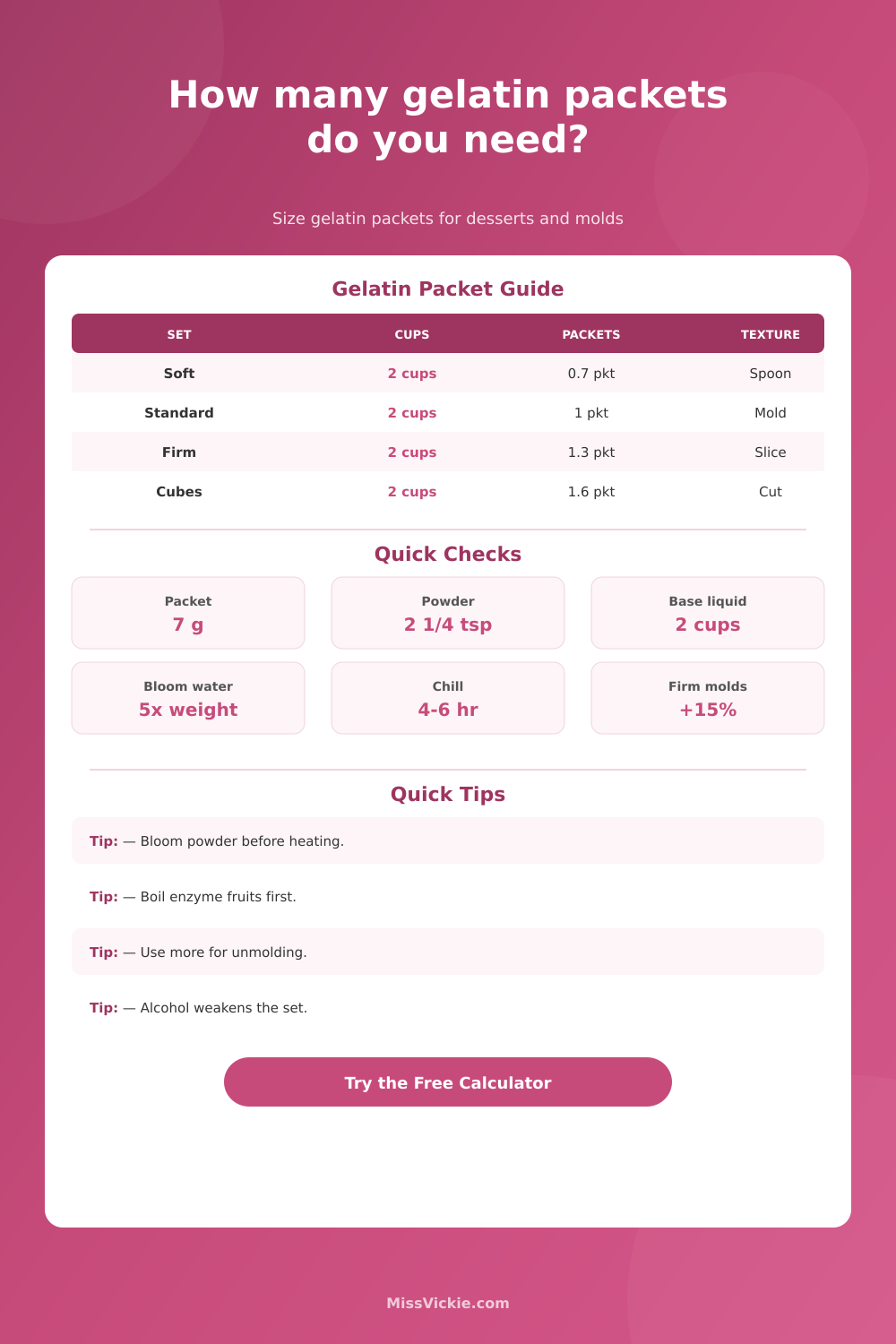
| Desired Set | Gelatin per 2 Cups Liquid | Gelatin per 480 ml | Best For | Texture Note |
|---|---|---|---|---|
| Barely set | About 0.55 packet | 3.8 g | Spoon desserts and very soft creams | Delicate wobble; serve in cups, not molds. |
| Soft set | About 0.70 packet | 4.9 g | Panna cotta, custards, and creamy glasses | Holds a spoon shape but may slump if unmolded. |
| Standard set | 1 packet | 7 g | Classic gelatin molds and fruit juice gels | The common packet baseline for 2 cups of liquid. |
| Firm slice | About 1.25 packets | 8.8 g | Terrines, layered desserts, and clean slices | Better for knife cuts and plated wedges. |
| Very firm cubes | About 1.55 packets | 10.9 g | Gelatin cubes, gummies, and sturdy squares | Chewy and resilient; less delicate at the table. |
| Mousse stabilizer | About 0.45 packet | 3.2 g | Whipped cream, mousse, and fillings | Stabilizes aeration without turning the cream rubbery. |
A common unflavored packet is about 7 g or roughly 2 1/4 teaspoons. Brands vary, so the packet-size field is editable.
🔬 Bloom Strength Adjustment Table
| Gelatin Bloom | Strength Compared with 225 Bloom | Use This Weight Multiplier | Example for 7 g Baseline | Kitchen Use |
|---|---|---|---|---|
| 160 bloom | Lower strength | 1.41x | 9.8 g | Soft bronze-style gelatin; needs more powder. |
| 180 bloom | Moderate strength | 1.25x | 8.8 g | Useful for tender creamy desserts. |
| 200 bloom | Medium high | 1.13x | 7.9 g | Silver-style sheets or powder conversion point. |
| 225 bloom | Packet baseline | 1.00x | 7.0 g | Standard unflavored packet assumption. |
| 250 bloom | Higher strength | 0.90x | 6.3 g | Gold-style strength; use a little less by weight. |
| 275 bloom | Very high strength | 0.82x | 5.7 g | Strong commercial gelatin; weigh carefully. |
🍋 Ingredient Adjustment Reference
| Ingredient Factor | Typical Adjustment | Why It Matters | Calculator Handling | Practical Cue |
|---|---|---|---|---|
| Acidic juices | Add 8% to 18% | Acid can weaken the gel network and sharpen the texture. | Citrus and very tart choices raise the packet estimate. | Use a firmer set for lemon, lime, cranberry, or vinegar gels. |
| Raw enzyme fruits | May not set | Raw pineapple, kiwi, papaya, fig, and guava can break down gelatin. | The result shows a warning and a very high risk status. | Heat the fruit first or use canned fruit packed after heat processing. |
| Dairy and fat | Add 3% to 15% | Fat, thickness, and aeration change how firm the dessert feels. | Cream, cream cheese, and mousse styles increase the estimate. | Fold gelatin evenly into warm base before adding whipped cream. |
| Alcohol | Add 8% to 35% | Alcohol slows setting and can prevent a sturdy gel at high levels. | The alcohol selector raises powder and adds a risk note. | Keep spirits moderate and chill longer for cleaner texture. |
| Unmolding | Add 8% to 18% | Ring molds, detailed molds, and deep terrines need extra support. | Mold style changes the final packet count and status. | Oil the mold lightly and dip briefly in warm water to release. |
| Short chill time | Add 8% to 16% | Gelatin continues strengthening for hours after it first looks set. | Quick chill settings nudge the formula firmer. | Use shallow cups or a cold metal pan for speed. |
📘 Common Volume Examples
| Total Liquid | Standard Set | Soft Set | Firm Slice | Notes Before Add-Ins |
|---|---|---|---|---|
| 1 cup / 240 ml | 0.5 packet | 0.35 packet | 0.65 packet | Small ramekin batch; weigh powder if possible. |
| 2 cups / 480 ml | 1 packet | 0.7 packet | 1.25 packets | Classic packet baseline for juice or water. |
| 4 cups / 960 ml | 2 packets | 1.4 packets | 2.5 packets | Good for a family mold or eight half-cup servings. |
| 6 cups / 1.4 L | 3 packets | 2.1 packets | 3.8 packets | Large bowl or ring mold; chill overnight if deep. |
| 8 cups / 1.9 L | 4 packets | 2.8 packets | 5 packets | Party-size mold; divide layers for cleaner setting. |
💡 Gelatin Handling Notes
It’s a network of proteins called gelatin, and this network has particular conditions under which it will assemble. Know those conditions, and you don’t guess anymore; you engineer your dessert. You use the math-heavy tool above to do all the work for you. This means you don’t have to worry about whether you’ll fail to set.
The tool takes into account things most home cooks would never think of, like how acidic your fruit is or what exact strength of your powder are. That brings us to the packet itself, the initial stumbling block in most cases. Unflavored gelatin? Sure, we think that all of them is alike. Nope! They’re not, especially when it comes to how much gel they can provides based off their bloom strength. Gelatin’s bloom is measured by how firm it gets per gram of protein. A standard packet (typically labeled as 225 bloom) should of be a good starting point. A gold style gelatin will have a higher bloom number because it’s stronger. This means you’ll add less powder to get the same thickness. A weaker one, such as a softer bronze variety common at specialty shops, mean you will need more powder. The beauty of the calculator: it accounts for all that so you never end up with a too-hard ball from an extra-strong packet, or a too-soft slab from a weak one. Small detail, big difference.
How Gelatin Works and How to Use It
The same thing happens with acidity: It disrupts the protein structure. Vinegar, cranberry sauce, and other tart things (like lemon juice) can softens an otherwise firm set, because they weaken the gel network. To account for that, tool assumes that you’ll add more powder when you check off tart ingredients on your recipe card. For example, a cup of lemonade is not technically “liquid” at all; it’s actively working against the gelatin’s bonding powers. That’s also why citrus gels often require a firmer base different than neutral broths or milk.
And similarly, since alcohol also interferes with hydration (and slows down the setting process), when you’re working with a boozy dessert, you want to plan for that interference: Add extra powder and give it longer to chill. Then there’s dairy and fat, which adds other complications. Acid breaks down gelatin, but not milk or cream; instead those thing alter structure and also mouthfeel. A clear aspic differs from a mousse stabilized by gelatin, and the calculator takes account of that difference in texture. What about a firm sliceable terrine versus a softer set custard? The former would need more support than the latter. In essence you’re creating a scaffold. A light airy dessert will have a delicate scaffold, whereas a rich dense one will require a strong scaffold to hold up under weight of a fruit puree or cream without caving in.
The other silent killer is raw enzymes. Proteins in pineapple, papaya, kiwi, and fresh figs breaks down collagen. This is why if you combine raw fruit and gelatin together, you’ll never get the gel to set. It will just be a runny warm soup no matter how many hours you wait for it to chill. This risk flag is another handy feature of the tool, which reminds you to first cook those fruits, so their raw enzymes loses all activity, and then let the gelatin do what they’re supposed to do. It’s an easy mistake to make but now that you know the chemistry behind it, it is also an easy one to avoid.
They also underestimate how much they need chill time. Gelatin will continue to strengthen for hours after it first look firm. A brief two-hour chill may look solid, but it is still setting on the inside. You must let it rest overnight if you want the mold to have detail or depth. If you are using a shorter chill-time, the calculator recommends using a firmer formula. This forces the gel into a quicker set to avoid slumping out. Better to over-powder a bit than to risk under-chilling and losing everything.
And then there’s the mold. Deep terrines and ring molds is harder to unmold than a spoon dessert eaten out of a glass. This shows that we are dealing with forces like friction and gravity. We are fighting physics as well as chemistry. This is why the calculator allows for the ingredients, the volume of the liquid, and shape of what you want. You measure the powder, hydrate it with some cold water, let it bloom, gently heat up the rest of the water, stir, and pour. Not luck. Physics properly applied.