🍳 Gas Stove BTU Calculator
Estimate burner output, gas flow, daily use, and heat fit for simmering, boiling, searing, and wok cooking
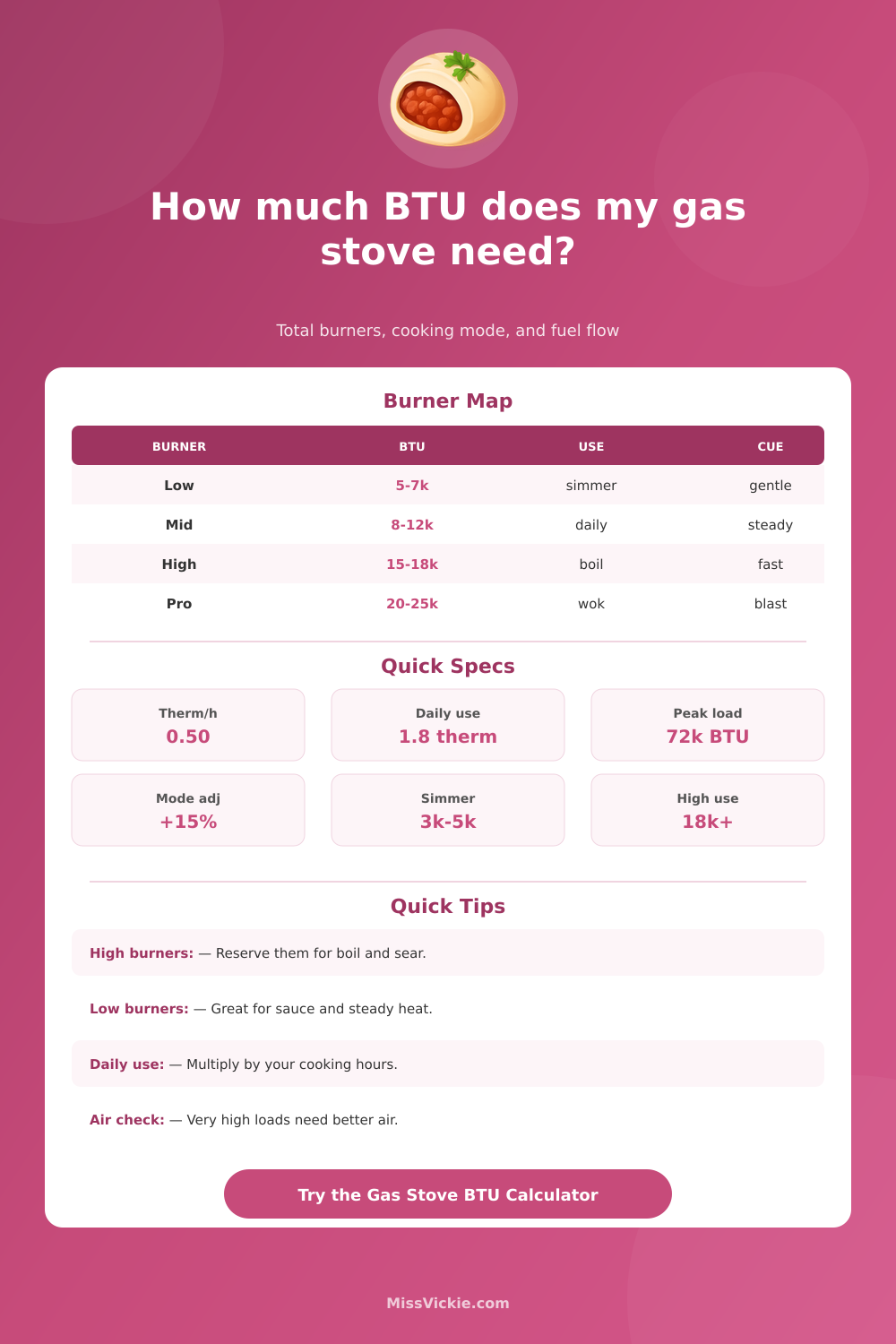
| Burner | BTU/h | Best Use | Signal |
|---|---|---|---|
| Low | 3k-5k | Simmer, melt | tiny flame |
| Medium | 8k-12k | Daily pans | steady heat |
| High | 15k-18k | Boil, saute | fast response |
| Pro | 20k-25k | Wok, sear | big flame |
| Mode | Factor | What It Means | Use Cue |
|---|---|---|---|
| Simmer | 0.85x | Lower heat target | gentle hold |
| Boil | 1.00x | Full heat output | hard rolling |
| Sear | 1.10x | More peak demand | quick crust |
| Wok | 1.18x | Maximum burst use | rapid toss |
| Load | Therms/h | MJ/h | Notes |
|---|---|---|---|
| 20k | 0.20 | 21.1 | light burner |
| 40k | 0.40 | 42.2 | mid range |
| 60k | 0.60 | 63.3 | busy kitchen |
| 80k | 0.80 | 84.4 | pro output |
| Setup | Load | Fit | Cook Cue |
|---|---|---|---|
| Low simmer | 26k | 4 burners | sauce work |
| Weeknight | 34k | family use | balanced |
| Chef style | 78k | power top | rapid heat |
| Outdoor | 96k | open air | stockpots |
Use this gas stove BTU calculator to total burner output, compare cooking modes, and estimate fuel demand. It helps you match simmer control, boil speed, and high-heat searing.
Stoves that use gas use British Thermal Units, or BTUs, to describe the power of the flames on the stovetop. The BTU ratings of a gas stove indicate how much heat that stove can produce in an hour. It is essential to ensure that the BTU ratings of the gas stove matches the cooking tasks that the cook is to perform on the stove.
Gas stoves typicaly comes with burners of three different types: high output burners, medium output burners, and low output burners. High output burners are used for tasks that require a great deal of heat, such as boiling water or searing meat. Medium output burners are of a middle heat level and can be used for a variety of tasks.
Pick the Right Gas Stove by BTUs and Burners
Low output burners are used for tasks that require minimal heat, such as simmering liquids or melting chocolate. If a stove has only high output burners, it will be more challenging to perform tasks that require lower heat levels. If a stove has only low output burners, it will take considerably longer to cook tasks that require higher heat level.
Many gas stoves has a high BTU rating for only one of the burners but lower BTU ratings for the other burners on that stove. However, a stove that has a higher BTU output for one of the burners than the other burners may be difficult to use for those who cook delicate sauces. The number of burners of each type will determine how many pot one can use at the same time for cooking.
Hence, if someone cooks many recipes at the same time, they will need a stove with more burners on it. The mode in which one cooks also determine the type of gas stove that would be most appropriate for that task. Simmering requires a low level of heat output on the gas stove.
Boiling tasks requires the stove to be set to a medium or high heat level. Stir frying requires a high heat level to maintain the heat while stirring the food. Therefore, there will need to be different BTU ratings on a gas stove to accommodate these different cooking modes.
Stoves that use gas are not as efficient as other types of stovetops since the flames will lose some of there heat to the surrounding air. Sealed burners are more efficient than burners that do not have a sealed burner on the stovetop. When using a gas stove with high BTU ratings, ventilation in the cooking area will be necessary.
High output burners will produce more moisture in the cooking area and the ventilation hood should be strong enough to remove this moisture and the combustion products from the kitchen. The total amount of fuel that a gas stove will use will depend on the BTU output of the stove and the length of time that it is used. One therm is roughly 100,000 BTUs.
Using this measurement, its possible to calculate the potential cost of using a gas stove. The longer that burners are heated to high BTU ratings and the more burners that are used, the more fuel the stove will use. It is essential to ensure that the gas stove matches the cooking habits of the user.
In order to choose the appropriate gas stove for a kitchen, the cook should evaluate the BTU ratings of each of the burners on the stove. The stove should have burners of each of the heat levels: high for boiling, medium for cooking tasks and low for simmering. The efficiency of the stovetop and the ventilation requirement of the kitchen should also be considered when purchasing a gas stove.
If the BTU levels of the stove match the cooking tasks in the kitchen, then the stove will function correctly and the cooking will be more easy performed.