🔥 MissVickie gas mark converter
Gas Mark Converter
Convert gas mark, Celsius, Fahrenheit, and fan settings with practical oven adjustments for shelves, pans, and recipe styles.
Ten real kitchen presets fill in common oven scenes, from fruit cake to pizza, then run the converter straight away.
Choose the source temperature, the target unit, and the oven details that shape a real baking setting rather than a bare math answer.
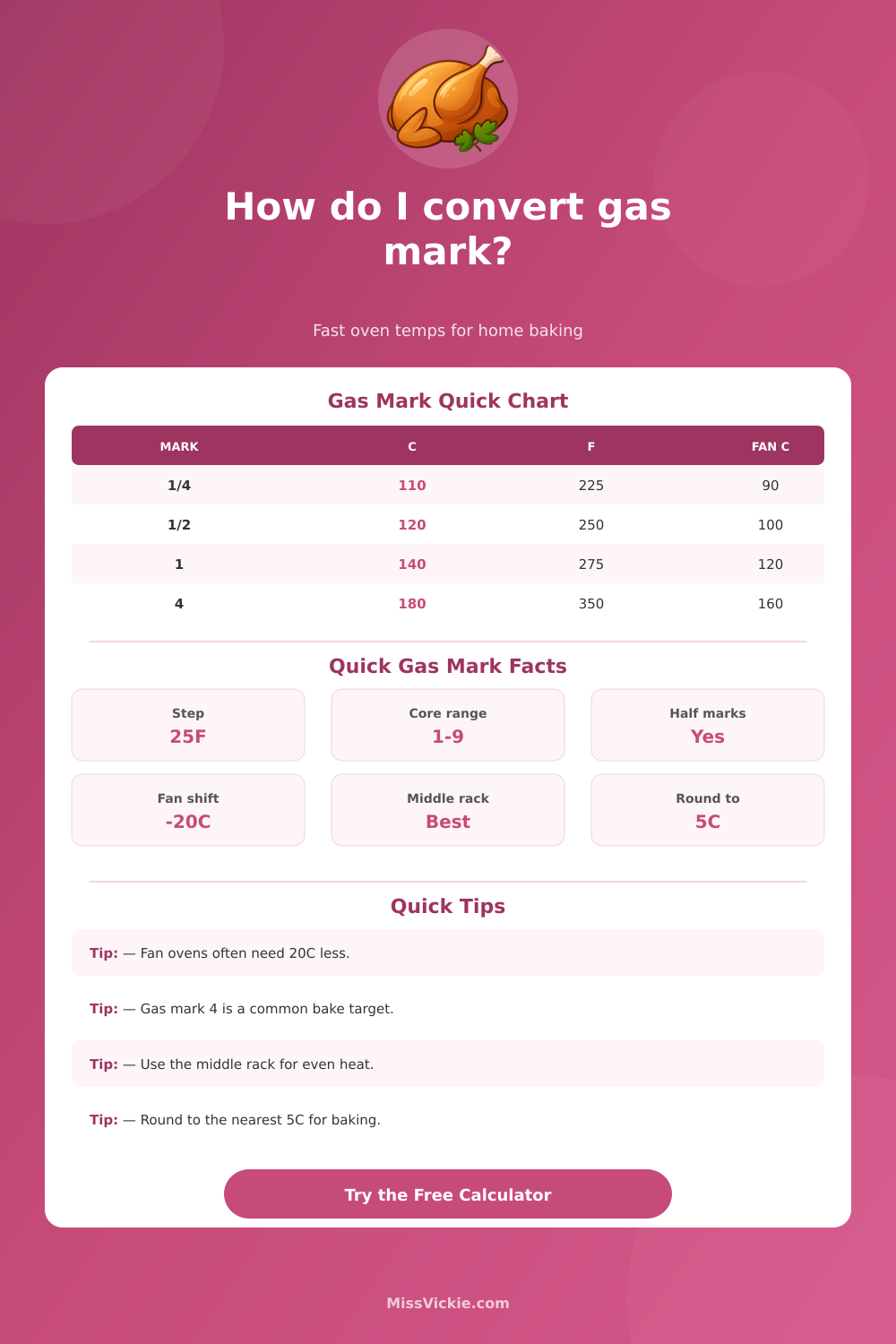
These are the familiar gas mark steps most recipe books use, with the fan equivalent shown as a quick oven adjustment.
| Gas mark | Celsius | Fahrenheit | Fan C |
|---|---|---|---|
| 1/4 | 110C | 225F | 90C |
| 1/2 | 120C | 250F | 100C |
| 1 | 140C | 275F | 120C |
| 2 | 150C | 300F | 130C |
| 3 | 165C | 325F | 145C |
| 4 | 180C | 350F | 160C |
| 5 | 190C | 375F | 170C |
| 6 | 200C | 400F | 180C |
| 7 | 220C | 425F | 200C |
| 8 | 230C | 450F | 210C |
| 9 | 240C | 475F | 220C |
Common bakes often start from a familiar temperature target, then move up or down a little once the pan, shelf, and oven style are known.
| Dish | Set point | Gas mark | Note |
|---|---|---|---|
| Fruit cake | 140C | 1 | slow bake |
| Victoria sponge | 180C | 4 | even rise |
| Shortcrust pastry | 200C | 6 | crisp base |
| Roast chicken | 190C | 5 | brown skin |
| Bread loaf | 220C | 7 | oven spring |
| Meringue | 120C | 1/2 | dry gently |
| Cookies | 190C | 5 | golden edge |
| Pizza | 240C | 9 | fast finish |
These adjustment clues are practical, not exact laws. They help you nudge a temperature when the recipe, dish, or oven layout changes the heat feel.
| Factor | Shift | When | Why |
|---|---|---|---|
| Fan oven | -20C | fan mode | moves heat faster |
| Top shelf | -5C | upper rack | strong top heat |
| Upper-middle | -2C | slight lift | balanced browning |
| Lower-middle | +3C | lower rack | gentler surface heat |
| Bottom shelf | +5C | base heat | slows top browning |
| Shallow tray | 0C | thin tin | fast heat transfer |
| Deep dish | -5C | thick pan | holds heat longer |
| Dense batter | -5C | heavy mix | heat needs more time |
Use this quick reference when the bake is sensitive to tray depth, rack height, or oven hot spots that shift the final temperature choice.
| Shelf | Pan | Shift | Note |
|---|---|---|---|
| Top | Shallow tray | -5C | more top heat |
| Upper-middle | Standard tin | -2C | bright browning |
| Middle | Standard tin | 0C | safe default |
| Lower-middle | Deep dish | +3C | slower center heat |
| Bottom | Heavy tray | +5C | base heat softens |
Best for older cookbooks and UK recipe notes that speak in marks rather than plain degrees.
The clearest base for modern ovens, especially when a recipe needs a single heat target.
Useful when you are reading a US book or a recipe that names Fahrenheit first.
Usually sits about 20C lower, so the bake lands with steadier air movement.
To convert oven temperatures, you need to understand the relationship between the gas marks, the Celsius, and the Fahrenheit temperature scales. Gas marks were originally used for older cookers that did not have precise thermostats to control the heat. A gas mark of 4 equals 180 degrees Celsius, which is the same as 350 degrees Fahrenheit.
Many recipe from the United Kingdom use gas marks, so you might need to convert that gas mark to an appropriate Celsius or Fahrenheit temperature to use in your moddern oven. Modern ovens use fan to circulate the heat. Fan ovens can cook food much more faster than conventional ovens.
How to Convert Oven Temperatures
If you use a fan oven, you must lower the temperature of the recipe by 20 degrees Celsius. If you dont lower the temperature for food that you cook in a fan oven, the outside of the food can burn before the inside cook. Depending on the recipe, food require different oven settings.
For example, bread recipes require higher heat in the oven to enable the bread to rise, while custard recipes require a lower heat setting to avoid curdling the custard. The shape and the material that cooking pans are made of impact the heat that cooks the food. If you use deep pans, the food can be insulated from the heat of the oven.
In this case, you should adjust the temperature of the recipe. The position of the shelf within the oven also affect the foods cooking. Food that sits on the top shelves of the oven cooks under more direct heat from the ovens top.
Bottom shelves receive more heat from the bottom of the oven. Therefore, you have to take into consideration the position of the oven shelf, the pans shape and material when converting oven temperatures. A smart oven temperature converter make it easy to adjust recipe temperatures according to the oven variables.
A smart temperature converter does not just change the gas mark to Celsius; it takes into consideration the fan setting and the pan depth. First, you choose the starting temperature of the recipe. Then, you choose the type of recipe and the position of the oven shelf.
The smart temperature converter will give you the appropriate temperature on the oven dial. Oven dials move in five-degree increments, so the smart temperature converter will show you the temperature rounded to the nearest increment. To avoid common mistakes in the kitchen, you must understand how heat work in your oven.
Many ovens have hot spots where the heat is more intense than the remaining area of the oven. For instance, if you are baking pastry in a fan oven, you must lower the temperature so that the pastry crust will not become too tough. If you are roasting a chicken, you can roast the chicken on the middle oven shelf.
However, once the chicken is cooked, you can move it to a shelf on the bottom of the oven to create a more crispier base for the chicken. In this case, you have to adjust the recipe temperature for the recipe based off the shelf on which you are cooking the food. An oven thermometer can help you improve your baking success.
An oven thermometer tells you the actual temperature in the oven compared to the temperature setting on the ovens dial. If you bake a cake and the cake comes out pale, the temperature in the oven was too low. If you bake a cake and the top of the cake cracked, the oven temperature was too high.
Additionally, you can use an oven thermometer to observe how cooking pans of different materials respond to heat; dark pans will heat up faster than pans with a shiny material. For an oven to cook your food correctly, the air must flow freely around the food. If you place too many food on an oven shelf, you will block the air that circulates around the food.
This will cause the food to cook unevenly in the oven. Make sure to preheat the oven before you place the food into the oven. Otherwise, the oven will not reach the correct cooking temperature.
By taking into consideration the gas mark, fan oven settings, pan shapes, and shelf positions in the oven, you can successfully convert oven temperatures as needed for any recipe.