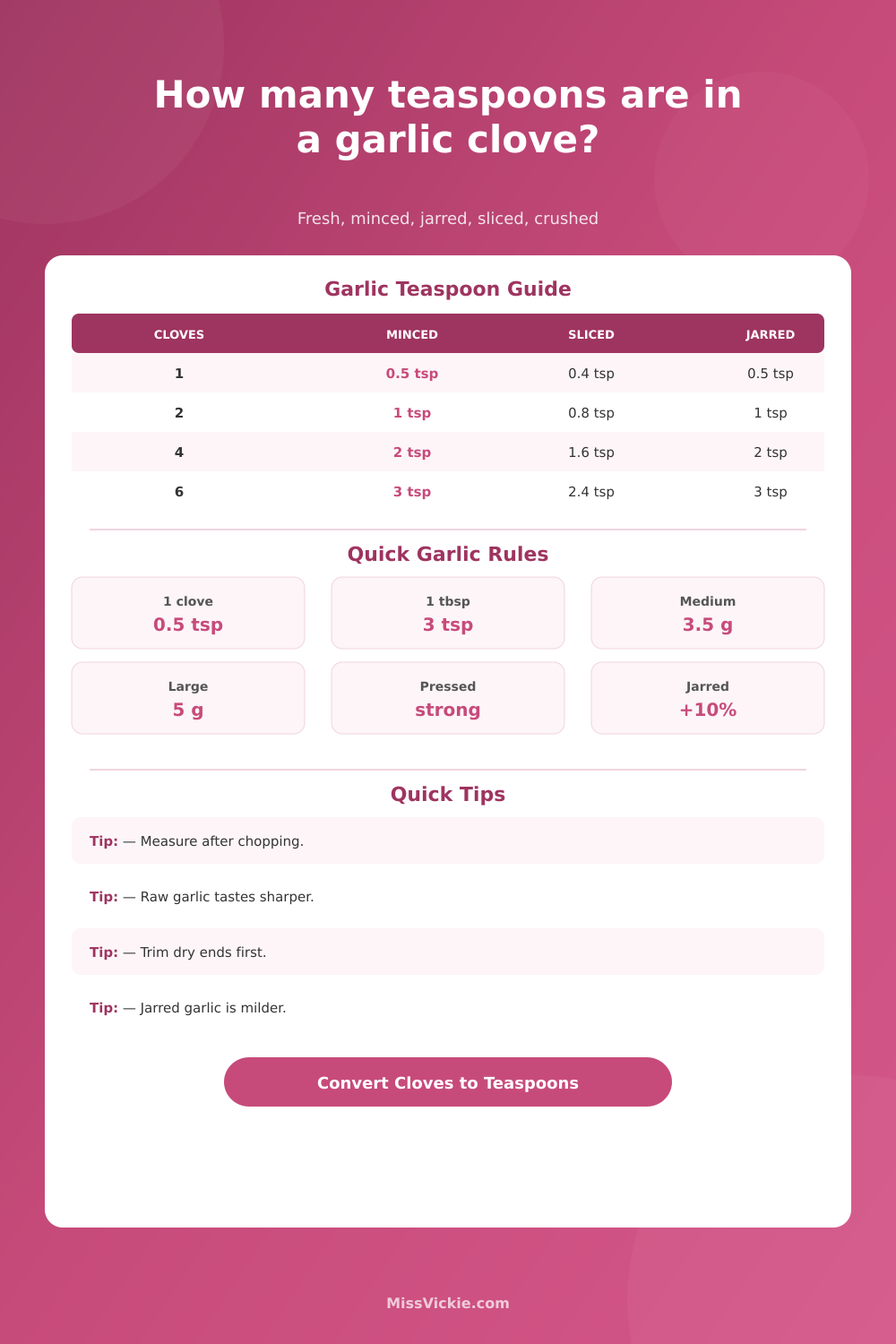
🧄 Fresh, jarred, minced, crushed, and sliced garlic math
Garlic Clove to Teaspoon Converter
Convert garlic cloves into teaspoons with clove size, prep style, recipe type, source strength, intensity, trim waste, and kitchen rounding for practical home cooking.
Choose a kitchen case, then adjust the clove count, chop style, source, and flavor target.
Standard measure for one medium clove in sauces and skillet meals.
Compact spoon with stronger aroma and less visible texture.
Looser pieces take more spoon space and cook more slowly.
Lower spoon volume because slices stack with air gaps.
Close to minced volume with extra juice for sauces.
Small volume, strong bite, best for butter and dips.
Dense spoon amount with the strongest raw impact.
Milder garlic often needs a small spoon boost.
| Clove size | Average weight | Minced teaspoons per clove | Cloves per teaspoon | Best kitchen use |
|---|---|---|---|---|
| Tiny | 1.8 g | 0.25 tsp | 4 cloves | Delicate dressings and small pans |
| Small | 2.5 g | 0.36 tsp | About 3 cloves | Raw dips, fish, quick vegetables |
| Medium | 3.5 g | 0.50 tsp | 2 cloves | Standard recipe conversion |
| Large | 5 g | 0.68 tsp | 1 1/2 cloves | Pasta, soups, roasted dishes |
| Jumbo | 6.5 g | 0.90 tsp | About 1 clove | Large pots and garlic-forward meals |
| Garlic source | Strength factor | Teaspoon cue | Texture cue | Best recipe fit |
|---|---|---|---|---|
| Fresh peeled cloves | 1.00x | Use standard clove math | Bright, juicy, sharp | Sauces, skillet bases, roasts |
| Jarred minced garlic | 0.90x | Add about 10% more | Soft pieces in brine | Fast sauces and meal prep |
| Older jarred garlic | 0.78x | Add about 25% more | Milder aroma | Long simmered dishes |
| Oil packed minced garlic | 0.82x | Add about 20% more | Rich and soft | Garlic bread and marinades |
| Roasted cloves | 0.70x | Use more for punch | Sweet, spreadable | Mash, soups, butter |
| Sprouted or dry cloves | 0.75x | Trim core first | Drier, sometimes bitter | Cooked sauces only |
| Recipe type | Adjustment | Why it changes | Good start | Watch point |
|---|---|---|---|---|
| Sauce, stew, or skillet base | 1.00x | Balanced heat and liquid spread garlic evenly | 1 to 3 tsp | Cook gently before liquids |
| Soup, chili, or beans | 1.12x | Large liquid volume softens the bite | 2 to 5 tsp | Bloom in fat first |
| Garlic butter or bread | 1.15x | Fat carries aroma through the loaf | 2 to 6 tsp | Pressed garlic tastes hot |
| Dressing, aioli, or dip | 0.82x | Raw garlic gets sharper as it sits | 1/2 to 2 tsp | Taste after resting |
| Stir-fry or saute | 0.92x | High heat blooms garlic quickly | 1 to 3 tsp | Garlic burns fast |
| Raw salsa or topping | 0.70x | No cooking keeps full garlic bite | 1/4 to 1 tsp | Paste can dominate |
| Medium cloves | Fresh minced | Fine mince | Sliced | Approx fresh weight |
|---|---|---|---|---|
| 1 clove | 0.5 tsp | 0.46 tsp | 0.39 tsp | 3.5 g |
| 2 cloves | 1 tsp | 0.92 tsp | 0.78 tsp | 7 g |
| 3 cloves | 1.5 tsp | 1.38 tsp | 1.17 tsp | 10.5 g |
| 4 cloves | 2 tsp | 1.84 tsp | 1.56 tsp | 14 g |
| 6 cloves | 3 tsp | 2.76 tsp | 2.34 tsp | 21 g |
| 8 cloves | 4 tsp | 3.68 tsp | 3.12 tsp | 28 g |
There’s no way to know how many teaspoons a clove is (until now) Sometimes the recipe says “2 cloves of garlic,” and when you grab the garlic from your pantry, it doesn’t match what you purchased last week. That difference trigger kitchen anxiety which derails an otherwise easy meal. Plug in your variables; the type of garlic you’re working with, and the garlic clove to teaspoon converter does math for you. No need to wonder if the batch you harvested today was the same as the chef’s original intention; it converts vague instructions into exact volume measurements, based off reality, not hope.
Variance is the problem and it varies: A typical clove of the standard-sized medium variety are 3.5 grams, producing approximately one-half teaspoon minced garlic. This will be your starting point but Mother Nature doesn’t stamp out uniform units; there is those wimpy, papery-looking ones, and then there are these jumbo guys who resembles baby fists when held in your palm. To compensate for this, the tool allow you to specify the clove size… Which will adjust the calculated volume so you don’t inadvertently overdo it (underdoing it, too) or turn your dish into the equivalent of a trip to dentist’s chair.
Why Garlic Cloves Are Different Sizes
No matter what the exterior dimensions are, the weight determine the amount of flavor compound. The rest is about how it’s prepared and what it means. Mincing it makes a thick paste which will fit tightly onto your spoon. When sliced, there is gaps with no actual garlic. You must add more to equal the amount you would of get if using a minced product.
Pressed or crushed also affects the flavor. How much juice flows out first alter both taste and how strong it seems. Also, crushed and pressed do not produce the same volume. A teaspoon of finely chopped garlic is not like a teaspoon of minced stuff; the former is mostly empty space while the latter is concentrated goodness. Knowing this prevents you from eyeing measurements for one recipe and applying them to another, only to fail because the two recipes requires different methods.
There’s also an element of source quality: Fresh, hand-peeled whole cloves taste sharp and bright, but lose those qualities when cooked. Brined jarred garlic is softened at the edges and loses some flavor from sitting in brine, so it frequently require a boost of 10 percent or more above the amount called for by recipe to hit the same level as fresh ingredients. Older versions requires even more because allicin breaks down during storage. The converter adjusts for those variations in strength and lets you substitute ingredient without throwing off the entire dish. It does not treat the jarred variety as an easy way out; instead, it treats it as a separate ingredient with its own unique chemistry.
Because it depends on recipe and your preference, we’ve created tools so you can be as bold or restrained as you’d like. Raw applications like aioli and dressings retain full harshness of the raw compound. Cooked dishes will mellow out the bite. This means you may need more by volume to saturate flavor without overwhelming the dish. To bridge the gap between sensory expectation and measurement, we provide a way to set an intensity target. This can range from mild background notes up to bold garlic-forward profiles. This helps you choose between leaning in when building a robust chili base or backing off with a delicate vinaigrette.
You do lose some trim waste here (it’s a tiny bit of loss, but it’s still real). A bruised spot, a green sprout, or a dry end get deducted from the usable weight of any given clove. So the calculator deducts that percentage before it converts it to teaspoons. And you get an accurate picture of how much garlic is actualy going to make its way into the pan. You can’t count a sprouting clove as if it were fresh and expect the same yield. You must consistently take those losses into account.
Under Pressure: Home cooks rely on their eyes for estimation, but this doesn’t work under pressure. They also assume that all cloves is the same, but they are not. Because of this, they measure by counting them, when they should of actually be measuring volume. A converter eliminates the guesswork and ensures consistent results from batch to batch and bulb to bulb. Because you’re measuring the actual active ingredient (not counting skins) you can expect consistent flavor each time.
Here’s the trick: Know what it is that you’re actualy measuring. Once you know that garlic volume depends on how fresh it is, how it is prepared, and its size, the math is simply arithmetic. Guessing stops here; confident cooking begins.