🧄 Fresh, jarred, minced, sliced, and crushed garlic math
Garlic Clove to Tablespoon Converter
Convert a clove count into tablespoons or teaspoons with clove size, prep style, recipe style, fresh or jarred strength, intensity target, trim waste, and spoon rounding.
Choose a real kitchen scenario, then fine tune the clove count, prep, garlic source, and spoon rounding.
Best spoon match for most recipes and jarred swaps.
Air gaps lower spoon volume, while flavor stays gentler.
Close to minced volume with more juice in sauces.
Smaller volume, stronger aroma, fast bite.
Coarser pieces fill a spoon loosely.
Dense texture, compact spoon, strong spread.
Milder punch, so the calculator raises the target amount.
Sweet and soft, so bold recipes need extra volume.
| Clove size | Average weight | Minced volume per clove | Cloves per tablespoon | Best use |
|---|---|---|---|---|
| Small | 2.5 g | 0.36 tsp | 8 to 9 cloves | Dressings, dips, light sauces |
| Medium | 3.5 g | 0.50 tsp | 6 cloves | Standard recipe conversion |
| Large | 5 g | 0.68 tsp | 4 to 5 cloves | Pasta, soups, roasted dishes |
| Jumbo | 6.5 g | 0.90 tsp | 3 to 4 cloves | Big batch cooking and bold garlic bread |
| Prep style | Tablespoon volume factor | Flavor impact | Texture impact | Recipe fit |
|---|---|---|---|---|
| Minced | 1.00x | Balanced | Fine, even pieces | Sauces, soups, skillet meals |
| Chopped | 1.08x | Moderate | Loose and rustic | Roasts, stews, sautés |
| Sliced | 0.78x | Milder | Visible slices | Oil infusions, stir-fry, roasts |
| Crushed | 0.95x | Stronger | Juicy, uneven mash | Marinades and sauce bases |
| Pressed | 0.90x | Very strong | Fine pulp | Aioli, dressing, garlic butter |
| Paste | 0.82x | Strongest | Smooth and dense | Raw dips, rubs, dressings |
| Recipe type | Use factor | Why it changes | Good starting point | Watch point |
|---|---|---|---|---|
| Pasta sauce or stew | 1.05x | Long simmer softens sharp edges | 1 tbsp per 4 to 6 servings | Add near the start for mellow flavor |
| Soup, chili, or beans | 1.10x | Large liquid volume spreads garlic out | 1 tbsp per medium pot | Bloom in fat before liquid goes in |
| Garlic bread or butter | 1.15x | Fat carries aroma well | 1 to 2 tbsp per loaf | Pressed garlic can taste hot |
| Dressing, aioli, or dip | 0.85x | Raw garlic lands sharper | 1 tsp to 1 tbsp per cup | Rest before adding more |
| Stir-fry or skillet sauce | 0.90x | High heat brings aroma fast | 2 tsp to 1 tbsp per pan | Garlic burns quickly |
| Raw salsa or topping | 0.72x | No cooking means full bite | 1 to 2 tsp per bowl | Start low with paste or press |
| Medium cloves | Minced teaspoons | Minced tablespoons | Jarred minced amount | Approx fresh weight |
|---|---|---|---|---|
| 1 clove | 0.5 tsp | 0.17 tbsp | 0.5 tsp | 3.5 g |
| 2 cloves | 1 tsp | 0.33 tbsp | 1 tsp | 7 g |
| 3 cloves | 1.5 tsp | 0.5 tbsp | 1.5 tsp | 10.5 g |
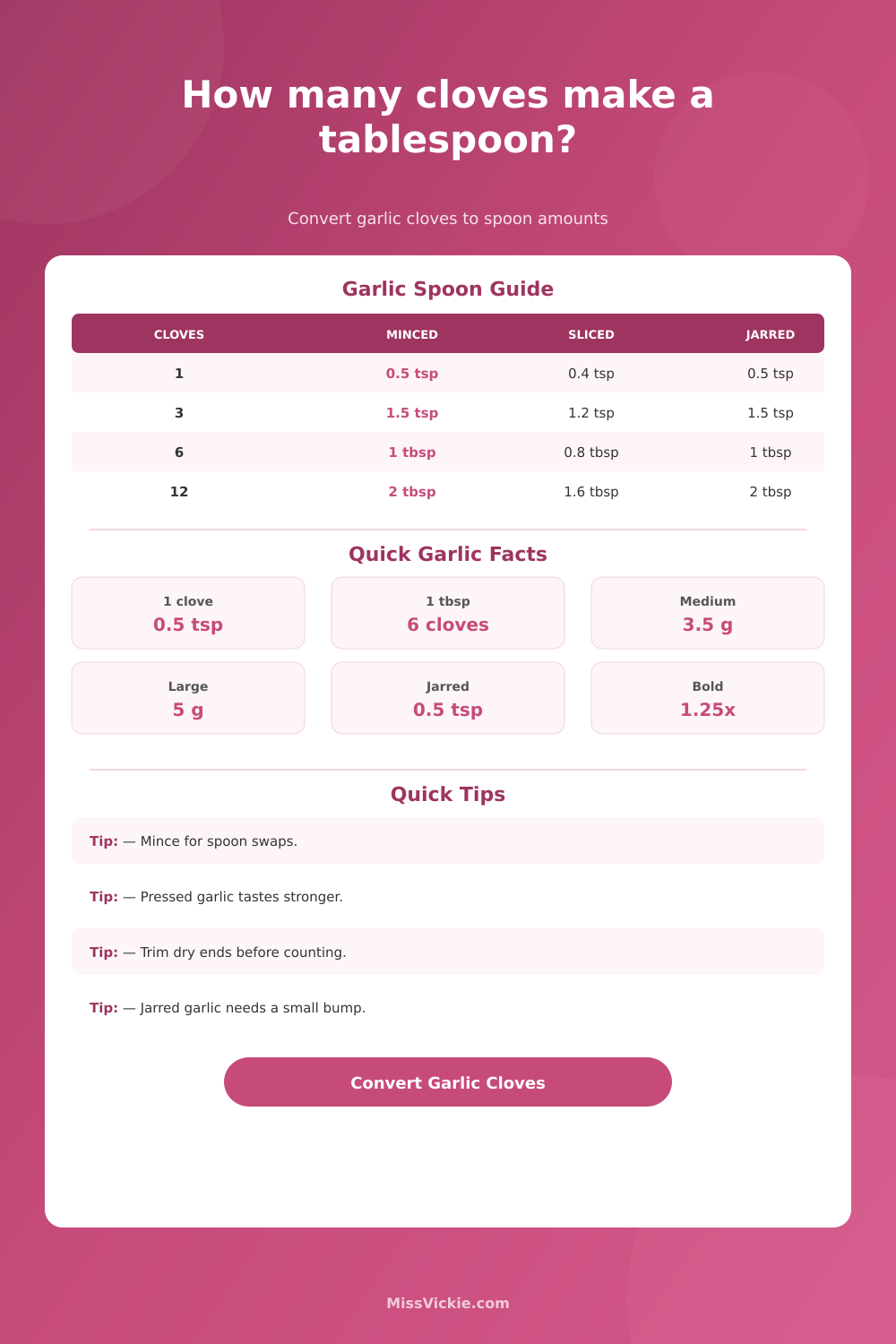
| 6 cloves | 3 tsp | 1 tbsp | 1 tbsp | 21 g |
| 9 cloves | 4.5 tsp | 1.5 tbsp | 1.5 tbsp | 31.5 g |
| 12 cloves | 6 tsp | 2 tbsp | 2 tbsp | 42 g |
There you are: Your hand holds a head of garlic as if harvested from a field of rocks. It doesn’t look like the perfect medium bulbs in cookbook photos; cloves is tiny and lumpy. Now what? A recipe asks for a tablespoon of chopped garlic, and there are just three dodgy-looking cloves at your disposal. Do you go ahead and use ’em all up, or do you cut yourself short? Many cooks find themselves here, at the connection of taste and arithmetic, a potential moment of anxiety in the kitchen. How well you convert a measurement like a tablespoon into a count of cloves can mean the difference between overdoing it with heat versus falling flat on seasoning.
The general agreement among most home cooks is to estimate that one tablespoon of chopped garlic require about six medium-sized cloves. That’s fine if your groceries behave, but the real world isn’t quite so simple. A large clove from a jumbo bulb contain significantly more flesh than a small one from standard supermarket head. Use these as the same unit and suddenly your stir-fries is inedible. Your pasta sauce might also be milder then you’d like.
How to Measure Garlic Correctly
By entering your actual circumstances into the calculator, above, the math are done for you, so no more guessing at conversion factors or coefficients. It will even take into account the weight variation that straight-up counting completely overlooks.
The amount you measure also depends on how you prepare the ingredient. If recipe calls for minced garlic (finely chopped); you’ll have a heap of it packed in spoon. The individual pieces fits together and take less room (there’s less empty air to expand the measurement). If it says sliced, however, the flat sides of garlic will spread apart and allow plenty of breathing room in the tablespoon. Depending on whether you chop or slice, you may find yourself needing many more cloves before you’re able to scoop up the same amount. And this is particularly true when texture matter to the overall outcome of the dish; for example, in a compound butter where you want to see small bits, or in a dressing.
There’s another wrinkle: Where did your garlic come from? Even if you’re using jarred mince. Again, usually loaded with other ingredients and anti-oxidant preservatives, you’ll probably get less flavor per serving than if you’d used fresh cloves. And since it’s also moister, it will take up more room in a measuring spoon, too. If you keep some in jars as insurance (and who doesn’t?) be aware that you’ll have to add a little extra (by volume) to get the same flavor boost that you would of get by prepping fresh. That change is accounted for here, and what you’ll make won’t be a dull dip simply because you didn’t peel anything.
Surprisingly, the level of intensity matter when converting accurately. Sometimes a soup recipe calls for a subtle hint of garlic as it provides background flavour, whereas a marinade require a bolder garlic taste to cut through the fibres of tougher meats. Instead of simply matching volume with this tool, you can adjust the strength until it hits the right note. It recognizes that we don’t just use garlic as an ingredient but as a flavour driver. Being able to adjust for intensity help hit your mark without having to keep tasting throughout the process.
Another thing people often forget when converting on the fly is waste trimmings. Garlic’s got rough skins. Each clove has dry ends. If you had any luck with sprouting your garlic, there’s also a core of sprouts to be trimmed out. That’s weight lost, so subtracting trim waste shows how much useful garlic you’ll actualy get in your spoons (as opposed to theoretical whole cloves). The math help close the space between ideal recipe and lived-in-kitchen reality, and it’s a sensible detail, too.
It all boils down to knowing these variables, so you can choose the correct setting. This isn’t a case of blindly entering numbers. Think also about what your individual bulbs is like, such as their size. What texture do you want in the finished dish? And do you seek subtlety (background notes), or bolder flavours? There’s a quick check reference table on the page that makes it clear, but where it gets really useful is when you apply those principles to whatever ingredients are in front of you.
Cooking is an exercise in adapting, rather than sticking to the average. Knowing how to measure your garlic takes the guesswork out of seasonings. You know that you can make adjustments up or down with confidence. Your variables becomes controllable again. Next time you peel a clove, think about its weight and texture before chopping. Knowing those things makes all your cooking more like a predictable success, not a roll of the dice.