Chocolate And Cream Planner
Ganache Ratio Calculator
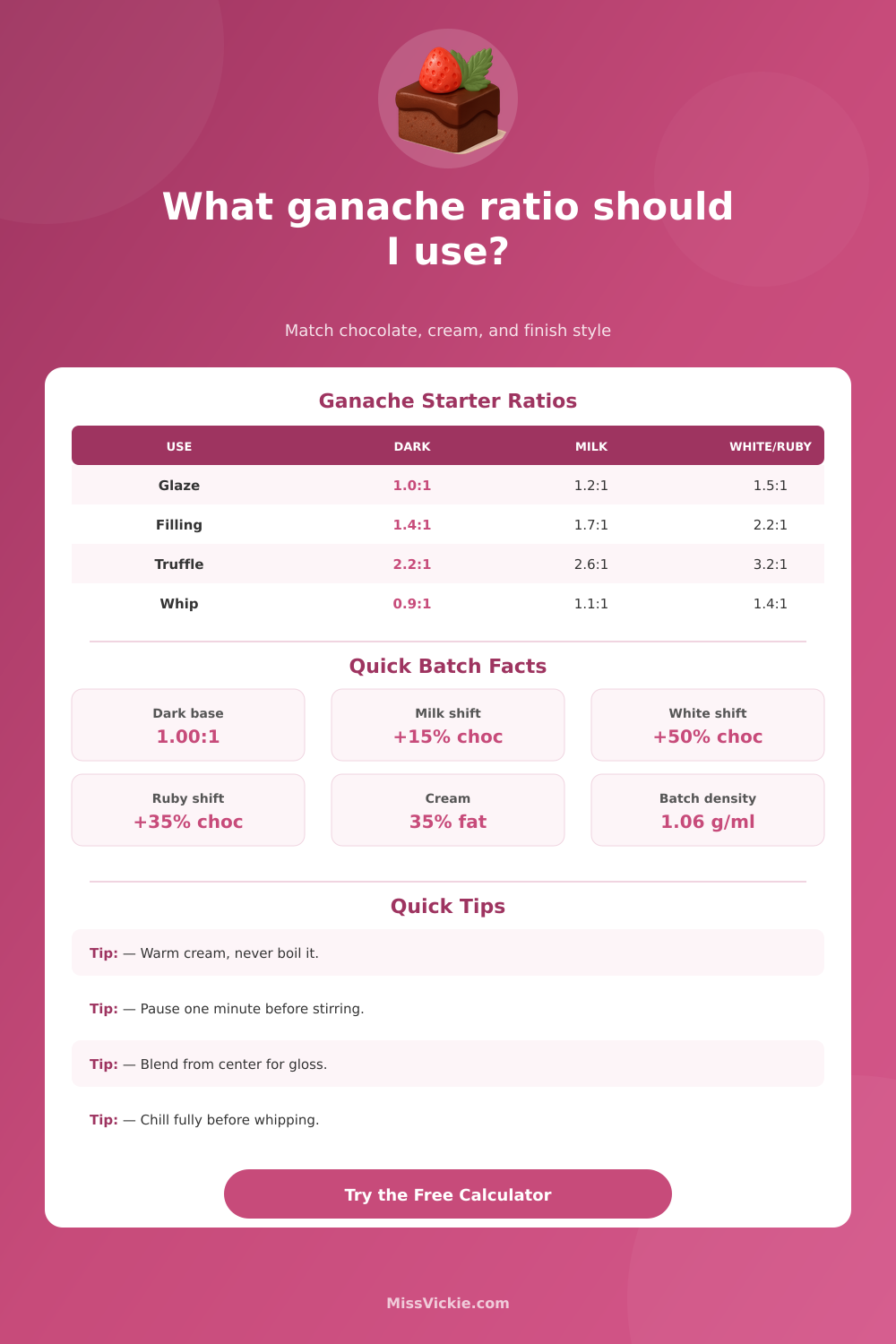
Dial in chocolate-to-cream balance by chocolate style, cocoa percentage, and finish goal. Build batches for smooth glazes, sturdy fillings, piped frostings, truffles, and whipped ganache with serving-based yield.
Ratio Logic And Batch Presets
Ganache texture is set by chocolate solids, cocoa butter, and total water from cream. This tool starts with dark chocolate ratios, then adjusts for milk, white, or ruby composition and your chosen working temperature.
Total batch mass is estimated from servings and target volume using a typical ganache density of 1.06 g/ml.
Chocolate ratio is adjusted by chocolate family, cocoa percent, room temperature, sweetness target, butter enrichment, and added flavor liquid.
Output includes chocolate mass, cream mass, optional flavor liquid split, and cross-style comparison for dark, milk, white, and ruby chocolate.
Batch Inputs
Batch Breakdown
Chocolate-Type Comparison Grid
Same serving target, same application, four chocolate families. Use this to quickly assess procurement differences before scaling production.
Reference Table: Application Ratios By Chocolate Family
| Application | Dark 60-70% | Milk 35-45% | White 28-35% | Ruby 43-50% | Typical Kitchen Use |
|---|---|---|---|---|---|
| Warm glaze | 1.0:1 | 1.2:1 | 1.5:1 | 1.35:1 | Sheet cakes, loaf cakes, tart sheen |
| Drip border | 1.2:1 | 1.45:1 | 1.9:1 | 1.7:1 | Tall cake edge drip control |
| Layer filling | 1.45:1 | 1.75:1 | 2.2:1 | 2.0:1 | Layered sponge and entremet inserts |
| Pipe frosting | 1.7:1 | 2.0:1 | 2.5:1 | 2.25:1 | Rosettes, borders, shell piping |
| Truffle core | 2.2:1 | 2.6:1 | 3.2:1 | 2.9:1 | Scoop and hand-roll centers |
| Whipped ganache | 0.9:1 | 1.1:1 | 1.4:1 | 1.2:1 | Mousse-like frosting and plated quenelles |
| Tart set | 2.0:1 | 2.35:1 | 3.0:1 | 2.65:1 | Sliceable tart interior |
Reference Table: Chocolate Composition Benchmarks
| Chocolate Type | Typical Cocoa Percent | Cocoa Butter Range | Sugar Range | Behavior In Ganache | Best Ratio Direction |
|---|---|---|---|---|---|
| Dark couverture | 55-75% | 32-43% | 25-42% | Strong cocoa solids, firmer finish | Can run lower chocolate for glaze |
| Milk chocolate | 35-45% | 30-38% | 45-55% | Softer set from higher sugar and milk solids | Needs more chocolate than dark |
| White chocolate | 20-35% cocoa butter | 20-36% | 45-55% | No cocoa solids, sweet and fluid when warm | Requires biggest chocolate boost |
| Ruby chocolate | 43-50% | 33-39% | 40-50% | Fruit-forward acidity with medium body | Between milk and white behavior |
Reference Table: Temperature And Set Planning
| Step | Target Range | Why It Matters | Common Error | Fix |
|---|---|---|---|---|
| Heat cream | 80-85 C | Fully melts couverture without scorch | Boiling cream above 95 C | Cool 2 minutes before pouring |
| Initial rest | 60 seconds | Even heat penetration into pieces | Stirring immediately | Wait and then stir center-out |
| Emulsion phase | 35-40 C | Stable glossy emulsion window | Aggressive whisking with air | Use spatula circles first, blend last |
| Glaze pour | 32-35 C dark | Smooth curtain with minimal runoff | Too hot and runs thin | Stand 3 to 5 minutes before pour |
| Whip stage | 16-19 C | Holds air for mousse texture | Whipping warm mixture | Chill until edges thicken first |
| Truffle scoop | 20-22 C | Clean scoop and fast crusting | Too cold and cracks | Rest briefly at room temp |
Reference Table: Serving Volume Benchmarks
| Dessert Format | Typical Ganache Per Serving | Application Style | Expected Texture | Scaling Note |
|---|---|---|---|---|
| Layer cake slice | 25-35 ml | Filling or frosting | Spreadable and clean cut | Add 8% for offset spatula loss |
| Drip cake wedge | 15-22 ml | Border drip plus top coat | Thin curtain set | Chill cake before drip |
| Truffle piece | 10-14 ml | Center filling | Firm scoopable core | Plan 12% shell carryover |
| Tart slice | 20-30 ml | Set filling layer | Dense sliceable body | Pour into cooled shell |
| Macaron pair | 4-7 ml | Piped center | Soft hold with no bleed | Aging overnight improves set |
| Plated quenelle | 18-24 ml | Whipped ganache | Light mousse texture | Serve cold then temper 4 min |
Quick Bench Cards
Heavy cream conversion baseline for ml and fl oz swaps.
Used for yield math from serving volume to total mass.
Helpful for micro-adjustments in finishing consistency.
Most stable range for airy, pipeable whipped ganache.
Production Tips
Chocolate ganache consist of chocolate and cream and the consistency of the ganache relies upon a ratio of the chocolate to the cream. While many believes that ganache should always be produced with a one-to-one ratio of chocolate to cream, such a ratio are not always correct. For instance, ganache can contains dark chocolate, white chocolate, or both.
Dark chocolate contains cocoa solids while white chocolate dont contain cocoa solids. Because of this, the ratio of white chocolate to ganache needs to be more higher than ganache that contains dark chocolate. Additionally, if the chocolate that is used in the ganache contains a lower percentage of cocoa solids, more of that chocolate need to be added to the ganache recipe.
Ganache: How Much Chocolate and Cream to Use
Conversely, if the chocolate used in the ganache has a high percentage of cocoa solids, the cocoa solids will help to maintaining the structure of the ganache, so more cream can be used in the recipe. In addition to the ratio of chocolate to cream, the temperature of the room in which the ganache is setting is another factor that may impact the setting of the ganache. If the room is hotter then the desired setting of the ganache, the fat in the cream and the chocolate will remain in liquid form for a longer period of time.
Thus, if the setting of ganache in a hot room, more chocolate will need to be used in the recipe to ensure that the ganache set to the desired firmness. Conversely, if the room in which the ganache is setting is cool in temperature, the ganache will take less time to set. Thus, the cook will need to make adjustments to the ratio of chocolate to cream according to the temperature of the environment in which the ganache is produced.
The purpose for which the ganache is to be used can also impact the ratio of chocolate to cream that should be used in the recipe. For instance, ganache that is to be used as a mirror glaze will require more cream to the ganache than ganache that is to be used as a truffle; truffles must be firm enough to be scoop from the pan. Whipped ganache recipes require the ganache to be soft as they will be whipped to incorporate air into the ganache.
If the ganache is too firm, the whipping process will result in grainy ganache or ganache that break apart during the whipping process. Additionally, butter can be added to ganache to increase the shine and the flavor of the ganache. However, the fat content of the butter will affect the setting of the ganache; it may soften the setting of the ganache if too much butter is added.
The method in which the ganache is prepared is another factor in the creation of ganache. For instance, the cook should heat the cream to hot but not boil; boiling the cream will remove some of the water in the ganache, and boiling the cream to the point of scorching the fat in the cream will cause the ganache to separate once prepared. After heating the cream, the chocolate should be poured into the heated cream; after the chocolate and cream are combined, the ganache must be allowed to rest for a period of time.
This rest period allow the heat to reach the center of the chocolate chunks. If the ganache is stirred too early in the resting period, the ganache may become grainy or may contain piece of chocolate that did not melt during the resting period. If the ganache becomes separated, the fat will separate from the liquid component of the ganache; the ganache will appear oily.
If the ganache becomes oily, whisking in some milk or cream to the ganache can fix the ganache. An immersion blender can also be use to recombine the fat and liquid components of the ganache. Overall, ganache is a recipe that is based on the understanding that there is a balance between the solids and the liquids.
Once that balance can be understood, changes can be made to the type of chocolate or the amount of cream that is used yet still produce the same ganache products.