Frozen Lasagna Cooking Time Calculator
Estimate frozen lasagna oven time from tray weight, pan depth, thawed versus rock-solid state, covered foil time, convection, oven temperature, cheese uncover finish, center temperature target, foil tenting, and rest time.
🍝Frozen lasagna presets
Choose a frozen tray size, then fine-tune the actual pan depth, oven temperature, foil cover style, cheese browning preference, and target center temperature.
⚖Units
🧊Frozen weight, pan depth, and starting state
🔥Oven temperature, convection, foil, cheese, and rest
Frozen lasagna cooking estimate
Lasagna timing breakdown
Use an instant-read thermometer in the deepest center and continue covered baking if the middle is below target.
⏱Quick frozen lasagna timing markers
Probe the deepest middle, away from tray edges and browned cheese.
Most frozen trays heat best under foil for most of the bake.
Finish uncovered only after the center is close to hot.
Resting helps the center equalize and the layers slice neatly.
📋Frozen lasagna size reference
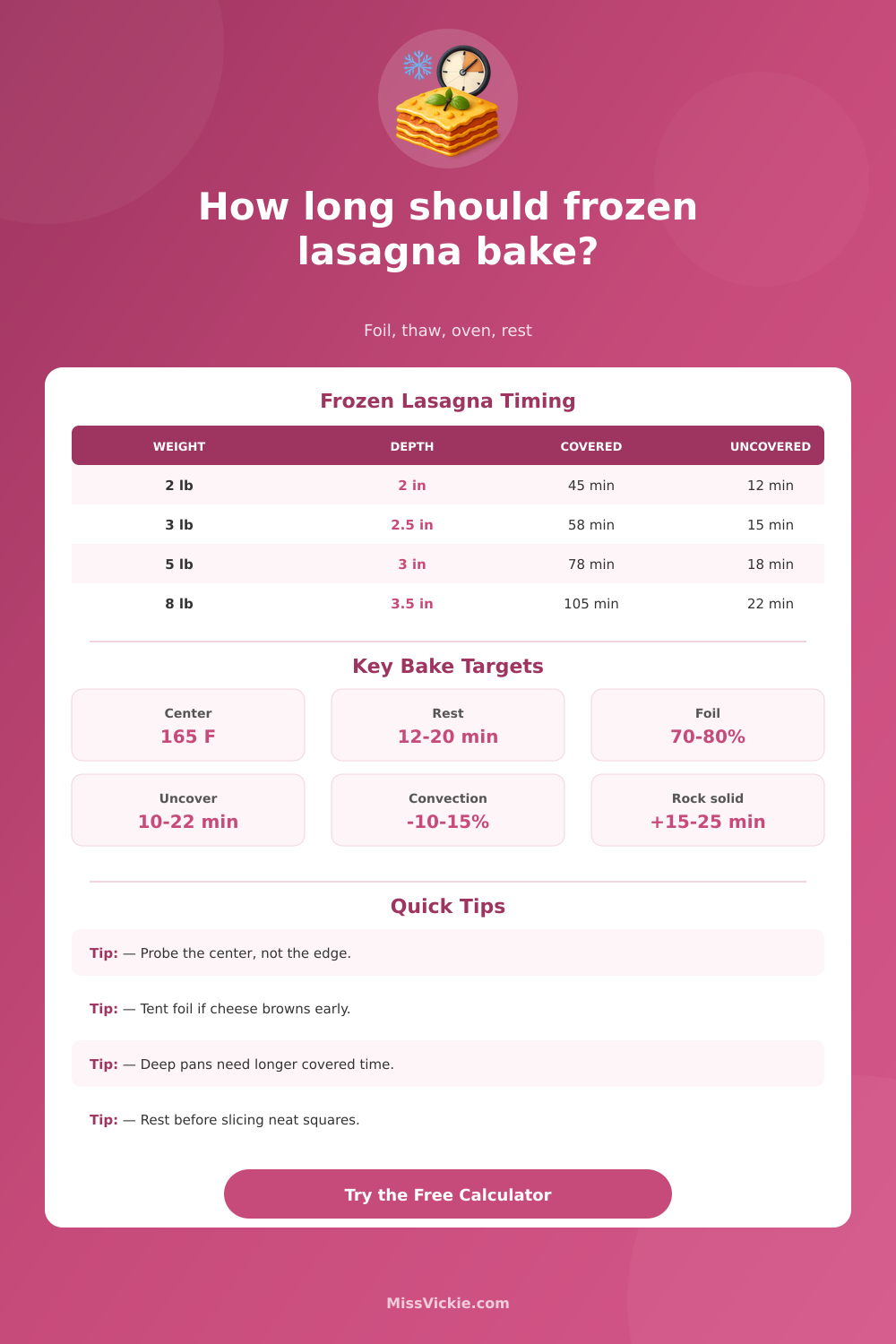
| Frozen tray | Typical weight | Typical depth | Covered foil time | Uncovered cheese time | Rest time |
|---|---|---|---|---|---|
| Single-serve tray | 10-24 oz | 1.25-1.75 in | 28-42 min | 7-12 min | 6-10 min |
| Loaf pan frozen lasagna | 32-42 oz | 2-2.5 in | 45-60 min | 10-16 min | 10-15 min |
| Family tray | 44-64 oz | 2.25-3 in | 55-78 min | 12-18 min | 12-18 min |
| Club or party tray | 5-6 lb | 2.75-3.25 in | 75-96 min | 16-22 min | 15-20 min |
| Catering pan | 7-9 lb | 3-4 in | 95-125 min | 18-26 min | 18-25 min |
🌡Oven, foil, and pan adjustments
| Condition | Time adjustment | Covered phase effect | Cheese finish effect | Best check point |
|---|---|---|---|---|
| Convection fan on | Reduce 10-15% | Shorter but still covered | Browns faster | Start checking 15 min early |
| Rock-solid deep center | Add 15-25 min | Needs longer steam heat | Uncover later | Probe before removing foil |
| Glass or ceramic dish | Add 5-12 min | Slower center heating | Edges stay gentler | Probe center and corner |
| No foil cover | Uneven result | Center may lag badly | Cheese can overbrown | Tent once cheese bubbles |
| Crowded holiday oven | Add 8-18 min | Heat recovery is slower | May need final uncovered boost | Rotate at first check |
🔪Center temperature and rest guide
| Step | What to check | Target | What to do next |
|---|---|---|---|
| Before uncovering | Probe the deepest middle | 150-158°F | Uncover if close; keep covered if cold |
| End of oven time | Probe center and one dense corner | 165°F | Return covered if below target |
| Cheese browns early | Look for dark spots or dry edges | Still juicy | Add a loose foil tent |
| Resting | Loose tent, pan on rack | 12-20 min | Slice after bubbling settles |
| Serving | Clean center slice and hot sauce | Steamy center | Hold loosely covered if needed |
💡Frozen lasagna baking notes
Covered foil time: Keep frozen lasagna covered until the sauce is bubbling near the center and the middle is close to the target temperature.
Foil tent: If the cheese browns before the center reaches target, add a loose tent so the top stops darkening while the middle heats.
Rock-solid trays: A deep freezer tray can look done at the edges while the center is still cold, so probe before trusting the clock.
Rest time: Resting is part of the timing plan because lasagna continues to equalize and firms up for cleaner squares.
Frozen lasagna is fine right out of freezer, but not on the way there or getting onto the dinner plate. If your goal is not to destroy food in transit, you will want more then just a timer. What’s the deal with drying out top layer while leaving inside like a rock? There are three things to consider: timing the end of covered baking, when to take off the cover to brown and doing a temperature check rather than just depending on the clock.
To help with this, use a cooking time calculator. It converts what you know into a plan to follow. Those variables, those are the inputs. Because they adjust path of heat through dish. Each input shifts ratio of time uncovered compared to time covered. Weight is an input because that’s the amount of mass to get up to temperature. But depth is another input that matter more. Even if box says your pan is full, the edge will warm faster then middle of a tall tray. And then there’s the starting state: A tray that has been in fridge to start to thaw requires noticeably shorter covered time than one frozen all the way to back of freezer.
How to Cook Frozen Lasagna Perfectly
Other factors shift balance between uncovered and covered phases. Foil type, oven type, and pan material all tweaks the math. The calculator does it for you when you put those inputs in so you don’t have to guess if a glass dish changes things slightly or if a convection fan helps or hurts.
Everyone thinks that cheese topping is the risk as that’s all you see when taking foil off. What’s actualy at risk is under the cheese! Even if the cheese appear beautiful, it may look perfect while center remains undercooked. The tool suggests cook times for both covered and uncovered methods along with an uncovering window. So you get right temp before reaching your target and keep top from burning. Plus accounts for rest time after cooking. This allow those layers to settle before slicing. This makes for a cleaner cut.
But there are complexities that no number can account for in real-life kitchen: The holiday oven full of casserole dishes takes longer to recover its heat when you open the door. Cheese that browns early need a loose tent, not just more time. That rock-hard bottom shelf out of chest freezer can be frozen underneath even though it looks perfectly cooked on the corners. For these scenarios, thermometer wins (not extra minutes) every time.
So, what is main point? The practical takeaway is to set your phases of covered and uncovered based off your results from the calculator. Let temp reading tell you when it’s really done. That one read will protect against both overbrowning the top and undercooking the middle. It means no more wasting an otherwise good dinner, you should of used a thermometer.