
Bag of frozen fries goes on counter. Let’s get cooking!
Dump in air fryer basket. We’re doing a full batch. Press the button and let the machine do its thing. You can go off and do other things.
Tips for Cooking with an Air Fryer
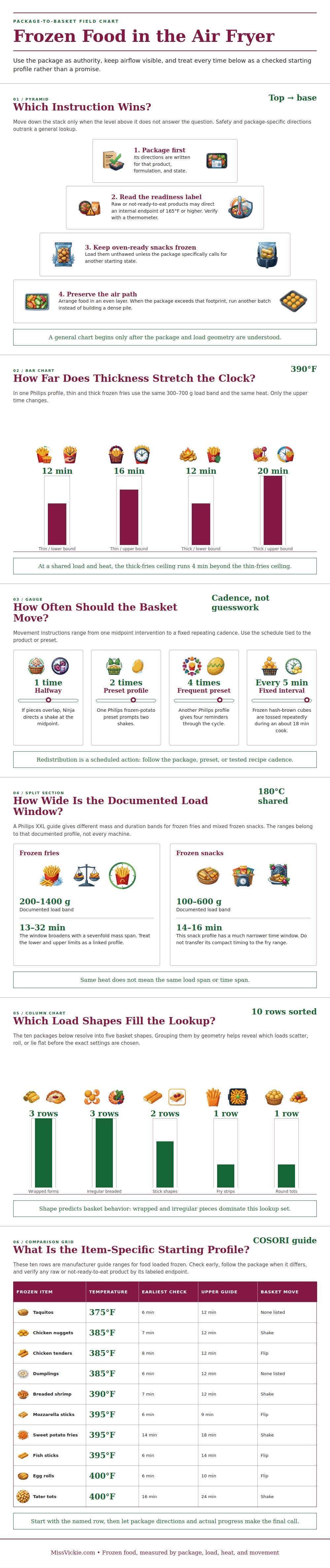
That’s where most folks mess up. Air fryers is great tools, but they’re not magical. They require that you respect the laws of physics. The infographic above show you what is really happening to help you see why air flow and load geometry matter more then remembering a particular time setting.
It’s easy enough: The instructions on the package are just a place to start. They’re written for a single product in ideal conditions. In your kitchen, there is different amount of food, a different basket, and perhaps a different humidity. When the label says “twelve minutes,” take that time as a starting point. Then check it. Is it cooked? Use a thermometer (if it’s raw) and look at it; then confirm.
Convenience isn’t more valuable than safety which is precisely why you don’t thaw out any oven-ready snack unless they specifically say so on the box. It won’t puff up propery without being frozen solid.
The thickness of load makes a big difference in cook time, as demonstrated based off the chart above. Take thin vs. Take thick cut fries, for example. They may have exact same weight and even temperature, yet the thicker fry will take longer because there’s just more distance from surface to center that has to gets heated. That could of mean a matter of a few minutes. A few minutes can mean crispy or soggy. You don’t want to burn the outside while waiting for the middle. Crisp up first then finish heating the inside. It is all about how heat moves through.
The primary purpose of this thing is airflow. That’s why when I say don’t pile your food up high, I’m not saying “don’t pile,” I’m saying “steamer.” Make sure there’s an unobstructed path for hot air to flow through. To get crispy, all pieces need to be in an even single layer. Run another batch if you has too much. Yes, this means cooking twice. But that’s how you ensure everything gets hot air.
Making a dense pile is the quickest route to a ruined meal. Why? Because you’re using it as a convection tool, which means letting it breathe.
Stirring is also important. Static heat doesn’t cook evenly. Stirring and flipping follow a pattern. Some items needs a single shake at the midpoint, while others require frequent tossing. Don’t assume. Stick with the recommended beat for each kind of food. For instance, hash browns should of agitated constantly so they don’t stick; whereas hardy foods such as fish sticks may only require a single flip. Moving the food around spreads heat to all surfaces and you must do it; it isn’t optional.
Each shape has a different behavior within the basket. Round tots, oddly shaped breaded items, and wrapped foods all need some space. The lookup chart breaks them into geometric categories based off their shape. Shapes predict behavior. Irregular pieces will roll around; wrapped things generally remains in place. Knowing that informs your decision about how much you should fill the basket so it doesn’t get messy. You don’t want too little (not enough space) but not too much either (no air flow).
What’s your temperature? That depends on the food being cooked. Some foods begin thawing slowly at low heat and then crisp up, while other foods requires a blast of heat right out of the gate. The chart includes both an early check-in time as well as an upper limit, but the actual test is with your own eyes. Use the recommended settings as a starting point, then tweak according to visual feedback. Is it browning quickly on the exterior? Drop the temp. Is it still cool in the middle? Add more cook time. You be the jury.
What does this all mean? It’s a matter of setting expectations. This isn’t a matter of heating something up, it’s a matter of taking something that was once a cold slab of starchy goodness and turning it into a crisp, golden thing. The chart above explains why and how to use those settings so you are no longer guessing but using a strategy instead. Move the food, respect the package, watch the air. That’s the trick. Crispy fries, hot snacks, understanding your tools in the kitchen. More process than clock.