How Much Flour and Cornstarch for Fried Chicken
Build a deep dredge bowl for fried chicken by raw weight, cut shape, crust depth, wetness, coating passes, seasoning, and bowl loss, then split the dry mix into flour and cornstarch.
Load a real frying setup, then adjust the bowl size and ratio for your chicken. This model estimates the dry dredge placed in the bowl, not only what sticks to the meat.
Deep Dredge Breakdown
| Chicken shape | Base dry per lb | Typical piece weight | Dredge note |
|---|---|---|---|
| Mixed bone-in pieces | 95 g | 5.5 oz | Needs a roomy bowl because shapes are uneven. |
| Bone-in thighs | 100 g | 6.5 oz | Skin folds hold extra flour, especially after buttermilk. |
| Drumsticks | 88 g | 4.5 oz | Lower surface area than wings, but ends grab crumbs. |
| Separated wings | 115 g | 2.2 oz | High surface area means more dry mix per pound. |
| Boneless tenders | 105 g | 2.8 oz | Long edges collect a thick ridge of seasoned flour. |
| Thin cutlets | 120 g | 4 oz | Flat surface area makes dry mix disappear quickly. |
| Bite-size nuggets | 130 g | 0.8 oz | Small pieces need the highest bowl allowance. |
| Quartered chicken | 82 g | 10 oz | Large pieces need less dredge per pound but more handling space. |
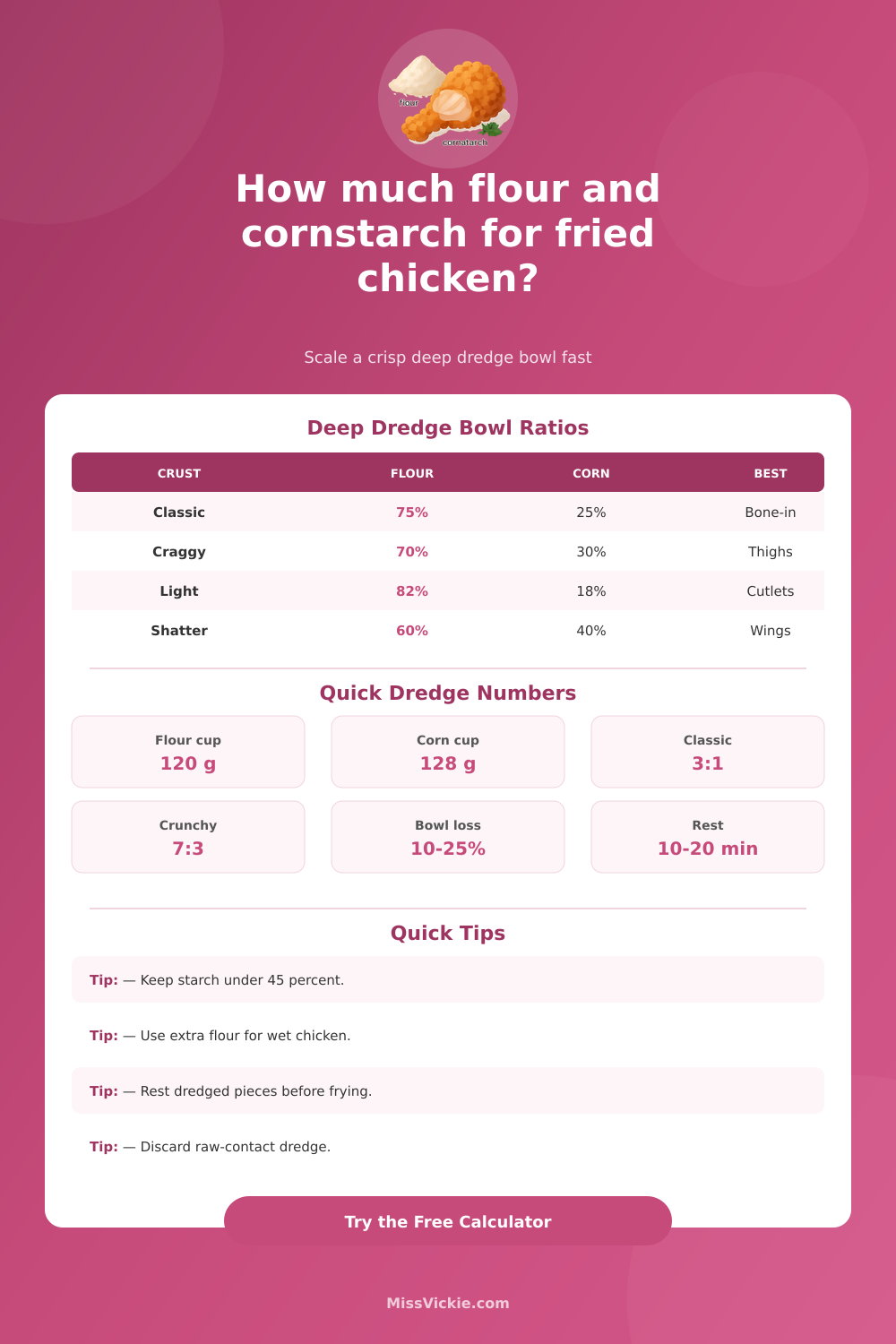
| Ratio strategy | Flour share | Cornstarch share | Best use |
|---|---|---|---|
| Southern flour-forward | 80% | 20% | Classic bone-in chicken with a sturdy crust. |
| Classic balance | 75% | 25% | Reliable all-purpose dredge for thighs, drums, and mixed pieces. |
| Crisp craggy bowl | 70% | 30% | Buttermilk chicken where ridges need a little snap. |
| Shattery wing blend | 60% | 40% | Thin, crisp crust for wings, tenders, and fast frying. |
| Raw chicken | Standard bowl | Craggy bowl | Approx flour + corn |
|---|---|---|---|
| 2 lb tenders | 260 to 310 g | 330 to 390 g | About 2.2 to 3.2 cups |
| 4 lb mixed pieces | 440 to 520 g | 560 to 670 g | About 3.8 to 5.5 cups |
| 6 lb wings | 790 to 930 g | 980 to 1180 g | About 6.6 to 9.8 cups |
| 10 lb potluck batch | 1100 to 1350 g | 1450 to 1750 g | About 9.5 to 14.5 cups |
Best for cutlets, oven finish, and light pan-fried chicken.
A balanced bowl for most family fried chicken batches.
Extra dry mix for buttermilk ridges and hand-pressed crust.
Deep crunchy coating for double-dipped party chicken.
When you fry chicken, you must consider an amount of dry mix that you place into the dredge bowl. The dredge bowl is the bowl in which you will place the flour and cornstarch. Too little of the dry mix will prevent the crust from forming upon the chicken, but too much of the dry mix will waste the dry mix.
Consequently, the amount of flour and cornstarch necessary to coat the chicken depend upon a variety of factors. The variables that affect the amount of flour and cornstarch that you should use include the cut of the chicken that is to be fried, the thickness of the crust, the moisture that exists upon the chicken, the ratio of flour to cornstarch, the number of times that you coat the chicken in the dry mix, the amount of seasoning that you are to use with the flour and cornstarch, the allowance for bowl loss, the resting of the chicken prior to frying, and the temperature of the frying oil. The cut of the chicken that is to be fried will impact the amount of flour and cornstarch that is required because not all cut of chicken have the same amount of surface area.
How Much Flour and Cornstarch to Use When Frying Chicken
For instance, wings will have more surface area per pound than drumsticks or thighs (due to the skin folds upon the thighs), and cutlets will have a larger flat and wide area for the flour and cornstarch to dissapear into the dredge more fast than some of the other cuts of chicken. Thus, not all cuts of chicken will require the same amount of flour and cornstarch. Additionally, the thickness of the crust that is to be formed will impact the amount of flour and cornstarch that you should use in the dredge bowl.
If thick crusts are to be formed, more flour and cornstarch will be required than if the crust is to be light and dust upon the chicken. Each added thickness of flour and cornstarch will require more of the dry mix to be place into the dredge bowl. Furthermore, the amount of moisture that exists upon the pieces of chicken will impact how much flour and cornstarch are required to adhere to those pieces of chicken.
Chicken soaked in buttermilk will require more flour and cornstarch than chicken that has been patted dry, and chicken that has been dipped in an egg wash will require more flour and cornstarch than chicken that has not been dipped in an egg wash. Another of the variables that will impact the amount of flour and cornstarch that you should place into the dredge bowl is the thickness of the crust. More flour and cornstarch will be required if thick crusts are desired rather than light crust.
Additionally, the amount of seasoning that you are to use in place of the flour and cornstarch will reduce the amount of flour and cornstarch that can be used because the seasoning will take up some of the space in the dredge bowl. Consequently, more flour and cornstarch will be used in a recipe that uses a light amount of seasoning than another recipe that uses a heavier amount of seasoning. Another of the variables that impact the amount of flour and cornstarch to be used is bowl loss.
Some of the flour and cornstarch will stick to the sides of the dredge bowl, some of the flour and cornstarch will become gummy and be discarded, and some of the flour and cornstarch will become contaminated with the raw chicken. Thus, there will always be some loss of flour and cornstarch, and it is important to provide for this loss in the amount of flour and cornstarch that is measured and placed into the dredge bowl. Another variable that you should consider is the resting of the chicken prior to frying.
By resting the chicken that has been dredged in flour and cornstarch, the flour and cornstarch will have time to hydrate and adhere to the chicken pieces. Furthermore, by resting the chicken, it will not form a crust while resting, which can prevent the coating from adhering to the chicken while it is being fried. Because the chicken will no longer be “grabby” after resting, there may be small adjustments to the amount of flour and cornstarch that you should measure.
Finally, it is important to remember that the dredge bowl does not control the temperature to which the oil will be heated. If the oil is too hot, the crust will brown too quickly. If it is too hot, the oil will produce a temperature that makes the chicken soggily.
While the dredge bowl cannot control the oil temperature, using the proper amount of flour and cornstarch will allow for the chef to have a successful frying process. Additionally, if you measure the amount of flour and cornstarch according to the specific type of chicken that is being prepared, it is certain that there will be enough of the dry mix for frying the chicken, and that it wont be wasted in the process.