🍞 MissVickie yeast conversion math
Fresh to Dry Yeast Converter
Convert fresh yeast into active dry or instant yeast, see packet and teaspoon equivalents, and keep dough yield steady with practical baking adjustments.
Each preset drops in a real baking scenario, from pizza dough to sweet rolls, then runs the converter with a practical target.
Choose the fresh yeast amount, the dough style, and the practical baking conditions. The converter keeps the base ratio visible while nudging for real kitchen use.
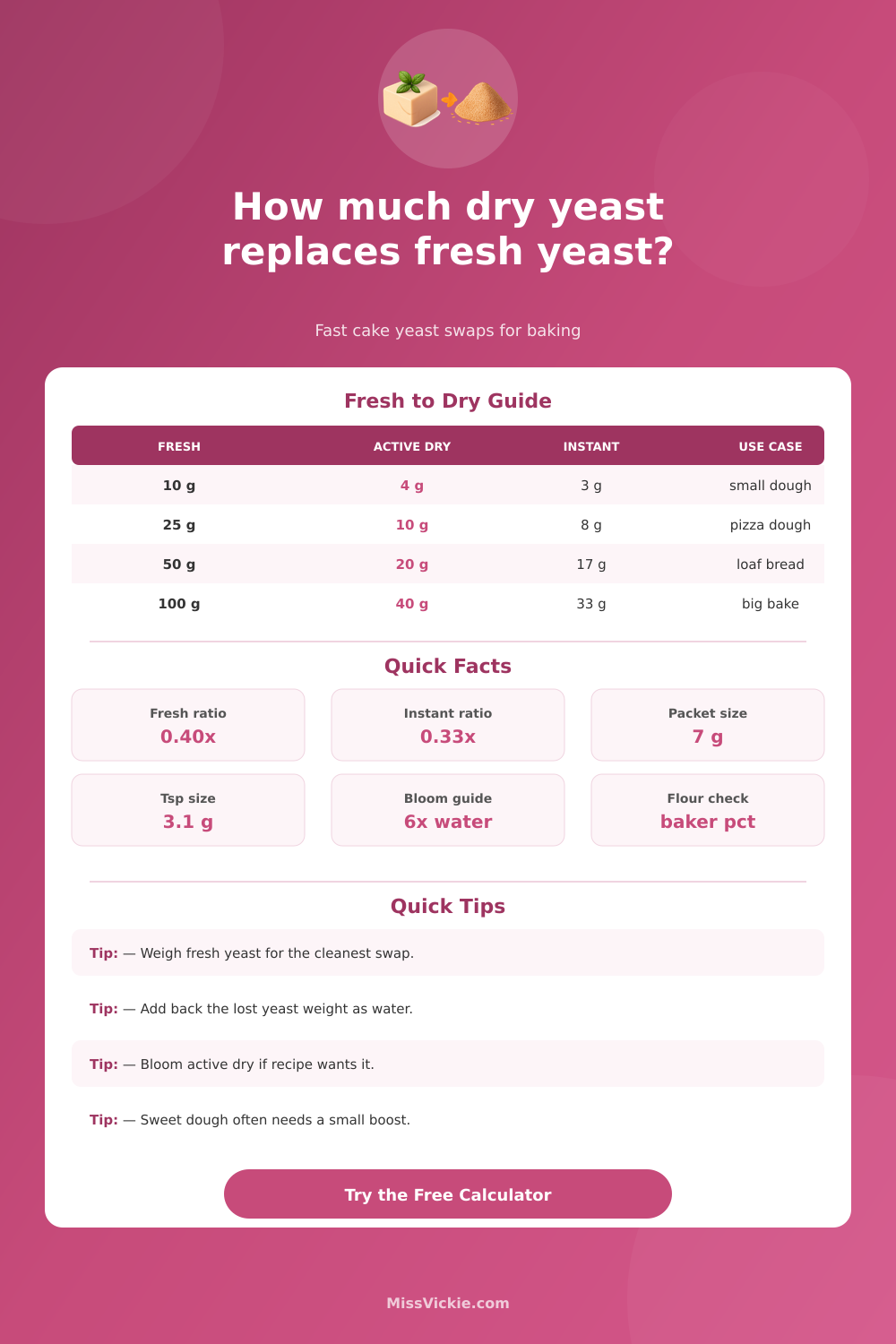
The base math uses common baking guidance: fresh yeast to active dry is 0.40x, and fresh yeast to instant is 0.33x.
| Fresh | Active Dry | Instant | Use Case |
|---|---|---|---|
| 10 g | 4 g | 3 g | small dough |
| 15 g | 6 g | 5 g | one loaf |
| 25 g | 10 g | 8 g | pizza dough |
| 50 g | 20 g | 17 g | rich dough |
One packet is about 7 g, which is roughly 2 1/4 teaspoons. Use this table when a recipe is written in packet or spoon form.
| Dry Yeast | Packets | Teaspoons | Short Note |
|---|---|---|---|
| 3.5 g | 1/2 pkt | 1 1/8 tsp | half packet |
| 7 g | 1 pkt | 2 1/4 tsp | standard pkt |
| 14 g | 2 pkt | 4 1/2 tsp | double batch |
| 21 g | 3 pkt | 6 3/4 tsp | large batch |
Dough style changes the practical yeast recommendation a little. Sweet and enriched doughs usually need a touch more support.
| Dough Type | Sugar Range | Factor | Practical Note |
|---|---|---|---|
| Lean | 0-5% | 1.00x | standard rise |
| Enriched | 6-12% | 1.05x | softer crumb |
| Sweet | 13-20% | 1.10x | slower lift |
| Very sweet | 20%+ | 1.15x | more support |
Cooler dough usually needs a little more yeast support, while warm dough can move faster and needs closer watching.
| Dough Temp | Factor | Proof Style | Timing Note |
|---|---|---|---|
| Cold | 1.06x | overnight | slow start |
| Cool | 1.03x | long rise | steady build |
| Room | 1.00x | direct mix | normal pace |
| Warm | 0.97x | fast rise | watch closely |
Fresh yeast is moist and perishable. Dry yeast is easier to store, and instant dry usually goes straight into the dough without blooming.
Soft, perishable, and common in bakery settings.
Often bloomed first for a reliable lift.
Fast, simple, and usually one-to-one with active dry.
Osmotolerant styles help rich doughs rise evenly.
Fresh yeast and dry yeast is two different forms of the same ingredient. However, the two form of yeast contain different amounts of moisture. Fresh yeast contains approximately 60 percent of water.
Dry yeast, on the other hand, have had the moisture removed from it to allow the yeast to be stored for longer periods of time. Because of these difference in moisture content, the amount of yeast and the amount of liquid that is to be used in a recipe must be adjusted when changing from fresh yeast to dry yeast. To convert fresh yeast to active dry yeast, you should multiply the fresh yeast by a factor of 0.40.
How to Replace Fresh Yeast with Dry Yeast
To convert fresh yeast to instant dry yeast, you should multiply the fresh yeast by a factor of 0.33. These conversion factor are accurate for lean dough recipes. Lean dough recipes are recipes for doughs that contain very little sugar and fat ingredient.
For enriched dough recipes, however, it is necessary to use more dry yeast than the calculation indicate. Enriched dough recipes contain ingredient like sugar, butter and milk. These ingredient slow the action of the yeast.
To compensate for this slowing of the yeast activity in enriched dough recipes, it is necessary to add an additional five to fifteen percent of dry yeast to the recipe. The type of dough recipe that is to be prepared will impact the adjustments of dry yeast that is to be made. Lean dough recipes, such as those for pizza or bagels, will not require any additional adjustment to the yeast amount other than those required for converting from fresh yeast to dry yeast.
Enriched dough recipes will require additional yeast to compensate for the fat ingredient in those recipes. Sweet dough recipes will require the most adjustment to the amount of dry yeast that is to be used. The sugar content of sweet recipes will reduce the activity of the yeast.
To adjust for this reduced activity, bakers often use what is known as baker’s percentages. Baker’s percentages use the total weight of the flour in the recipe as a reference point for the amount of yeast to be used. For instance, a recipe that use lean dough will contain two percent of yeast relative to the weight of the flour in the recipe.
A sweet recipe, however, may require three percent of yeast relative to the weight of the flour that is to be used in the recipe. The temperature at which the dough is prepared will also impact the amount of dry yeast that should be used in the recipe. If the kitchen in which the dough is prepared is warm, the dry yeast will begin to activate at a faster rate.
Therefore, less dry yeast will need to be used in warm environment than in cooler environment. In cold environment and kitchens, more dry yeast will be required to allow the dough to rise. Similarly, the activity of the fresh yeast will impact the amount of dry yeast that is to be used.
Fresh yeast that is new and firm is very active. Fresh yeast that is old or has been stored for lengthy period may not be as active. If you are to replace old fresh yeast with dry yeast, then a slight increase in the amount of dry yeast will be required.
Because fresh yeast contains water and dry yeast does not, adjustment will need to be made for the hydration of the dough. If fresh yeast is to be replaced with dry yeast, then the amount of water or milk that is included in the recipe should be increased to ensure that the dough is not too dry. The amount of water or milk should be increased to compensate for the loss of water that occurred when the fresh yeast was removed from the dough.
Dry yeast can be prepared in different ways. Active dry yeast requires what is known as “blooming.” Blooming is the process of mixing the active dry yeast with warm water for five minutes to allow the yeast to begin to activate. Instant dry yeast does not require blooming before being mixed into the dough.
To ensure that the dry yeast is active and working as it should be in the recipe, it is necessary to test the yeast. Active dry yeast should be tested by crumbling it into warm water that weighs six times as much as the yeast that is to be used in the recipe. If the yeast begins to foam, it is alive and can be used.
If it does not foam, it is dead yeast and should not be used in the recipe. Fresh yeast can also be tested. Pressing the fresh yeast with the thumb will reveal whether or not it is active.
If the fresh yeast is soft, it is active. If it feels dry or crumbles when pressed, the yeast is likely not active any longer. Finally, you should take care in the storage of both fresh and dry yeast.
Fresh yeast should be stored in a container that is both dry and sealed and stored in the refrigerator. Dry yeast should be stored in a cool and dry place. Once the package of dry yeast is opened, it will remain active for many month.
By taking the time to follow these guideline for converting fresh yeast to dry yeast, adjusting for the type of dough, the temperature of the environment in which the recipe will be prepared, the activity level of the yeast itself, and the hydration of the dough, a baker will be able to successfully use dry yeast in any recipe that called for fresh yeast.