🌿 MissVickie herb swap math
Fresh to Dried Herb Converter
Convert basil, parsley, thyme, oregano, dill, rosemary, sage, cilantro, marjoram, and tarragon with classic kitchen ratios, serving scaling, and flavor-strength adjustments for real recipe swaps.
Each preset loads a realistic cooking situation with herb, direction, units, servings, and intensity, then runs the conversion automatically.
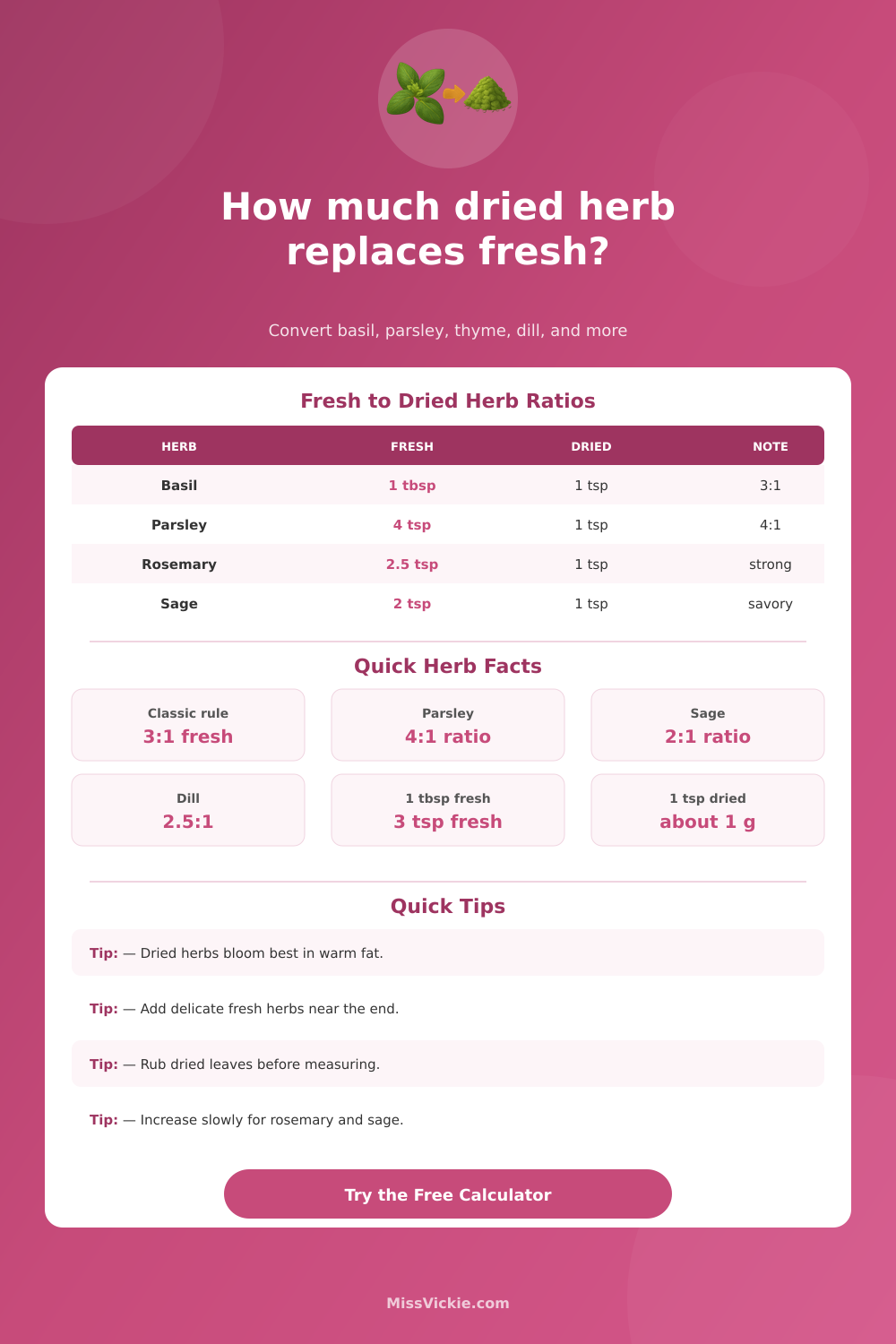
These kitchen ratios reflect how dried herbs concentrate flavor as moisture drops, so the dried amount is usually smaller than the fresh amount.
| Herb | Fresh to Dried | 1 Tbsp Fresh | 1 Tsp Dried |
|---|---|---|---|
| Basil | 3:1 | 1 tsp dried | 1 tbsp fresh |
| Parsley | 4:1 | 3/4 tsp dried | 4 tsp fresh |
| Thyme | 3:1 | 1 tsp dried | 1 tbsp fresh |
| Oregano | 3:1 | 1 tsp dried | 1 tbsp fresh |
| Dill | 2.5:1 | 1.2 tsp dried | 2.5 tsp fresh |
| Rosemary | 2.5:1 | 1.2 tsp dried | 2.5 tsp fresh |
| Sage | 2:1 | 1.5 tsp dried | 2 tsp fresh |
| Cilantro | 4:1 | 3/4 tsp dried | 4 tsp fresh |
| Tarragon | 3:1 | 1 tsp dried | 1 tbsp fresh |
| Marjoram | 3:1 | 1 tsp dried | 1 tbsp fresh |
Use this table when your recipe and measuring tools do not match, especially when moving between spoon measures, cups, and metric volume.
| Unit | Teaspoons | Tablespoons | Milliliters |
|---|---|---|---|
| 1 teaspoon | 1 tsp | 1/3 tbsp | 4.93 ml |
| 1 tablespoon | 3 tsp | 1 tbsp | 14.79 ml |
| 1/4 cup | 12 tsp | 4 tbsp | 59.15 ml |
| 1/2 cup | 24 tsp | 8 tbsp | 118.29 ml |
| 1 cup | 48 tsp | 16 tbsp | 236.59 ml |
| 1 fluid oz | 6 tsp | 2 tbsp | 29.57 ml |
This quick guide shows how much dried basil or dried parsley you would use if a recipe starts with one tablespoon of fresh herbs for four servings.
| Target Servings | Fresh Basil Need | Dried Basil | Dried Parsley |
|---|---|---|---|
| 2 | 1.5 tsp | 0.5 tsp | 0.4 tsp |
| 4 | 1 tbsp | 1 tsp | 0.75 tsp |
| 6 | 1.5 tbsp | 1.5 tsp | 1.1 tsp |
| 8 | 2 tbsp | 2 tsp | 1.5 tsp |
| 12 | 3 tbsp | 1 tbsp | 2.25 tsp |
| 16 | 4 tbsp | 4 tsp | 3 tsp |
Best for parsley, cilantro, basil, and dill added right before serving when color and lift matter most.
Great for oregano, thyme, rosemary, and marjoram because dry leaves hold up better over longer cooking.
Rosemary and sage can dominate quickly, so start slightly below the calculator and add more after tasting.
Basil, parsley, and cilantro lose their bright notes fast, so fresh versions usually belong near the end.
These cards summarize the live herb selection so you can see ratio, dried density, flavor lift, and timing in one glance.
Herbs comes in two forms: fresh and dried. Fresh herbs contains high amounts of moisture, while dried herbs does not contain moisture. Fresh herbs contain eighty percent or more of water.
Because of the water in fresh herbs, the moisture molecules dilutes the essential oils that the herbs naturally contain. However, when the herbs are dried, the water is remove from the herbs. As a result, the essential oils in the herbs become more concentrated.
How to Use Fresh and Dried Herbs
Because dried herbs contain more concentrated essential oils than fresh herbs, few dried herbs have to be used than fresh herbs to extract the same amount of flavor from the herbs. One common herb ratio is three part of fresh herbs to one part of dried herbs. However, the ratio may have to be adjusted according to the types of herbs that is being used.
Basil has a three to one herb ratio, but herbs like parsley have a four to one ratio because parsley is much mild in flavor then basil. If too many dried herbs are used in a recipe, the flavor of the dish will be too strong. However, if too few dried herbs is used, the flavor of the dish wont be strong enough.
Depending on the number of servings of a recipe that are to be prepared, the herbs will have to be increased in amount. However, it is also important to consider the strength of the herbs that are to be used, as well as the loss that may be experience from the herbs during the cooking process. Simmering herbs for long periods may lead to a loss of the flavor of the herbs.
Additionally, triming the stems of herbs may also lead to a loss of the volume of the herbs. Therefore, a conversion tool can be used to calculate the amount of fresh or dried herbs that will be needed for a recipe that has been scaled in size. Conversion tools can take the amount of herbs that are currently listed in a recipe and calculate how many gram or ounces of the herbs are needed, as well as how many cup of fresh or dried herbs are required.
Certain herbs is strong and have a strong flavor, such as rosemary. Dried rosemary is one of the stronger dried herbs. For this reason, two-and-a-half parts of fresh rosemary is used to one part of dried rosemary.
Other herbs, such as rosemary and sage, should be used with caution so as to not overpower the other flavors of the dish. Herbs such as dill and parsley should be added towards the end of the cooking process because the herbs will wilt if cooked for long period of time. However, herbs such as oregano and marjoram should be added to a recipe at the beginning of the cooking process because these herbs will not change in flavor if cooked for long periods of time.
The way in which herbs are used in a recipe can differ according to the type of herb that is being used; dried or fresh. Dried herbs are best crushed before being added to a recipe. Crushing the herbs will allow the essential oils contained within the herbs to be released into the fat in the recipe.
Additionally, fresh herbs should be added to a recipe late in the cooking process so as to not make the herbs too mushy. Herbs can be measured in various unit. For example, one tablespoon is equal to approximately fifteen milliliters of the herb, and one cup of an herb is equal to approximately two hundred thirty-six milliliters of that herb.
By understanding the information provided about fresh and dried herbs, cooks can avoid common mistake when using herbs in cooking. One common mistake is using the same amount of dried herbs as fresh herbs. However, dried herbs are more denser than fresh herbs.
Therefore, a teaspoon of dried herbs will contain more flavor than a teaspoon of fresh herbs. Another mistake that cooks can make is not considering that the flavor of herbs may fade during certain cooking methods. For instance, herbs may fade in a stew; therefore cooks must add a buffer amount of herbs to stews.
Another way to manage a kitchen and its cooking process is to ensure that both dried and fresh herbs are stock in the kitchen. Dried herbs are best used in the bases of dishes and last longer than fresh herbs. However, fresh herbs are best used towards the end of cooking to add a brightness to the finished dish.