Household size, bulk meat, meal prep, frozen produce, backup margin, and freezer style
Freezer Size Calculator
Estimate the freezer capacity you need from family size, shopping habits, meat boxes, freezer meals, garden produce, emergency backup, packing style, and chest or upright layout.
Load a familiar storage pattern, then tune the household, meat, produce, meal prep, backup margin, and freezer style to match your kitchen or garage.
Capacity Breakdown
| Household Pattern | Suggested Capacity | Typical Food Load | Best Freezer Type | Planning Note |
|---|---|---|---|---|
| Single person or small apartment | 3 to 5 cu ft | Short-term frozen meals, fruit, and basics | Drawer or compact upright | Useful when the fridge freezer section is tiny. |
| Couple with normal weekly groceries | 5 to 8 cu ft | Sale meat, pizza, vegetables, and leftovers | Small chest or upright | Enough for rotation without overbuying. |
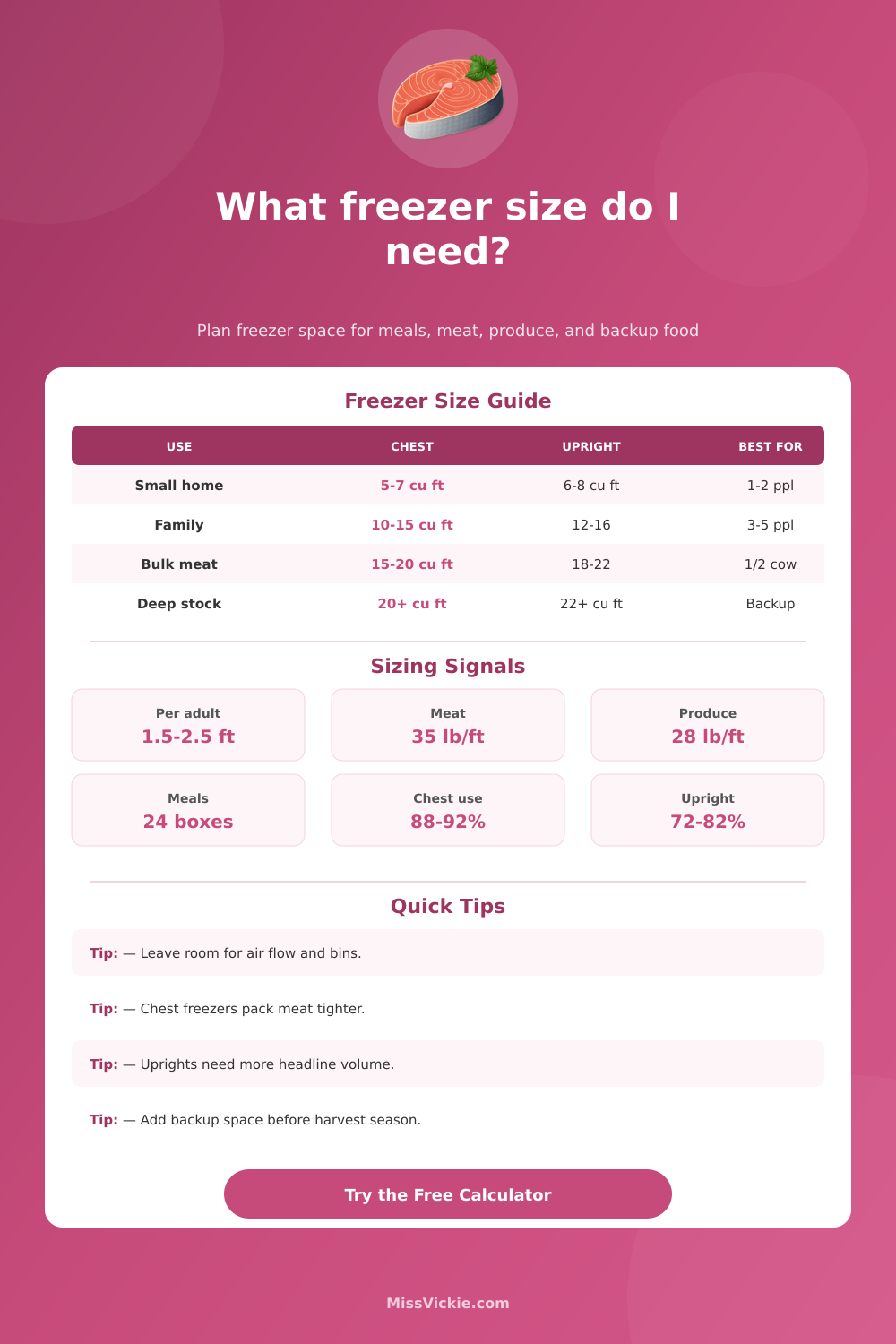
| Family of three to five | 10 to 15 cu ft | School lunches, frozen produce, and family packs | Medium chest or upright | Most households land here before bulk meat orders. |
| Bulk buyer or meal-prep household | 15 to 20 cu ft | Warehouse runs, casseroles, soups, and protein boxes | Large chest freezer | Use bins so older food does not disappear at the bottom. |
| Deep stock or homestead pattern | 20+ cu ft | Bulk meat, harvest produce, and backup meals | Chest plus upright | Two smaller freezers can be easier to organize than one huge unit. |
| Storage Driver | Capacity Rule | Chest Behavior | Upright Behavior | Calculator Treatment |
|---|---|---|---|---|
| Bulk meat boxes | About 30 to 40 lb per cu ft | Packs tightly in flat layers | Needs shelf gaps and door clearance | Uses meat weight and packaging density. |
| Frozen meal prep | About 18 to 28 portions per cu ft | Flat bags stack well | Containers are easier to see | Uses portion count and container style. |
| Frozen produce | About 24 to 32 lb per cu ft | Loose bags fill corners well | Rigid bins reduce shelf efficiency | Uses produce weight and harvest style. |
| Backup food margin | Add 10 to 30 percent | Good for seasonal overflow | Good for rotating labeled packages | Applied after household and food load. |
| Organization bins | Adjust usable capacity by 6 to 16 percent | Improves access but can waste depth | Improves rotation with less digging | Changes usable volume before final size. |
| Bulk Meat Order | Packaged Weight | Chest Capacity | Upright Capacity | Notes |
|---|---|---|---|---|
| Small meat box | 25 to 50 lb | 1 to 2 cu ft | 2 to 3 cu ft | Works in most small household freezers. |
| Quarter beef | 100 to 130 lb | 4 to 5 cu ft | 5 to 7 cu ft | Add more room for bones, odd roasts, and soup packs. |
| Half hog | 70 to 100 lb | 3 to 4 cu ft | 4 to 6 cu ft | Sausage boxes and bacon stacks need organized bins. |
| Half beef | 180 to 260 lb | 8 to 10 cu ft | 10 to 13 cu ft | Reserve extra room if you also keep everyday frozen food. |
| Whole beef | 360 to 520 lb | 16 to 20 cu ft | 20 to 26 cu ft | Usually better split across two freezers. |
| Freezer Meal Or Produce Pattern | Capacity Rule | Good Packaging | Watch Point | When To Size Up |
|---|---|---|---|---|
| Single meal containers | 18 to 24 portions per cu ft | Same-size stackable boxes | Odd lids waste height | When prepping more than 40 meals. |
| Flat freezer bags | 28 to 36 portions per cu ft | Freeze flat on a sheet pan | Labels must face outward | When soups and sauces are bulky. |
| Garden vegetables | 24 to 30 lb per cu ft | Blanched quart bags | Harvest arrives all at once | Before summer and fall preservation. |
| Frozen fruit | 26 to 34 lb per cu ft | Flat gallon bags | Berries crush if overpacked | When smoothie packs share the same freezer. |
| Family casseroles | 8 to 14 pans per cu ft | Foil pans or flat wrapped portions | Pans force fixed shelf spacing | When upright shelves are already crowded. |
Freezer capacities is a significant factor in food storage, as the capacity of the freezer will determine how much food a person can store at one time. A person’s choice of freezer will determine how much food a person can store at one time during sales or if a person has an excess amount of food prepared for storage. A freezer dont grow in size to store more food as time passes, so the capacity that a person select for their freezer will determine the amount of food they can store within the appliance.
The inputs that will go into the calculator will include the size of the households, the frequency with which a person shops for food, the amount of meat that will be stored in the freezer, the amount of meals that will be stored in the freezer, and the amount of produce that will be stored in the freezer. The size of the household will determine the amount of food that will be consume daily. A person who shops for food every week will require less freezer storage then a person who shops once every month.
How to Choose the Right Freezer Size
The amount of meat, meals, and produce will vary in the amount of space that they take up within the freezer. The output of the calculator will provide the capacity of the freezer needed to account for the amount of food that will be stored in the freezer. In addition, the calculator will account for the loss of capacity of freezers based on the type of freezers that is to be purchased.
Chest freezers tend to have more capacity than upright freezers because the items that is stored in the chest freezers do not create gap between the items. Upright freezers create gaps between the shelves in which the food is stored, and the calculator will account for this wasted space. The backup margin will be provided to account for the fact that a person may need to store more food at certain times of the year than others, such as during holidays or storm seasons.
Small habits that will determine how much of the freezer is used will also be modeled in the calculator. A person who stores many meal in the freezer will have less space for the storage of meat and produce. A person who purchases meat in bulk will need extra space within the freezer.
These categories are additive within the calculator so that a person can change one of the variable and see if the amount of food that they would like to store in the freezer will fit in the freezer that they currently own. The type of freezers that will be purchased have different long-term consequences for the storage of food within the appliances. Chest freezers are energy efficient but require digging through the stored items to find the food that they requires.
Upright freezers are easy to access but have shelves in a fixed position that waste some of the capacity of the appliances. Drawer freezers are easy to access, especially in small kitchens, but draw freezers do not provide the capacity required for long-term storage of food. The organization of the food within the appliances will also affect how much food can be stored.
Using bins within the appliances will make it easier to find the food that is required, but the amount of food that can be stored will be less than if the food is stored without bins. Packing the food loosely into the appliances allows for odd-shaped food items to fit in the appliance, but the food items waste some of the capacity of the appliances. Using the FIFO system wastes some of the capacity of the appliances because air gap must be created for the food to be used in a timely manner.
The mistake that many people make when purchasing a freezer is that they purchase a freezer that is too small to meet their future storage needs. People also make the mistake of purchasing a freezer that is too large for their needs as they do not want to pay too much for the operation of the appliance. People should of plan for the needs of one month when they purchase their freezers.
This is the time when people require the most meat, the most produce, and the most cooking skill for holidays and other events. By using this calculator, people can model the different scenarios within their freezers before purchasing one. The model allows people to increase the weight of the meat that will be stored and observed, as well as increase the capacity for produce to see how these changes will affect the total capacity of the appliances.
This model will allow people to avoid purchasing a freezer that is too small or too larger for their kitchens. The goal is to find the perfect size of freezer that allows people to store the amount of food that they desire without having to constantly rearrange the food within the appliance.