Salt, spice, herbs, sodium, rubs, and marinades
Seasoning Calculator
Scale seasoning by food weight, salt percentage, herb and spice intensity, cuisine style, batch size, and rub or marinade mode with a sodium estimate per serving.
Enter the food weight before cooking. The calculator converts the batch to grams, applies the selected food and cuisine factors, then separates salt, dry spice, herbs, sugar, oil, acid, and optional marinade liquid.
Full Breakdown
| Component | Amount | Kitchen measure | Purpose |
|---|
Lower salt, high oregano, basil, parsley, garlic.
Cumin, chile, garlic, and moderate salt for tacos.
Balanced salt with paprika and sugar for browning.
Bold paprika, pepper, herbs, and more chile heat.
Short contact foods usually need a lighter hand.
Thicker cuts can handle stronger salt and pepper.
More green herb flavor with less sodium impact.
Reduce added salt when salty sauces are included.
Use these tables as a starting point. Thin foods, salted sauces, and long marination times usually need a lower added-salt rate.
| Food type | Light salt | Balanced salt | Bold salt | Typical serving |
|---|---|---|---|---|
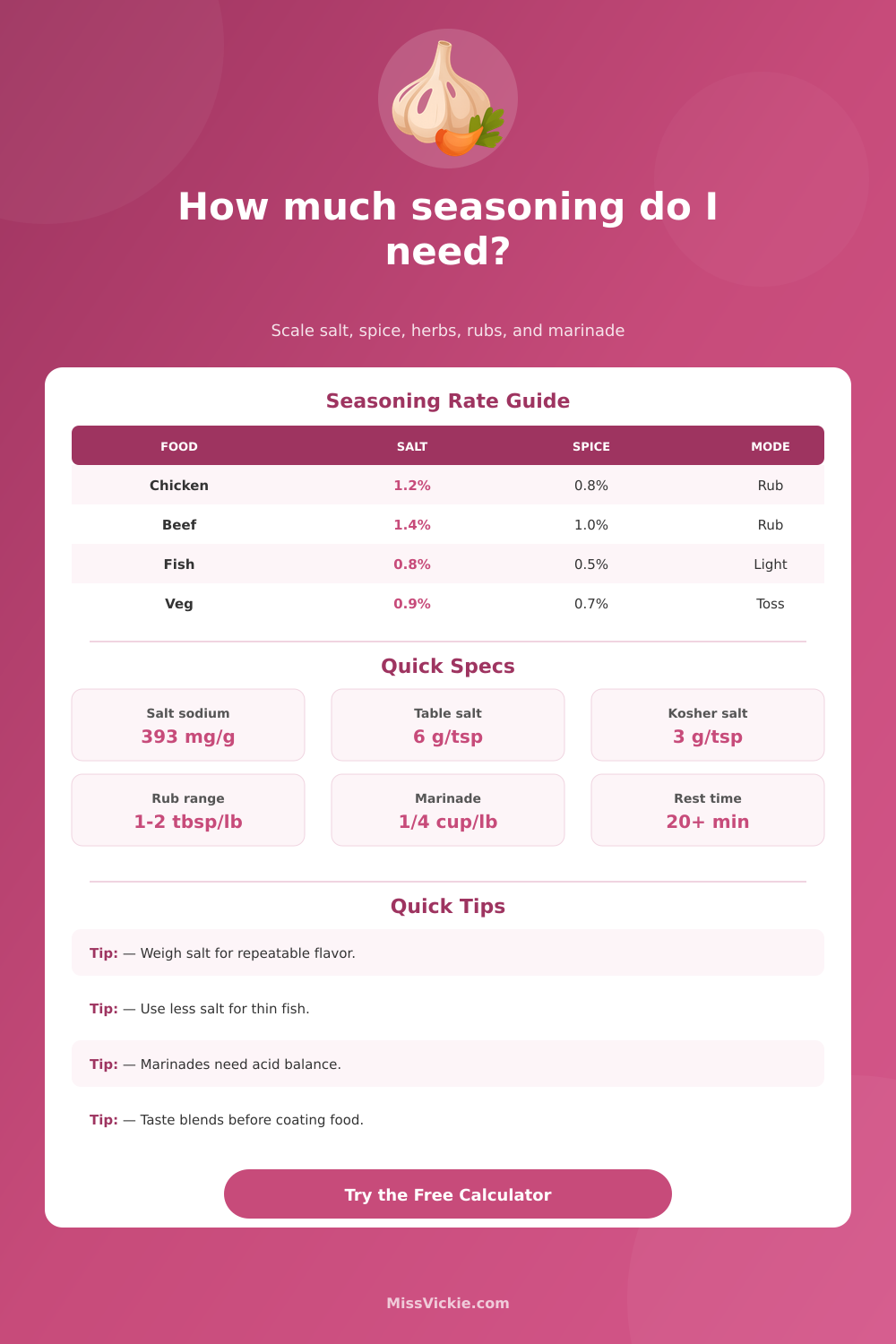
| Chicken pieces | 0.9% | 1.2% | 1.5% | 6 to 8 oz raw |
| Beef steak or roast | 1.0% | 1.4% | 1.8% | 6 to 10 oz raw |
| Pork shoulder or chops | 1.0% | 1.3% | 1.7% | 6 to 8 oz raw |
| Fish fillets | 0.5% | 0.8% | 1.1% | 5 to 7 oz raw |
| Vegetables | 0.5% | 0.9% | 1.2% | 4 to 6 oz raw |
| Cuisine style | Spice rate | Herb share | Sweet share | Flavor note |
|---|---|---|---|---|
| Sweet BBQ | 0.85% | 18% | 0.60% | Paprika, garlic, onion, pepper |
| Tex-Mex taco | 0.95% | 12% | 0.10% | Cumin, chile, oregano |
| Italian herb | 0.70% | 55% | 0.00% | Basil, oregano, parsley |
| Mediterranean | 0.65% | 48% | 0.00% | Oregano, lemon, garlic |
| Cajun blackening | 1.15% | 18% | 0.10% | Paprika, thyme, pepper, cayenne |
| Mode | Dry seasoning | Oil or liquid | Best contact time | Use case |
|---|---|---|---|---|
| Dry rub | Full salt and spice | None | 20 minutes to overnight | Grilling, roasting, smoking |
| Wet rub or paste | Full salt, slightly less spice | Oil or puree binder | 20 minutes to 4 hours | Chicken, pork, vegetables |
| Marinade | Reduced salt concentration | Liquid plus acid | 30 minutes to overnight | Tofu, chicken, beef, seafood |
| Finishing sprinkle | Small amount added last | None | At serving | Fries, popcorn, roasted veg |
| Batch size | Chicken at 1.2% | Beef at 1.4% | Fish at 0.8% | Vegetables at 0.9% |
|---|---|---|---|---|
| 1 lb / 454 g | 5.4 g salt | 6.4 g salt | 3.6 g salt | 4.1 g salt |
| 3 lb / 1.36 kg | 16 g salt | 19 g salt | 11 g salt | 12 g salt |
| 5 lb / 2.27 kg | 27 g salt | 32 g salt | 18 g salt | 20 g salt |
| 10 lb / 4.54 kg | 54 g salt | 64 g salt | 36 g salt | 41 g salt |
Seasoning large batch of food requires an understanding of the relationship between seasoning weight and food weight. While it is possible to achieve a balanced flavor in the food by calculating the amount of seasoning to use based on the weight of the food to be seasoned, it is also possible to create a dish that is too salty if that calculated ratio of seasoning to food is not applied. Beyond determining how much seasoning to use, seasoning also involve understanding the mathematical proportion of that seasoning to the raw weight of the food to be seasoned.
The primary principle of seasoning is that ingredient like salt, herbs, spices, sugar, oil, and acid should be applied to the food in proportion to its raw weight. The proportion of each of these ingredients can help to determine both how the flavor will distribute throughout the food (evenly or on the surface), and also how much sodium will be introduced into the food prior to cook. Each of these factors can be calculated using the seasoning calculator by entering the weight of the food to be seasoned, and choosing the type of seasoning recipe and mode in which it will be applied to the food.
How to Season Large Batches of Food
Not all food products require the same level of seasoning as other food products. For instance, chicken features a neutral flavor, yet has a relatively moderate amount of surface area; thus, it can handle relatively high percentage of salt. Beef, however, has a relatively high amount of fat and protein content; the fat content allows the beef to be seasoned with high amounts of salt.
Fish, in contrast, contain proteins that are relatively delicate to salt seasoning, so the salt rate for fish products will be lower then that for chicken or beef products. The cuisine to which the food will be prepared also indicate the amount of seasoning for which it should be prepared. For instance, barbecue rubs contain high amounts of sugar and salt, while herbs used in Mediterranean cuisine contain different amounts of sugar, herbs, and acid.
Using a barbecue rub on vegetables will create an overly salty flavor in comparison to using a light herb seasoning on a thick piece of steak. An understanding of each of these recipes allow the seasoning calculator to adjust the recipe of the seasoning based off the cuisine that the food will feature, and through the adjustment of a slider to make the seasoning bolder or more restrained. The mode in which the seasoning will be applied to the food also affects the amount of seasoning for which the food should be prepared.
For instance, dry rubs are seasoning ingredients that are applied to the surface of the food; such dry rubs requires time to allow the seasoning to draw moisture from the food. Marinades are liquid seasonings that draw flavor into the food through the liquid. Consequently, the concentration of salt in the marinade should be lower than in the dry rub seasoning to avoid curing the food prior to cooking.
The seasoning calculator allows for the salt and spice factors to be adjusted according to the mode in which the seasoning will be applied to the food. Another factor that should be considered in the seasoning of food is the salty sauce credit. Many recipes include ingredients that contain salt, such as soy sauce or butter.
If salt is added to the food through both the seasoning rub and additional salty sauce, the food will contain too much salt. To account for this, the salty sauce credit reduces the amount of salt that must be added to the food according to the sodium content of other ingredients in the recipe. Each of the seasoning calculators will provide two different type of information.
Each of the recipes will include the total weight of seasoning that should be applied to the food of a certain weight, and the amount of sodium that will be provided to each portion of the food that is served. The total seasoning weight is useful for understanding the logistics of mixing the seasoning for the food that will be prepared. The sodium estimate per serving is useful for understanding the nutritional content of that food product.
While the seasoning calculator can provide the best estimate as to the amount of seasoning that should be applied to food, there are often other variables in the kitchen that the calculator cannot account for. For instance, the thickness of the food, the amount of moisture that remains on the surface of the food, and the temperature of the oven will affect the flavor of the seasoned food. Seasoning that may taste good to the chef when the food is cold may taste different when it has rested.
Thus, while the seasoning calculator can provide an excellent starting point for seasoning food, it should of not be the “final decree” as to the amount of seasoning to be used. The batch size for which the seasoning is prepared also has an effect upon the amount of seasoning to apply to the food. For instance, if the food will feed two people, there is a small range of error in adding the seasoning.
However, if the food will be prepared for twenty people, the deviation from the seasoning amount will be larger. It is best to weigh the amount of seasoning in grams rather than by measuring spoons. The seasoning calculator make adjustments for this by providing the amount of seasoning in grams.
Finally, the seasoning calculator can be of particular use for preparing food for large batches, or when a chef must be particularly consistent in the flavoring of the food. If the same food is prepared in the same manner repeatedly, it is possible that the chef does not require a calculator to determine the amount of seasoning to use. However, if the chef prepares different protein or cuisines, the seasoning calculator can remove any guesswork as to how much of each seasoning ingredient should be applied.
With repetition in using the calculator, the chef will begin to understand which seasonings work best with which type of food. Mastering these seasonings and their effect upon food will allow the chef to better apply them as seasoning ingredients. However, no calculator can replace the chefs knowledge of how to taste the food prior to cooking to make certain that the seasoning is balanced to taste.