
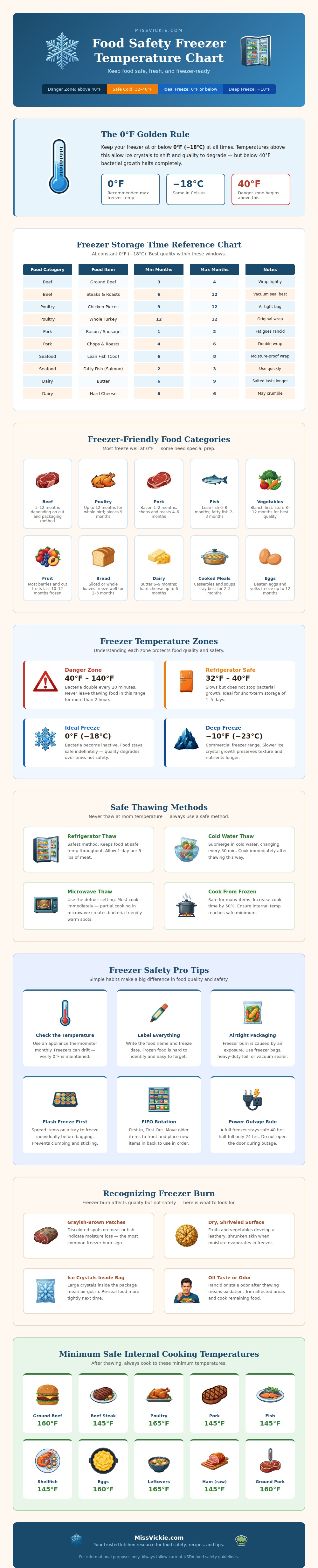
And then there’s this: You’re staring into your freezer. There’s a bag of chicken inside. You don’t recall purchasing it, and when you touch it, it feels frozen, safe? But is food in your freezer safe if it’s merely frozen? Actualy, it’s technically safe indefinitely as long as the temperature stay below zero.
Does it matter if the temperature is right? Because here’s what will happen if your freezer is hovering above zero degrees Fahrenheit: Ice crystals will move around and expand until they destroy food’s texture, long before bacterial growth become an issue. Staying below zero; or even at zero (is key to maintaining quality). As you can see on the chart, various foods fare different than with prolonged freezing. If it’s at or below zero degrees, then the food will be technically fine forever; however, that’s not really what we’re concerned about here. We want to know how long it will retain its quality.
Tips for Freezing Food Safely
In general, fatty items won’t keep as well as lean meat because they tend to spoil. Whole turkeys lasts longer (12 mo) than ground beef (3-4mo). This has more to do with fat content and surface area. A steak sealed in a vacuum bag last significantly longer than bacon. Bacon doesn’t last as long.
The freezer is not a time capsule. Things don’t just stand still in there for eternity. Chemical reactions still occurs, even if slowly. Even enzymes are slowed, though not stopped completely.
You’ll have no idea what’s in there if you don’t label everything with the date. Annoying? Yes. Saves you from chowing down on mystery freezer-burnt nuggets six months from now? Also yes. Use first-in-first-out by pushing new items to the back and pulling out old ones that need to be used up first. It’s inventory management for your kitchen. It works.
And then there’s that thaw. That’s where most accident occur. Never thaw meat out on counter. Bacteria doubles every twenty minutes between forty and one hundred forty degrees Fahrenheit. In a hurry? Submerge (sealed) in cold water and replace every half hour. Otherwise, use your microwave defrost setting and cook right away. Letting something sit in those warm spots that microwaves create is just an invitation to trouble.
To stay safe, always thaw food in the fridge. It is slower, typically taking twenty four hours per five pounds of meat, but everything stay safely in that less than forty degree cold range.
A common misconception: Freezer burn isn’t actualy spoilage; rather, it’s a grayish discoloration of food that occurs when moisture has evaporated and been replaced by air. It looks gross, tastes dry, but doesn’t pose any safety risk. Just cut away the affected areas and cook the rest, no problem.
Avoid freezer burn by removing as much air as possible from whatever you’re putting into your freezer. Freezer-grade bags or heavy-duty foil are superior options to regular ol’ sandwich bag. Also helpful: Flash freeze items on a tray before bagging them so that each portion can be scooped out individually (and also so they don’t clump together).
It’s easy to panic when the lights go out. Unless you open the door, your full freezer can last up to forty-eight hours. Your half-full freezer? Just twenty-four. Avoid opening the door. The cold air stays trapped in your freezer better than any amount of ice packs could.
How do you store cooked leftovers? One-hundred sixty-five degrees Fahrenheit on the inside should of been enough to kill any remaining germs. This is a small step, but it’ll put your mind at ease. But really, food safety isn’t so much about memorizing charts as it’s about developing good habits. Put a label on those bag. Rotate what’s inside. Check your appliance thermometer monthly; make sure it hasn’t slowly crept up over time. Thaw it properly in the fridge. Little things like these accumulate into a freezer where all that’s been preserved is the value of your food, not just food itself. And when you do get around to pulling out that bag of chicken, you’ll have no idea when it was put away or if it’s even worth eating anymore. It’s worth every moment of effort to keep things cold and organized for that reason alone.