🌡️ Food Dehydrator Calculator
Find the perfect drying time and temperature for any food — fruits, veggies, meats, herbs, and more
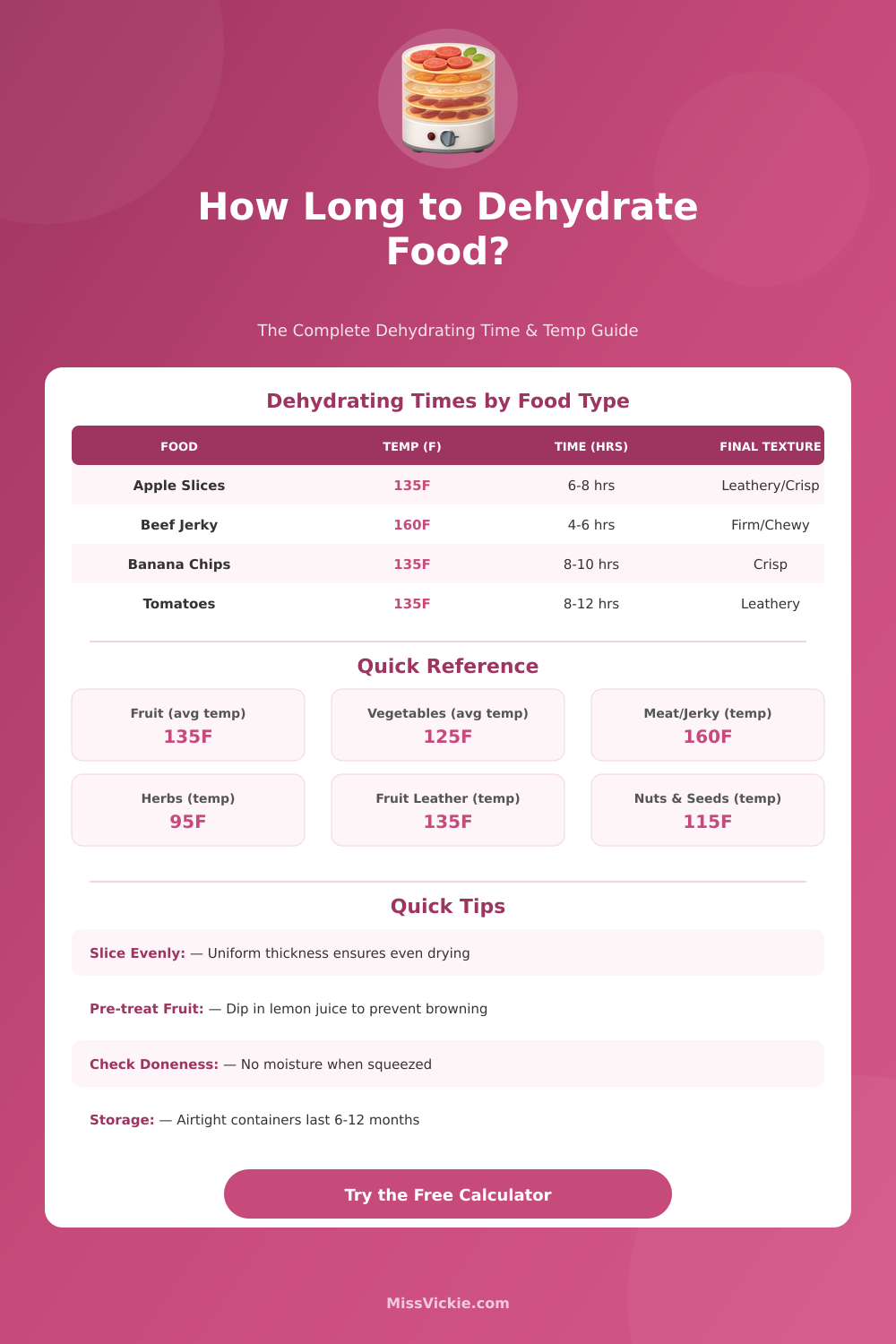
| Food Item | Temp (°F) | Time (hrs) | Thickness | Finished Texture |
|---|---|---|---|---|
| Apple Slices | 135 | 6–8 | 1/4 inch | Leathery to crisp |
| Banana Chips | 135 | 8–10 | 1/4 inch | Crisp |
| Strawberries | 135 | 8–10 | Halved | Leathery |
| Mango | 135 | 6–8 | 1/4 inch | Leathery |
| Pineapple | 135 | 10–14 | 1/4 inch | Leathery |
| Peaches | 135 | 8–16 | 1/2 inch | Leathery |
| Tomatoes | 135 | 8–12 | 1/4 inch | Leathery |
| Zucchini | 125 | 6–9 | 1/4 inch | Crisp |
| Bell Peppers | 125 | 5–8 | 1/4 inch | Leathery |
| Mushrooms | 125 | 4–8 | Sliced | Crisp |
| Onions | 125 | 3–9 | 3/8 inch | Crisp |
| Carrots | 125 | 6–10 | 1/8 inch | Leathery |
| Beef Jerky | 160 | 4–6 | 1/4 inch | Firm & chewy |
| Chicken Jerky | 160 | 4–6 | 1/4 inch | Firm & chewy |
| Fish / Salmon | 145 | 8–12 | 1/4 inch | Firm |
| Basil / Oregano | 95 | 1–2 | Whole leaf | Crumbly |
| Rosemary / Thyme | 95 | 2–4 | Whole sprig | Crumbly |
| Almonds / Walnuts | 115 | 6–10 | Whole | Crisp |
| Food Type | °F | °C | Notes |
|---|---|---|---|
| Herbs & Spices | 95°F | 35°C | Low & slow to preserve oils |
| Nuts & Seeds | 115°F | 46°C | Preserves enzymes |
| Vegetables | 125°F | 52°C | Blanch first for best results |
| Fruits | 135°F | 57°C | Pre-treat to prevent browning |
| Fish / Seafood | 145°F | 63°C | USDA safe minimum |
| Meat / Jerky | 160°F | 71°C | USDA safe for ground meat |
A food dehydrator is a compact electrical device that helps to dry foods inside. It has a heating element, vents and fans to move the air. The newest models of food dehydrators work as low-power convection ovens that remove the water from foods by means of warm air flow.
Usually foods have a lot of water commonly between 80 and 95 percent for fruits and vegetables, while other products like meat hold 50 to 75 percent.
What a Food Dehydrator Does and How to Choose One
A food dehydrator removes the moisture from food, which stops the growth of bacteria, mites and molds. No need to add preservatives, and the method naturally extends the life of food. Like this one can save money over long time.
Dried fruits and vegetables cost more than preparing them at home, and drying gives bettre control over food waste.
All food dehydrators rely on stackable plates, so the skill is rated by the surface of one plate, multiplied by the whole amount of plates. Juicy fruit requires more time for drying than meat or vegetables, so it is better to dry one big batch instead of several small loads over sum days with a machine of little skill. When choosing a food dehydrator, the power in watts matters.
Low power uses fewer energy, but heats more slowly. Models with higher power reach the heat quickly and work faster, even though they are more expensive to buy and use. Also the size plays a role; choose a food dehydrator that fits the available space.
A good food dehydrator keeps stable heat and cleans without trouble. The Magic Mill is easy to use, even without prior knowledge. It comes with stainless steel plates, a warm range of 95 to 176 degrees Fahrenheit and an optional ten-heat setting.
The most silent food dehydrator is the Samson Silent 6-Tray.
The Cosori Stainless Steel food dehydrator works well for beginners. It is easy to use and gives stable results. The net-shaped structure of plates together with the rear fan helps equal drying.
On the other hand, it is heavy and costly, and one can not change time or heat after starting a cycle. The Nesco FD-1018 Gardenmaster forms another solid option. Some models of Nesco extend to 30 plates.
There are also small models, ideal for tiny kitchens and few servings. One of them has seven plates, that stack for drying and storage. Flipping them, one can stack even more tightly.
Plates and lids are made from clear plastic, which allows you to check the food from above. The seen color through the sides points where thedrying stands.
Homemade garlic powder from a food dehydrator has much more flavor than that from a store. The same goes for ginger powder. Dried carrots and onions work well for fast soup making.
Dried angel hair pasta in cookies turns into crisp, bright biscuits. A food dehydrator works to create fruit leather, beef jerky, dried herbs and even dog treats.