🎂 Fondant Coverage Calculator
Estimate rolled fondant weight from cake geometry, tier count, rolling thickness, and trim loss so every tier has enough cover before you start smoothing.
Load a common cake, then adjust the measurements to match the frosted cake you will actually cover.
Coverage Breakdown
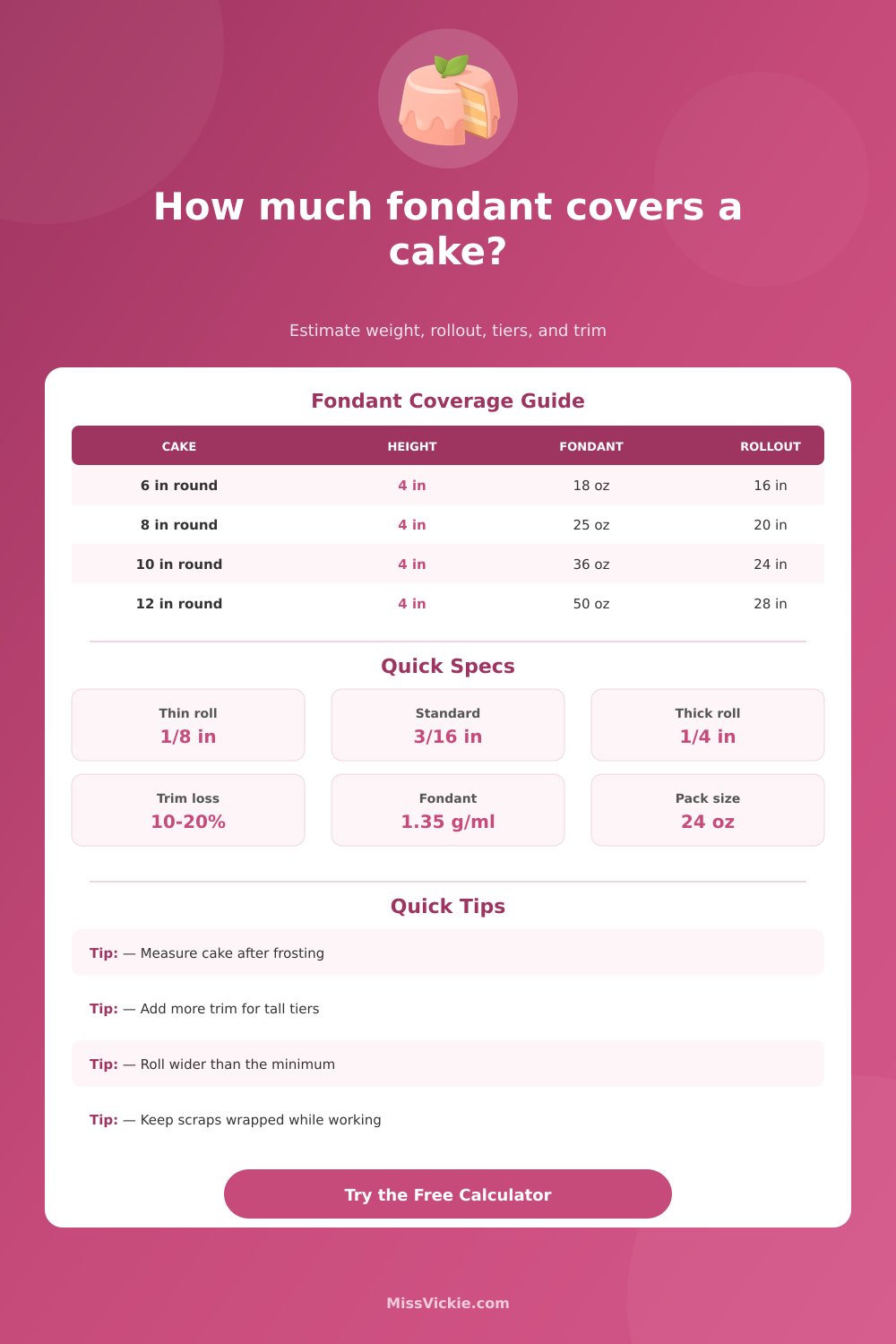
| Cake size | Base surface area | Standard fondant | With 15% trim |
|---|---|---|---|
| 6" round, 4" tall | 104 sq in | 16 oz / 455 g | 18 oz / 523 g |
| 8" round, 4" tall | 151 sq in | 22 oz / 624 g | 25 oz / 718 g |
| 10" round, 4" tall | 204 sq in | 31 oz / 865 g | 36 oz / 995 g |
| 12" round, 4" tall | 264 sq in | 44 oz / 1246 g | 50 oz / 1433 g |
| 8" square, 4" tall | 192 sq in | 28 oz / 796 g | 32 oz / 915 g |
| 9×13 sheet, 2" tall | 205 sq in | 20 oz / 565 g | 23 oz / 650 g |
| Shape | Coverage logic | Rollout minimum | Best trim loss |
|---|---|---|---|
| Round | Top circle plus side circumference times height | Diameter + 2 heights + overhang | 10-15% |
| Square | Top square plus four equal sides | Corner-to-corner plus drop allowance | 15-20% |
| Rectangle | Top rectangle plus perimeter times height | Length and width plus two heights | 12-18% |
| Oval | Ellipse top plus oval perimeter sides | Major and minor widths plus drop | 15-20% |
| Heart | Heart area factor plus curved side perimeter | Widest point plus two heights | 18-25% |
| Planning choice | Multiplier | Use when | Watch point |
|---|---|---|---|
| Thin 1/8" / 3 mm | 0.67× standard | Simple smooth cakes and experienced rolling | Tears more easily on tall sides |
| Standard 3/16" / 5 mm | 1.00× standard | Most birthday, party, and tiered cakes | Keep the sheet evenly rolled |
| Thick 1/4" / 6 mm | 1.33× standard | Sharp edges, textured mats, carved cakes | Can look heavy on small cakes |
| Two tiers | Add each tier | 6" + 8" cakes or small weddings | Cover tiers separately before stacking |
| Three tiers | Add each tier | 6" + 8" + 10" stacked cakes | Increase trim if tiers are very tall |
Calculating the correct amounts of fondant is an necessary step in decorating cakes. Calculating the correct amount of fondant will ensure that you dont run out of fondant while you are frosting your cake. Many people has been frustrated when they have discovered that they ran out of fondant while frosting their cakes.
A cake coverage calculator will help to determine how much fondant are needed for a cake. There are several different variable that a cake coverage calculator takes into account when estimating the amount of fondant that a cake will need. These variables include the surface area of the cake, the thickness of the fondant roll, and the amount of trim loss that will occur while rolling the fondant.
How Much Fondant Do You Need for a Cake
The surface area of the cake require that the decorator measures the cake to determine both the top and side surface area. The top area of a round cake will be a circle, but the side area will be a rectangle. The corners of a square and rectangular cake will increase the total surface area that needs to be frosted.
Additionally, because of these corners, the fondant is more likely to tear when frosted. Cake shapes with curved edge, such as hearts and ovals, are easier to frost, though they must also be measured to determine their total surface area. After measuring the cake, once the crumb coat has set, the cake coverage calculator will convert the dimensions to either square inches or centimeters.
The thickness of the fondant roll will impact the amount of fondant that is needed as well as the flexibility of the fondant itself. Thin rolls of fondant will use less of the fondant, but may tear when frosting a cake. Thick rolls of fondant will be easier to work with and allow for more texture on the fondant roll, but will add more weight to the cake.
A cake coverage calculator will allow the decorator to change the thickness of the fondant roll to calculate the impact that different thicknesses will have on the total amounts of fondant needed for the cake. For cakes that have several tier, each of those tiers will have a different amount of fondant needed based off the size of each tier. Each of these different sizes will have the same height for each tier, but will require an individual calculation of the amount of fondant needed for each tier of the cake.
For cakes that are covered with one piece of fondant, the decorator will need to account for the overhang of the fondant for each of the tiers, thus leading to an increase in the amount of trim loss for the fondant roll. Trim loss is another variable that must be accounted for when frosting a cake. Fondant will be lost when trimming the overhang of the fondant roll.
Additionally, fondant may lose some of it’s thickness when applying it to the cake. The more complex the cake or the taller its tiers are, the more trim loss that will be required. The cake coverage calculator will add a percentage of trim loss to the total area of the cake.
Another factor to consider is the density of the fondant. Depending upon the brand of fondant that is purchased, the density may differ. This impacts how much of the fondant will cover the cakes surface area.
Additionally, the calculator will convert the weight of the fondant to the number of package of fondant needed. The decorator can decide whether they will purchase one large package of fondant or several smaller packages of fondant. The cake must be measured once it has been filled with cake filling and the crumb coat applied.
The crumb coat will make the cake wider in diameter; thus, adding to the total surface area that needs to be frosted. If the cake has a domed top, that additional area must be accounted for in the measurement of the cake. The humidity in the room and the temperature of the cake will also impact the behavior of the fondant.
Finally, the calculator will round the amount of fondant needed to the nearest package size to allow for any unexpected fondant loss or frosting adjustment.