How Much Fondant To Cover a Cake?
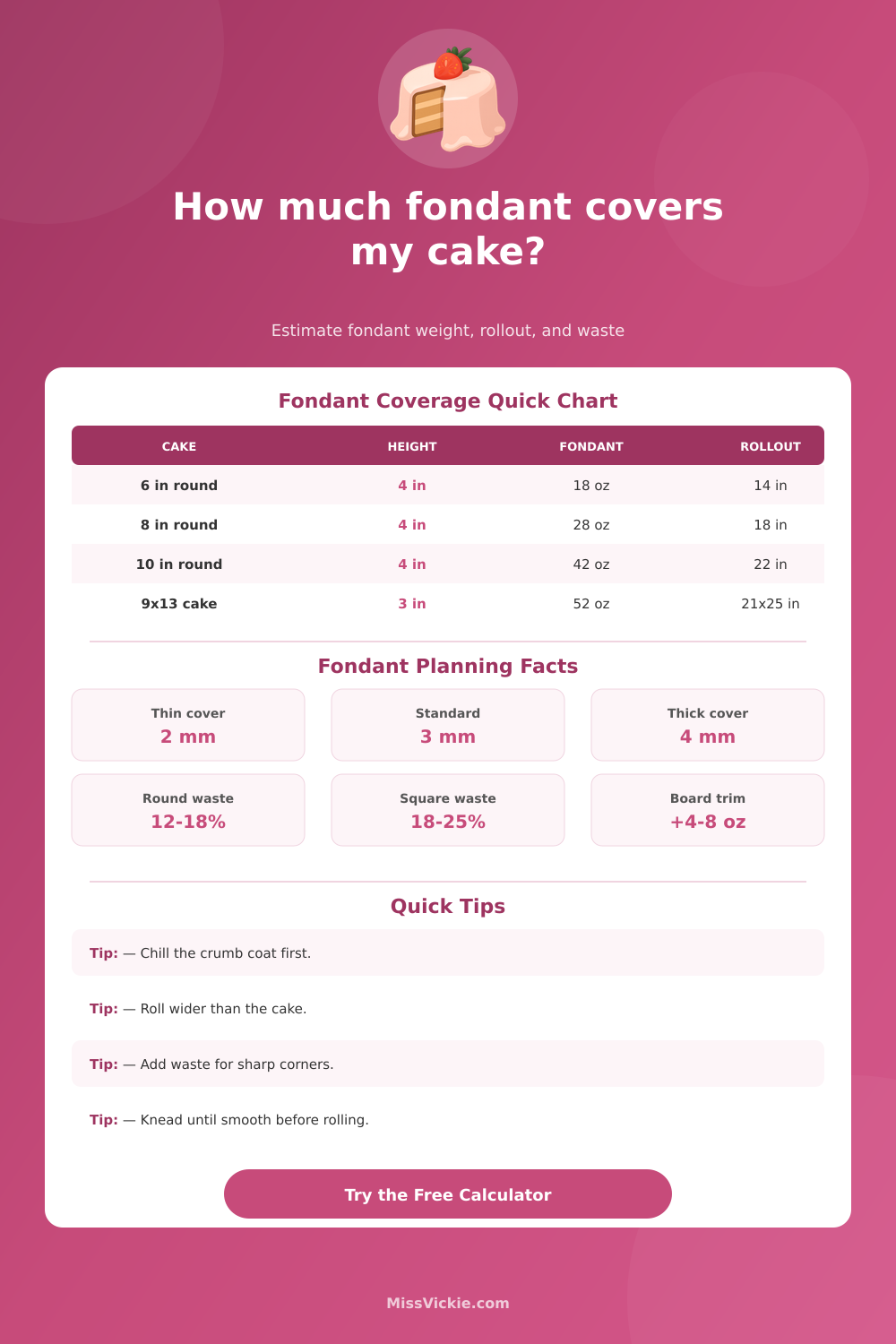
Estimate fondant by cake shape, diameter or pan size, height, tiers, rollout thickness, covered cake boards, finish style, and trimming waste.
Choose a real decorating scenario, then adjust the size, finish, and waste settings for your cake.
Fondant Calculation Breakdown
| Cake Size | Height | Standard Fondant | Rollout Target |
|---|---|---|---|
| 6 inch round | 4 inch | 18 to 22 oz | 14 to 15 inch circle |
| 8 inch round | 4 inch | 26 to 32 oz | 18 to 19 inch circle |
| 10 inch round | 4 inch | 40 to 48 oz | 22 to 23 inch circle |
| 12 inch round | 4 inch | 58 to 70 oz | 26 to 27 inch circle |
| 8 inch square | 4 inch | 34 to 42 oz | 19 inch square |
| Thickness | Best Use | Weight Effect | Watch Point |
|---|---|---|---|
| 2 mm | Experienced smooth cakes | About 33% lighter | Tears more easily |
| 3 mm | Most covered cakes | Baseline estimate | Needs even rolling |
| 4 mm | Beginners and texture mats | About 33% heavier | Can look bulky |
| 5 mm | Carved or display cakes | About 67% heavier | May slump on soft icing |
| Shape | Area Formula Used | Rollout Rule | Waste Risk |
|---|---|---|---|
| Round cake | Top circle plus side band | Diameter plus two heights | Low to medium |
| Square cake | Top square plus four sides | Side plus two heights | Medium at corners |
| Rectangle cake | Top rectangle plus side bands | Length and width plus heights | Medium to high |
| Tall barrel cake | Same shape with taller sides | Needs wider sheet | High if thin |
| Fondant Type | Calculator Factor | Texture | Best Use |
|---|---|---|---|
| Standard rolled fondant | 1.00x | Balanced stretch | Most cakes |
| Marshmallow fondant | 1.05x | Softer and stretchy | Home cakes |
| Modeling blend | 1.08x | Firm and shaped | Sharp edges |
| White chocolate fondant | 1.10x | Dense and rich | Cool rooms |
| Vegan fondant | 1.03x | Varies by brand | Diet-specific cakes |
| Gum paste blend | 0.96x | Firm, rolls thinner | Panels and accents |
Round cakes waste less because the sheet drapes evenly and trimming is predictable.
Sharp edges need a little more fondant so corners can be worked without pulling thin.
Square and rectangular cakes need extra allowance for pleats, corners, and trimming.
Calculate each different tier separately, then add totals for a cleaner shopping amount.
Calculating the correct amount of fondants before beginning to roll the fondant is a necessary step in the frosting process, as the amount of fondant that is used will determine the way that the fondant will appear when apply to the cake. Using too little fondant will require the decorator to stretch the fondant to the edges of the cake; excessive stretching of the fondant can lead to the fondant tearing. Using too much fondant will create excess fondant that isnt need to cover the cake.
To determine the amount of fondant that is needed, the decorator must measure the cake and decide the thickness of the fondant layer that will cover the cake. One of the factor that will impact the amount of fondant that is needed is the shape of the cake. Round cakes have smooth sides that allow the fondant to evenly cover the cake; the round shape of the cake allows even rolling of the fondant to the edges of the cake.
How Much Fondant Do You Need for a Cake
Squares and rectangles, however, have right angles on the cakes, which can cause the fondant to pull in two different direction on the cakes; these corners will require more fondant to roll to each side of the cake. The calculator for determining the amount of fondant allow for the dimensions of the cake (and its shape) to be entered; the program accounts for the extra fondant that will be required for these corner of cakes. The height of the cake is another factor; the higher the cake, the more fondant will cover the cake.
A tall cake will require more fondant than a short cake. Additionally, if the cake has carved sides, the fondant will have to cover those carved side. A style selection for the fondant allows the decorator to increase the amount of fondant that will be rolled for these instances of uneven cakes; the software accounts for these additional area to be covered.
The thickness of the fondant is another factor that many new decorator may not consider. A two-millimeter thick sheet of fondant is thin, but may require the decorator to push the fondant more easily to cover the cake; it will be less forgiving of any texture on the cake. A four-millimeter fondant sheet is more forgiving for beginners, but will add more weight to the cake.
Additionally, a four-millimeter sheet may appear bulky on small cakes. The calculator allows for the decorator to choose the thickness of fondant; the calculation will adjust for the thickness of the fondant. The type of fondant that is to be used can also impact the amount of fondant that will be needed.
Standard rolled fondant is the most common type of fondant. Marshmallow fondant is softer than standard rolled fondant; it may require more fondant to allow for it to hold its shape when being place onto the cake. Modeling blends contain gum paste, which is firmer than fondant; this type of fondant is helpful for creating fondant decorations with defined edges.
However, the extra firmness of the modeling blend may require more fondant to roll to avoid having thin spots in the fondant. These types of fondants are accounted for in the calculator. Additional factors to consider include the amount of fondant needed to cover the cake board and any decoration for the cake.
Fondant will be needed to cover the cake board; this will add several ounce of fondant that are not part of the cake. Additionally, decorations for the cake may include additional ounces of fondant. These allowances for decorations are accounted for separately from the allowances for the cake; this allows the decorator to view the amount of fondant needed for the cake alone and the amount needed for decorations alone.
The amount of waste that will be expected in rolling the fondant is another variable. Ten percent is a relatively low allowance for waste in rolling fondant; it may not provide enough room for the fondant to lie flat on the corners of cakes. Twenty-two percent provides more allowance for re-rolling portions of fondant that may have been torn; it accounts for additional practice with rolling fondant.
The percentage of waste allowed is an adjustment that should reflect the comfort level that the decorator have rolling fondant. Additional steps that should be taken before rolling the fondant include chilling the crumb-coated cake until the surface is firm, rolling the fondant to slightly larger sizes than the calculated size for the cake, and ensuring that the fondant is lightly dusted after it is rolled. By rolling the fondant to slightly larger sizes than the calculated size, it will allow for the air pockets in the fondant to be smoothed downward, which will prevent the decorator from having to stretch the fondant sideways along the cake.
Additionally, lifting the fondant with a rolling pin will ensure that the fondant does not stretch in an even manner prior to the fondants contact with the cake. The amount of fondant that each decorator use can be different than others; each decorator may have different personal standards for the thickness of the fondant or the amount of waste that is to be created when rolling the fondant. Thus, while the calculator provides the decorator with a starting point for the amount of fondant to use, the personal style and skill of the decorator will still impact the amount of fondant that is used.
By calculating the amount of fondant that will be needed for a cake before beginning to roll the fondant, the decorator treats the fondant as a resource that is to be obtained and used in the decorating process.