
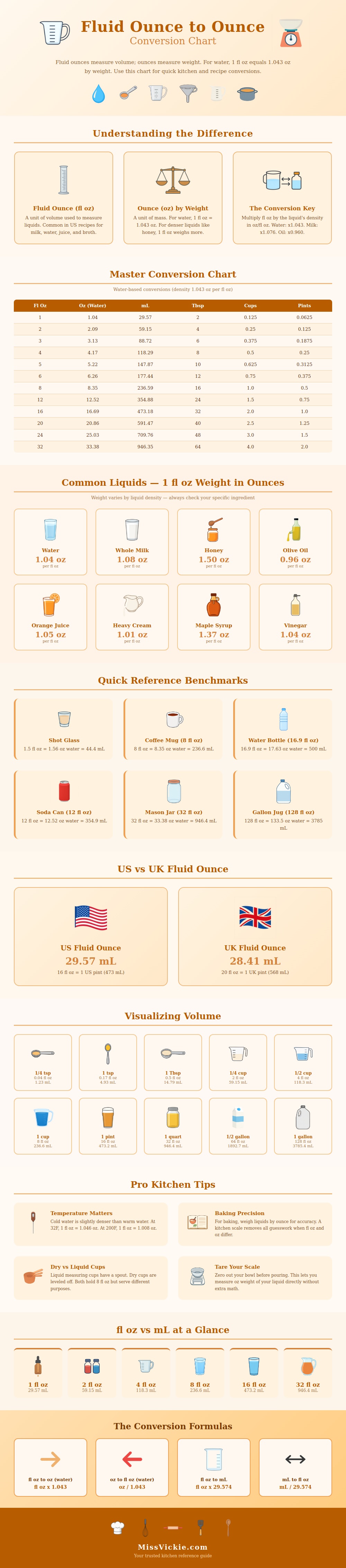
A fluid ounce and an standard ounce are two different units of measurement, and a fluid ounce and a standard ounce must not be used interchangeably if you want to achieve accuracy in cooking. A fluid ounce is a measure of volume, and a measure of volume describe the amount of physical space that a substance occupy within a container. A standard ounce is a measure of weight, and a measure of weight describes the mass of a substance when a person places a substance on a scale.
Many people assumes that fluid ounce and weight ounce are the same thing, but fluid ounces and weight ounces are not the same thing because the density of a substance affects how much a substance weigh. Density are the reason why volume and weight is different, and density is defined as how tightly the molecules of a substance are pack together. For example, two substance may occupy the same amount of space, but one substance may have more higher density than the other substance.
Fluid Ounces and Ounces by Weight
If a substance has a high density, then the same volume of that substance will weigh more than a volume of a substance with a low density. Water is a baseline for these measurement, and one fluid ounce of water weigh approximately one ounce of weight. However, honey has a higher density than water, so one fluid ounce of honey will weigh more then one ounce of weight.
Additionally, olive oil has a lower density than water, so one fluid ounce of olive oil will weigh less then one ounce of weight. You should use a scale if a recipe require a measurement of weight, because a scale provides more precision than a measuring cup. A measuring cup measure volume, but a scale measures mass.
Using a scale is more accurately because a scale removes the errors that occur when you try to read a measuring cup at eye level. To use a scale accurately, you must tare the scale, and taring the scale mean you must zero out the weight of a container so that you only measure the weight of the liquid. Using a scale is a reliable method, and using a scale is a precisely method.
You must also be aware that fluid ounce can vary based on international standards, because the US fluid ounce and the UK fluid ounce are not the same volume. A British fluid ounce is slightly smaller than a US fluid ounce, and these difference in volume can cause error if you are using a recipe from a different country. Furthermore, you must recognize that different type of measuring tools serve different purpose.
Liquid measuring cup are designed for volume and usually have a spout, but you design dry measuring cups to be leveled off with a flat edge. You should not use a dry measuring cup for a liquid because a dry measuring cup do not allow you to fill the container to the brim without spilling the liquid. Temperature also affect the measurement of liquids, because liquids expand and contract based on they temperature.
When a liquid is cold, the liquid is more compact, and when a liquid is compact, the liquid is slightly heavier than warm liquid. Because temperature change the density of a liquid, temperature can change the weight of a liquid. For example, professional baker often use chilled liquids because chilled liquids help to maintain consistency in a recipe.
Understanding the difference between volume and weight, understanding the role of density, and understanding the impact of temperature will help you to follow a recipe with accuracy.