🍞 Flour conversion planning
Flour Converter
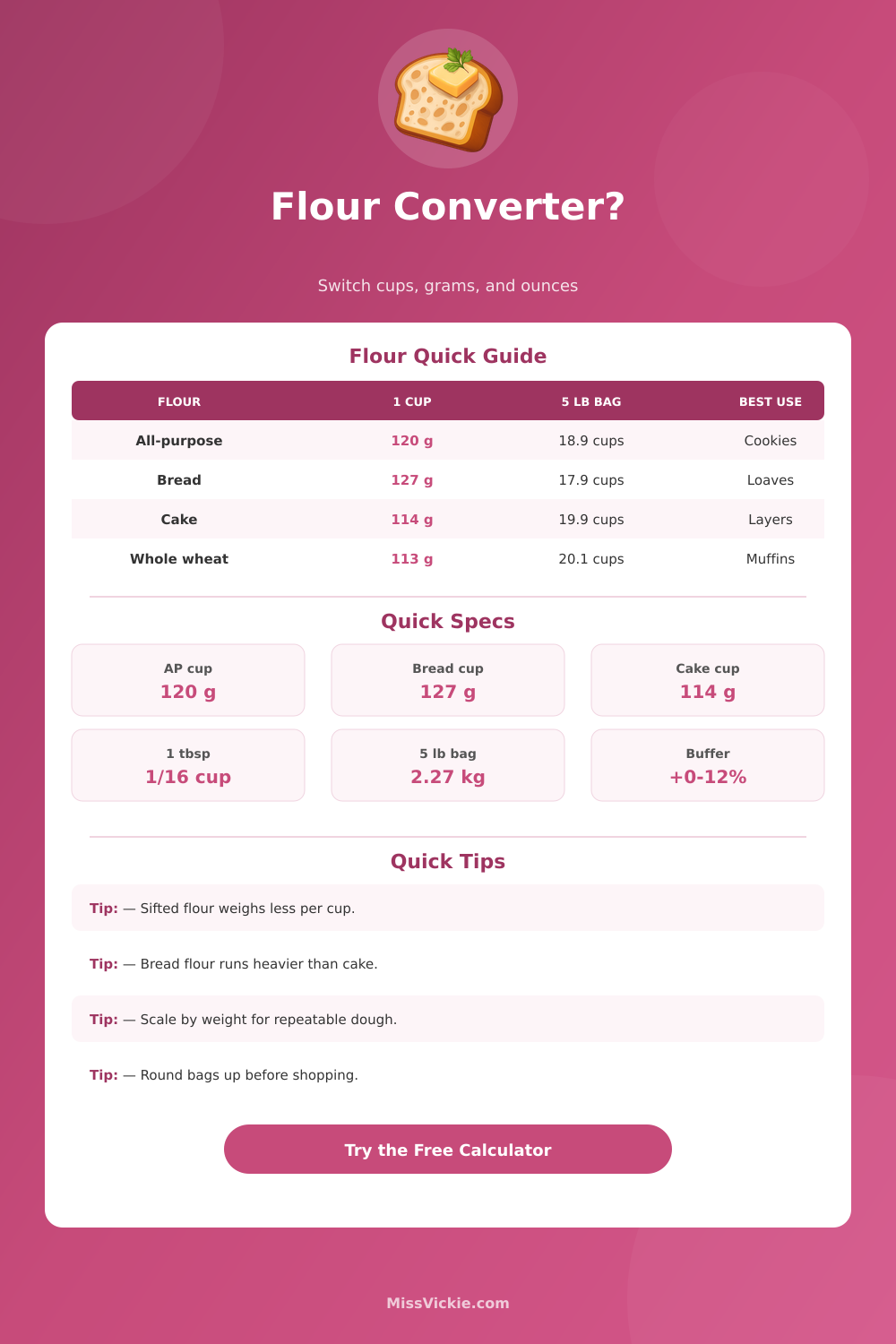
Convert flour between cups, grams, ounces, pounds, tablespoons, and teaspoons by flour type, measuring method, recipe scale, and shopping bag size.
Use weight whenever possible for repeatable baking. Cup conversions still help with older family recipes, scaled doughs, and quick bag planning.
The same total weight lands differently across flour styles. Use this grid to see how your current amount compares with common reference flours.
--
Equivalent cups at 120 g per cup.
Equivalent cups at 127 g per cup.
Equivalent cups at 114 g per cup.
| Flour Type | Grams Per Cup | Ounces Per Cup | Typical Use |
|---|---|---|---|
| All-purpose | 120 g | 4.23 oz | Cookies, biscuits, quick breads |
| Bread flour | 127 g | 4.48 oz | Sandwich loaves, pizza, chewy dough |
| Cake flour | 114 g | 4.02 oz | Layer cakes, tender cupcakes |
| Whole wheat | 113 g | 3.99 oz | Muffins, hearty loaves |
| Self-rising | 120 g | 4.23 oz | Biscuits, simple batters |
| Pastry flour | 106 g | 3.74 oz | Scones, pie dough |
| Rye flour | 102 g | 3.60 oz | Rye breads, crackers |
| Gluten-free blend | 140 g | 4.94 oz | GF cakes, muffins, pancakes |
| Measure | Cup Value | AP Weight | Notes |
|---|---|---|---|
| 1 tablespoon | 1/16 cup | 7.5 g | Useful for starters and roux |
| 1 teaspoon | 1/48 cup | 2.5 g | Best for tiny adjustments |
| 1/4 cup | 0.25 cup | 30 g | Good for half-batch muffins |
| 1/3 cup | 0.33 cup | 40 g | Common in pancake batters |
| 1/2 cup | 0.50 cup | 60 g | Easy mental scale point |
| 1 cup | 1.00 cup | 120 g | Reference for most home recipes |
| Bag Size | AP Cups | Bread Cups | Cake Cups |
|---|---|---|---|
| 2 lb bag | 7.6 cups | 7.1 cups | 8.0 cups |
| 5 lb bag | 18.9 cups | 17.9 cups | 19.9 cups |
| 10 lb bag | 37.8 cups | 35.7 cups | 39.8 cups |
| 25 lb bag | 94.5 cups | 89.3 cups | 99.6 cups |
| Recipe | Typical Flour | Cups | Weight |
|---|---|---|---|
| Chocolate chip cookies | All-purpose | 2.25 cups | 270 g |
| Sandwich loaf | Bread flour | 3.9 cups | 500 g |
| Two-layer cake | Cake flour | 3.0 cups | 342 g |
| Pizza dough for 4 | Bread flour | 4.3 cups | 540 g |
| Banana bread | All-purpose | 2.0 cups | 240 g |
| Pancake batch | All-purpose | 2.5 cups | 300 g |
Flour is one of the primary ingredient that will be used in baking. The amount of flour that is used in a recipe will determine the texture of the baked goods that is created. If too much flour is used in the baked good, it will be tough and dry when tasted.
However, if too little flour are used, the baked good may be thin or soft. The density of the flour change with how the flour is measured and with the type of flour that is used in the recipe. For instance, bread flour is more denser than cake flour because bread flour contains more protein than cake flour.
How to Measure Flour for Baking
Because flour can vary in density, using only volume measurements to measure flour will lead to error in the baking process. Therefore, weight measurements should of be use to ensure that the correct amount of flour is used in each recipe. The method in which flour is measured will impact the weight of the flour that is measured.
If flour scooped from the bag is directly load into a measuring cup, the weight of that flour will be heavier than if the flour is spooned into the measuring cup. Packed flour will have a higher weight than flour that is aerated by spooning it into a cup. Additionally, if the flour is sifted prior to measuring, the flour will be aerated, and will therefore have a lower weight than flour that is not sifted.
Because each of these methods will produce a different weight of flour, it is essential that each method are utilized consistently in each recipe to ensure that the recipe work as written. Different types of flour will have different weight and protein levels. Bread flour has a higher protein level than other types of flour, which allow it to create gluten for baked goods like bread.
Cake flour has a lower protein level, which result in a tender texture in baked goods like cakes. All-purpose flour is a type of flour that can be use in many different type of baked goods. When one type of flour is substituted for another in a recipe, adjustments need to be made to the recipe to account for the difference between the densities and protein levels of each type of flour.
For instance, if all-purpose flour is used in place of cake flour, adjustments need to be made to the recipe to account for the differences between these two types of flour. A flour conversion tool can help to calculate the amount of flour that is needed for changing the size of a recipe. If a recipe is to be doubled, the amount of flour that is required should be multiplied by two.
Additionally, if the recipe uses cups of flour but the scale that is used to measure flour measure in grams, the flour conversion tool can display the number of gram that are in each cup of flour. Additionally, many flour conversion tools also include a buffer percentage. This percentage account for flour that may become spilled during the baking process or used for simply dusting work area.
A buffer of 2 to 5 percent of flour is typically added to the recipe to ensure that enough flour is available for the baking process to be completed. Understanding how many cups of flour are in a bag of flour will make it easier for individuals to shop for the flour that is needed. A 5-pound bag of flour contain 2.27 kilograms of flour.
The number of cups of flour that are in that 5-pound bag will differ based on the type of flour. For instance, because bread flour is denser than all-purpose flour, the number of cups of bread flour that are in a 5-pound bag will be less than the number of cups of all-purpose flour that are in a 5-pound bag of flour. A flour table can be used to determine how many cup are in bags of flour of different sizes.
With this table, the number of bags of flour of each type will be easily purchase based on the number of cups of flour that are needed. Thus, baking processes can be planned to avoid purchasing too much flour or not having enough flour to complete the baked goods. Using the correct type of flour and measuring the flour properly will ensure that baking process result in the same products each time.
Using a scale to measure the flour will always result in the same amount of flour being measured each time the recipe is used. However, relying on volume measurements may result in different outcomes due to the different densities of the different types of flour. Therefore, understanding flour density, the types of flour that exist, and the math that relate to flour conversions are all steps that those individuals who would like to succeed in there baking endeavours must take.