Flour to Cornstarch Converter
Convert flour to cornstarch by cooking use: thickening sauce, making a slurry, crisping fried coatings, adjusting batters, or replacing a small baking portion without losing structure.
🍳Substitution Presets
Choose a real kitchen scenario, then adjust the flour amount, ingredient density, use case, crispness goal, slurry liquid, and gluten impact.
⚖Conversion Details
Cornstarch substitute
Enter the flour amount to see the matching cornstarch, slurry liquid, and gluten change.
Conversion Breakdown
Recipe Adjustment
Substitution Guidance
- Whisk cornstarch into cold liquid before adding it to hot sauce.
- Bring the sauce back to a gentle simmer so the starch fully activates.
📊Quick Ratio Cards
📘Use Case Conversion Table
| Use Case | Typical Flour Amount | Cornstarch Substitute | What Changes |
|---|---|---|---|
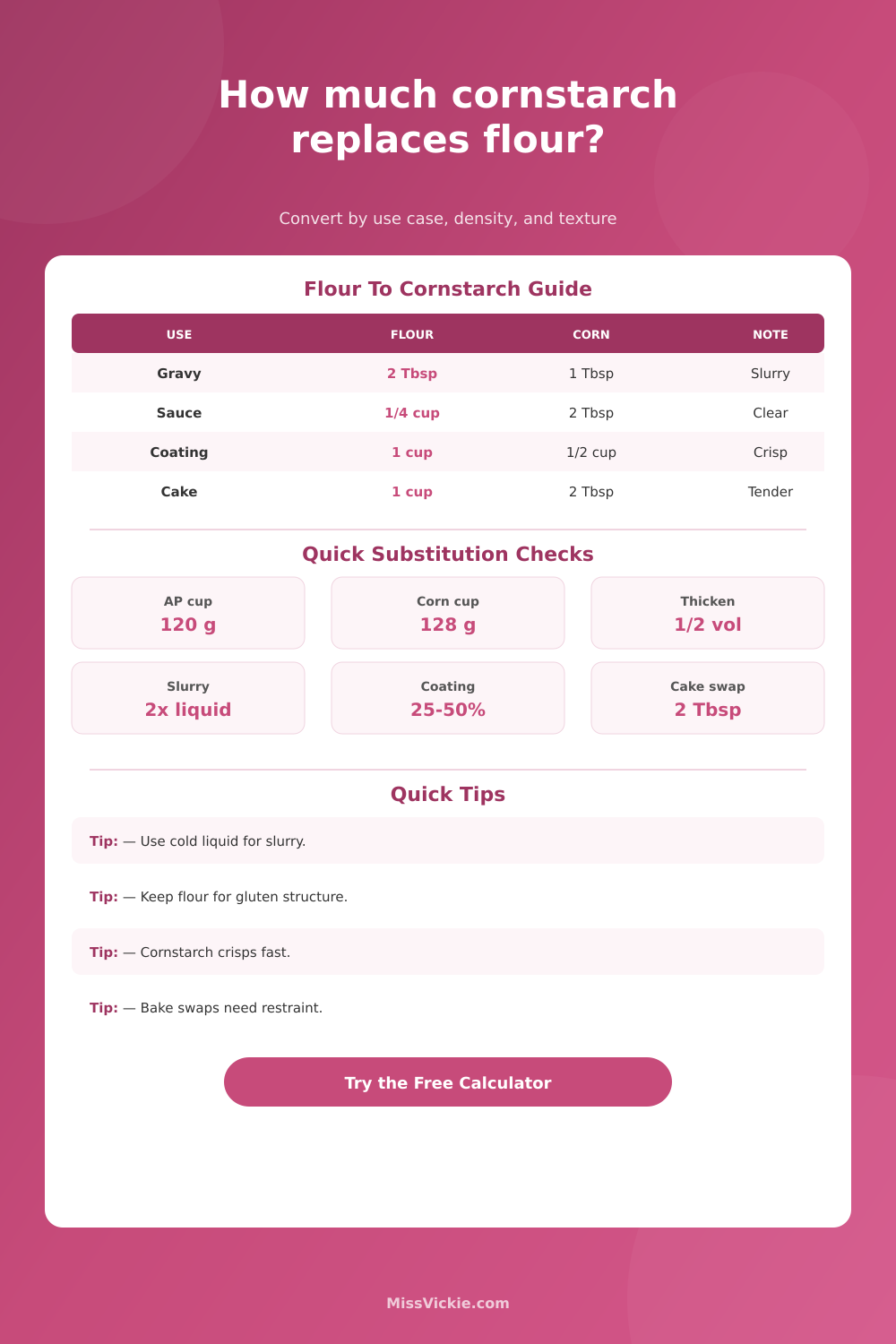
| Gravy, white sauce, pan sauce | 2 Tbsp flour | 1 Tbsp cornstarch | Clearer, glossier, less flour flavor |
| Soup or stew finish | 1/4 cup flour | 2 Tbsp cornstarch | Fast thickening at the end |
| Fruit filling dusting | 3 Tbsp flour | 1 1/2 to 2 Tbsp cornstarch | Cleaner set, less cloudy juice |
| Fried chicken or pork dredge | 1 cup flour | 1/4 to 1/2 cup cornstarch plus flour | Crisper crust, less bready bite |
| Tofu, shrimp, or vegetable dusting | 1 cup flour | 1/2 to 1 cup cornstarch | Very crisp, thin shell |
| Batter for frying | 1 cup flour | 2 to 6 Tbsp cornstarch plus flour | Lighter snap, lower gluten toughness |
| Cake flour style swap | 1 cup all-purpose flour | Remove 2 Tbsp flour, add 2 Tbsp cornstarch | Lower protein feel, softer crumb |
| Bread or yeast dough | 1 cup flour | Usually 0 to 1 Tbsp only | Too much weakens gluten structure |
For hot-liquid thickening, the classic substitution is half as much cornstarch by volume as wheat flour. For coatings and baking, the best amount depends on structure and crispness goals.
🧪Ingredient Density Table
| Ingredient | Grams Per Cup | Grams Per Tbsp | Best Use In This Calculator |
|---|---|---|---|
| All-purpose flour | 120 g | 7.5 g | General baking, sauces, dredges |
| Bread flour | 125 g | 7.8 g | Higher gluten doughs and coatings |
| Cake flour | 114 g | 7.1 g | Tender cakes and fine crumb baking |
| Whole wheat flour | 113 g | 7.1 g | Heavier batters and rustic thickening |
| Rice flour | 158 g | 9.9 g | Gluten-free crisp coatings |
| Fine cornmeal | 138 g | 8.6 g | Crunchy dredges, not smooth sauces |
| Cornstarch | 128 g | 8 g | Slurries, glossy sauces, crisp shells |
| Potato starch comparison | 160 g | 10 g | Extra crisp coating alternative |
🍟Crispness And Gluten Impact
| Cornstarch Share | Gluten Impact | Crispness | Kitchen Use |
|---|---|---|---|
| 0 to 10 percent | Minimal structure loss | Slightly lighter | Cakes, cookies, delicate batters |
| 10 to 25 percent | Noticeably softer | Moderate crisping | Pancakes, quick breads, shallow-fry coating |
| 25 to 50 percent | Less chew and less gluten toughness | Crisp, dry finish | Fried chicken, pork cutlets, onion rings |
| 50 to 100 percent | Almost no wheat structure | Very crisp but fragile | Tofu, shrimp, pan dusting, gluten-free dredge |
| Full replacement in bread | Structure risk is high | Can turn dry or crumbly | Avoid unless recipe is designed for starch |
💧Slurry And Liquid Adjustment Table
| Cornstarch Amount | Cold Liquid For Slurry | Hot Liquid Thickened | Adjustment Note |
|---|---|---|---|
| 1 tsp | 2 tsp cold water | About 1 cup light sauce | Good for thin pan juices |
| 1 Tbsp | 2 Tbsp cold water | About 1 to 1 1/2 cups gravy | Add at a simmer and whisk |
| 2 Tbsp | 1/4 cup cold water | About 3 to 4 cups soup | Hold back some slurry and adjust |
| 1/4 cup | 1/2 cup cold water | Large stew or filling batch | Acidic fruit may need a little more |
| Dry coating | No slurry liquid | Surface moisture only | Pat food dry for a finer shell |
📌Practical Substitution Tips
The story: You’re making a dinner from a recipe that asks for flour to coat chicken or thicken the sauce. Oh wait, there’s no flour in the cupboard, but there’s cornstarch! Easy substitution, right? But once you add it, the liquid gets all gummy and cloudy. Or maybe you’ve made a cake that’s as insubstantial as wet cardboard because you subbed too much starch (which lacks structure) than flour (which has some). Not so easy, eh?
What you’ve got here isn’t just a matter of volume; it’s also a question of chemistry and how the finished dish will feel in your mouth. Cornstarch is starch alone, without any bran or protein like you’d find in wheat flour. It’s more potent than flour by volume; roughly double the thickening capacity. So where a recipe might require two tablespoons of flour to thicken something it would take just a single tablespoon of cornstarch. Select your use case on the calculator and it do the math for you. That takes the guess work out of the ratio.
How to Swap Flour for Cornstarch
But knowing why the ratio works will make you a better cook. Flour imparts body (gluten). Cornstarch adds shine. It makes sauces glossy and clear. Replace one with the other and you’re getting trade-offs between shine and structure.
That’s particularly important with fried foods. If you’re aiming to fry something like chicken or tofu so that it gets nice and golden brown but also maintains crunch, cornstarch is your friend. It dries out fast and forms a very thin, glassy layer, whereas a flour-based dredge will be heavier. This allows it to hold up better to frying and stay crispy for longer. A lot of people mix the two together getting the best of both worlds. Depending on what they’re cooking, they’ll retain some of the flour for flavor/color and use some of the cornstarch for snap.
That’s why the tool includes an option for how strong the substitution should be. Want a little bit? Keep most of the flour in there to hold its shape. Looking to go all-in on starchiness and get something really crisp? Go for it. Do you want to coat something or do you want it to cling to the other food?
But then there’s baking. And this is where it gets dicey. Cornstarch doesn’t work in place of all the flour in a strong cookie or bread. Why? There is no gluten. Without gluten, there is no ability to form the shape and capture the air. It becomes crumbly and flat.
On the other hand, you CAN use cornstarch to mimic cake flour. Cake flour is made from standard all purpose flour but has a lower protein content which help keep cakes from being tough. So if you subtract two tbsp of flour for every cup you add two tbsp of cornstarch, you are decreasing the overall protein content in your mix, giving you a tender, fine crumb while still maintaining an equal amount of dry ingredients. This slight tweak in texture goes a long way.
Another way people mess up is the temperature of the liquid. Cornstarch needs to reach a higher temperature than flour to gelatinize, but boiling too hard will break it down. If you put it straight in the hot liquid, it will form clumps immediately. First you have to make what’s called a slurry, which is adding the cornstarch to some cold water or milk and whisking it together. That lets the cornstarch granules disperse and then expand at an even rate as it gets warm. The formula should of be 2 parts liquid to 1 part starch. The calculator figures out how much cold liquid to add depending on how many starchy tablespoons you’re using. Add the slurry to a bubbling sauce while whisking to avoid lumps and get a smooth result.
One last thing is gluten sensitivity. There is no gluten in cornstarch. Replacing flour with cornstarch is simple if you need to avoid wheat, whether in a sauce or not. When replacing it in a baked item, it needs something else as a binder (such as xanthan gum). And the converter will indicate if you’re losing any structure in your finished product that depends on gluten.
And that’s where cooking comes in: learning how to work within those parameters, adjusting the flavor, adjusting the texture, adjusting for diet and thickness without losing any of it. It’s why the ratios are simplified by the converter; everything else is up to you and your decision. You must know when to keep the gluten for structure and when to lose it for clarity. How to achieve that balance that transforms an ordinary meal into something special. The way to measure the difference remains with you, yet the tasting will always be up to you.