How Much Flour to Thicken Soup Calculator
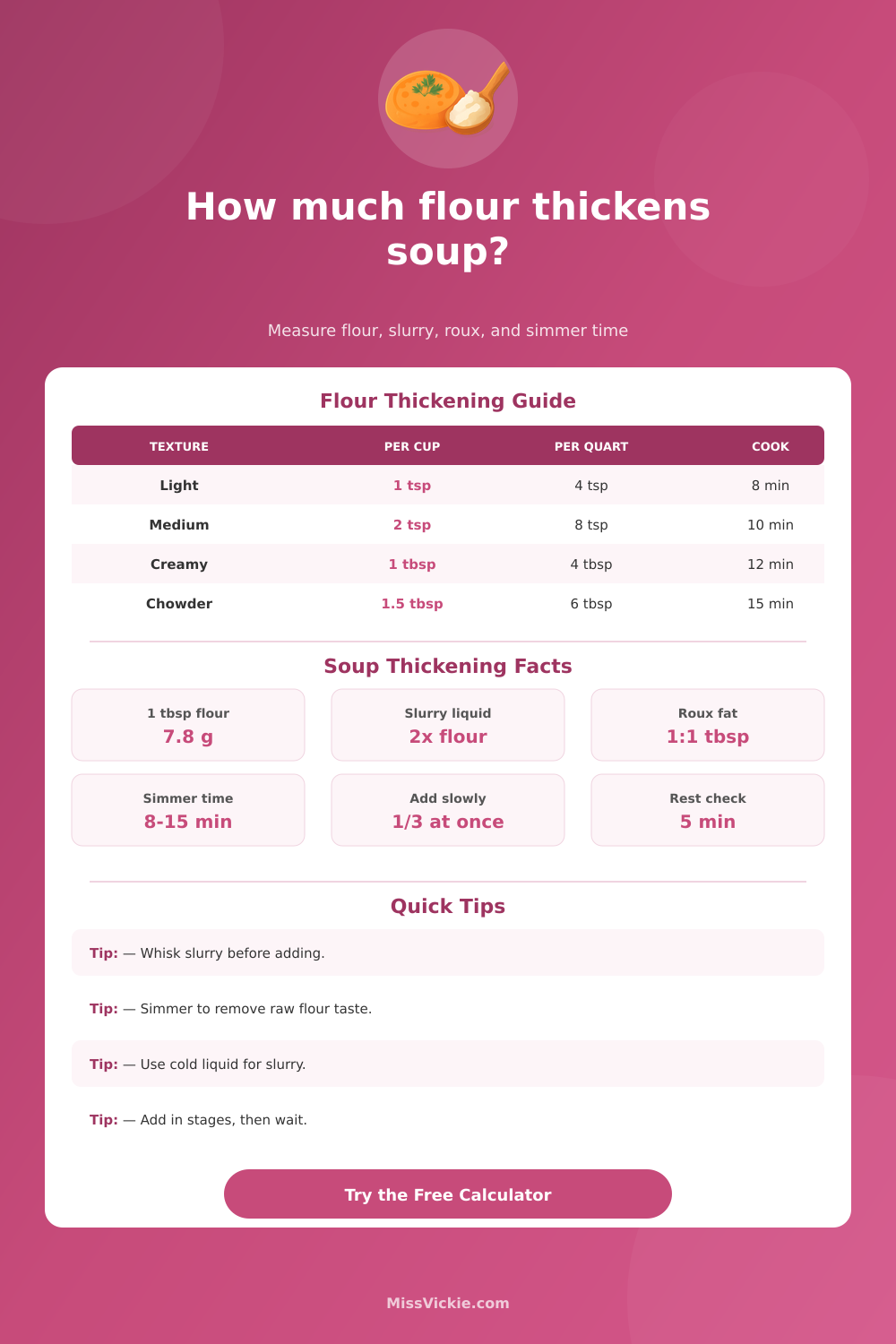
Estimate flour for thin broth, cream soup, stew, chowder, and gravy-style soup, then size the cold slurry or roux fat so the pot thickens smoothly.
Choose a real kitchen scenario to load soup volume, texture target, flour method, simmer time, and ingredient adjustments automatically.
Full Thickening Breakdown
| Desired Soup Texture | Flour Per Cup | Flour Per Quart | Best Use |
|---|---|---|---|
| Light broth body | 1 tsp | 1 tbsp plus 1 tsp | Chicken noodle, vegetable soup, thin turkey soup |
| Medium spoon-coating | 2 tsp | 2 tbsp plus 2 tsp | Cream soup, pot pie soup, saucy leftovers |
| Creamy full body | 1 tbsp | 4 tbsp | Bisque, creamy mushroom, dairy-based soup |
| Chowder-thick | 1.5 tbsp | 6 tbsp | Clam chowder, corn chowder, thick stew base |
| Soup Style | Adjustment | Why It Changes | Watch For |
|---|---|---|---|
| Clear broth | Use less flour | Too much flour can turn broth cloudy and pasty. | Whisk in small additions and stop early. |
| Cream soup | Use standard flour | Dairy gives body but needs stable thickening. | Keep at a gentle simmer, not a hard boil. |
| Potato or bean soup | Reduce flour | Starchy ingredients keep thickening as they sit. | Recheck after a 5 minute rest. |
| Tomato or wine soup | Add a little extra | Acid can make flour thickening feel looser. | Cook longer to smooth the raw edge. |
| Method | Mix Ratio | When To Add | Texture Result |
|---|---|---|---|
| Cold flour slurry | 1 tbsp flour to 2 tbsp cold stock | Near the end of cooking | Fast thickening with a lighter finish |
| Roux | 1 tbsp flour to 1 tbsp fat | Before liquid or as a side roux | Smoother, richer, more stable body |
| Kneaded butter | 1 tbsp flour to 1 tbsp soft butter | Whisk into hot soup in small bits | Glossy last-minute thickening |
| Floured ingredients | Dust meat or vegetables lightly | Before browning | Subtle thickness built into the base |
| Pot Size | Light | Medium | Chowder Thick |
|---|---|---|---|
| 4 cups / 1 quart | 1 tbsp plus 1 tsp | 2 tbsp plus 2 tsp | 6 tbsp |
| 8 cups / 2 quarts | 2 tbsp plus 2 tsp | 5 tbsp plus 1 tsp | 12 tbsp |
| 12 cups / 3 quarts | 4 tbsp | 8 tbsp | 18 tbsp |
| 16 cups / 1 gallon | 5 tbsp plus 1 tsp | 10 tbsp plus 2 tsp | 24 tbsp |
Best when the soup is already cooked and needs controlled body near the end.
Best for creamy soups, chowders, and dishes where richness is welcome.
Thickens with less volume, but can loosen with long simmering or reheating.
Blended beans, potatoes, or vegetables add body without extra flour.
Flour act as a thickening agent in soups, changing the texture of the soup. When you add flour to a soup, it increase the thickness of the soup. If you add to little flour to the soup, the texture will remain thin and watery.
If you add too much flour to the soup, it will become too thick and paste like. The amount of flour that should be added to a pot of soup is dependent upon the volume of the soup, the texture that is desired from the soup, and the other ingredient that are contained within the soup. The calculator provided on this page will help you to determine how much flour to add to you soup.
How to Thicken Soup with Flour
You must enter the volume of the soup into the calculator, as well as the desired texture of the soup. You should also enter the other ingredient in the soup into the calculator, as these ingredient will impact the thickening property of the flour. For instance, if the soup contain ingredient like potatoes or pasta, it will naturaly thicken the broth due to the starch that these foods naturally contain.
In this case, the calculator will recommend a different amount of flour then if the soup did not contain these ingredient. Another example is that if the soup contain acidic ingredient like tomatoes or wine, it will naturaly decrease the thickening property of the added flour. In this case, the calculator will recommend a higher amount of flour than if the soup contain no acidic ingredient.
There is two primary ways to add flour to a soup: using a slurry or using a roux. A slurry is a mixture of flour and cold liquid. By using a slurry, the starch from the flour is able to evenly disperse throughout the soup when it are added to the pot of hot soup.
Adding a slurry is the preferred method for adding flour to a soup because adding the flour directly to the hot soup can result in the formation of lumps in the soup, which will impart a flavor of raw flour into the pot of soup. A roux is a mixture of flour and fat. Before you add liquid to the roux, the roux should be cooked.
A roux will create a texture for the soup that is silky and stable. Additionally, the roux will add richness to the soup. You may choose to use a roux if you are making a creamy soup or you may choose to use a slurry if you would like the texture of the finished soup to be light.
The thickness of the soup can change as the soup heats and as the soup cools. The starch granulates in the flour will swell and burst when the starch granulates is heated in the soup. This create the thickness of the soup.
The soup should be allowed to simmer after adding the flour to the soup. The starch in the flour need time to hydrate. If the starch is not allowed to hydrate proper in the soup, the soup will have a grainy texture and may have a flavor of raw flour.
The soup should be allowed to simmer for at least eight to ten minute. Thick soups may require fifteen minute of simmering. All of the flour calculated for the soup should not be added to the soup at one time.
Instead, a portion of the flour should be added to the soup, such as one-third or one-half of the total amount of flour that you will be use for the recipe. After adding the flour to the simmering soup, you should taste the soup to ensure that the flavor of the flour have dissapeared and that the thickness of the soup is correct. If the thickness of the soup is not correct, more flour can be added to the soup using the method described above.
Additionally, if the soup will be cooked in a slow cooker, you should consider the thickness of the soup because the stew will thicken over time. If the soup will be served immediate after it is prepared, it may be necessary to add more flour to reach the desired thickness.