Flour to Thicken Pie Filling Calculator
Estimate all-purpose flour for fruit pie filling by fruit cups or weight, fruit juiciness, sugar draw, pie diameter and depth, bake time, filling temperature, top crust venting, flour hydration, and desired slice set.
Load a common fruit pie setup, then adjust the pan, bake, venting, filling temperature, and slice goal before calculating.
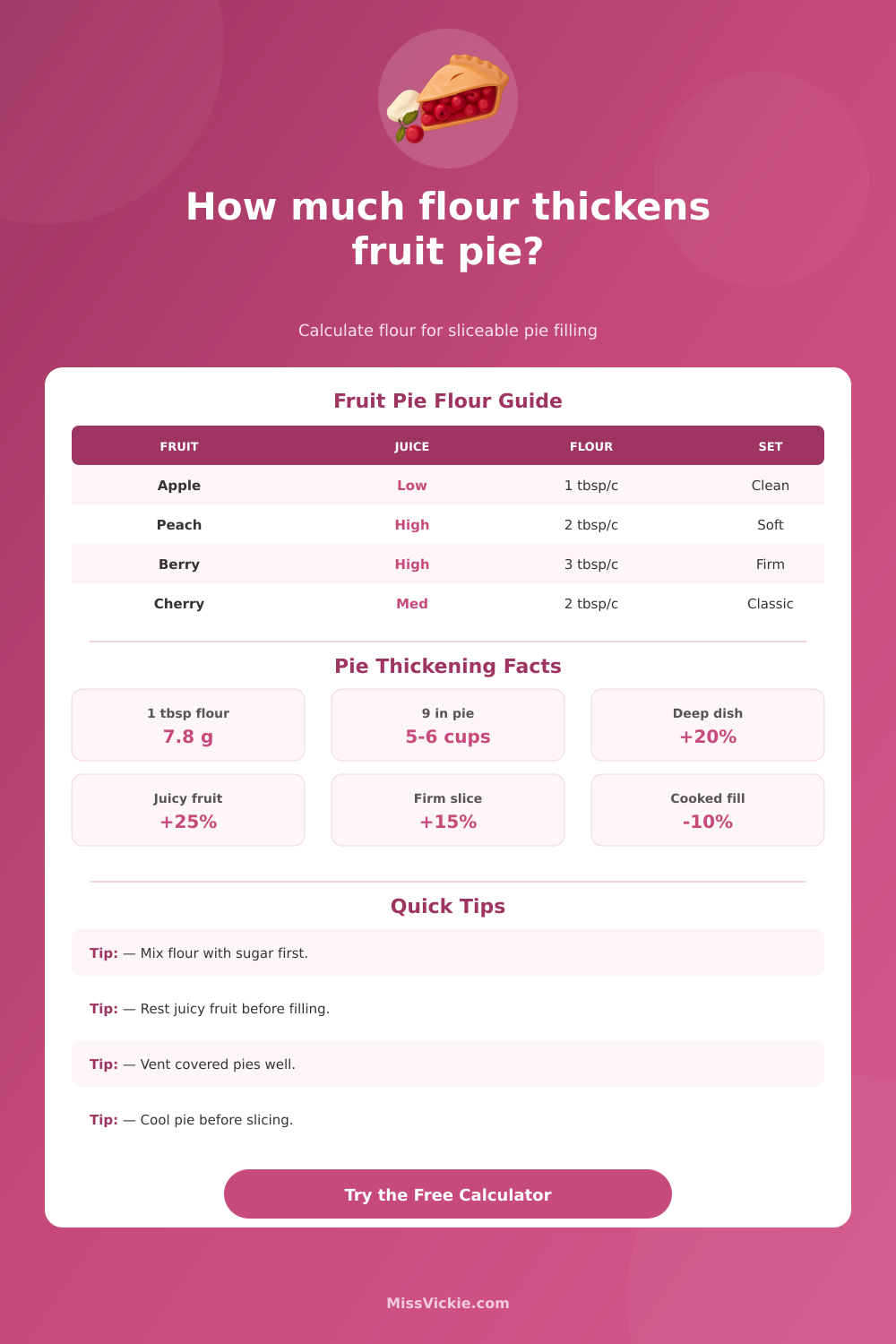
| Fruit Filling | Cup Weight | Typical Flour | Best Slice Goal | Notes |
|---|---|---|---|---|
| Apple slices | 110 g per cup | 1 to 1.5 tbsp per cup | Clean or classic | Low juice, strong pectin, mounded pies settle well. |
| Peach slices | 150 g per cup | 1.75 to 2.5 tbsp per cup | Classic or clean | Peels, ripeness, and sugar draw change liquid quickly. |
| Blueberries | 148 g per cup | 2 to 3 tbsp per cup | Clean | Needs bubbling in the center so flour fully hydrates. |
| Cherries | 140 g per cup | 1.75 to 2.5 tbsp per cup | Classic | Drained frozen cherries usually need less flour. |
| Blackberries | 144 g per cup | 2.5 to 3.25 tbsp per cup | Clean or firm | Seeds and high juice call for a longer cooling window. |
| Strawberry rhubarb | 125 g per cup | 2.25 to 3 tbsp per cup | Classic or firm | Rhubarb softens fast; flour should be well dispersed. |
| Pie Dish | Usual Fruit Cups | Depth Factor | Bake Exposure | Flour Adjustment |
|---|---|---|---|---|
| 8-inch standard | 4 to 5 cups | 1 inch to 1.5 inch | Good center heat | Use base result. |
| 9-inch standard | 5 to 6 cups | 1.5 inch | Balanced | Use base result. |
| 9-inch deep dish | 7 to 8 cups | 2 inch | Slower center boil | Add 10 to 20%. |
| 10-inch pie | 7 to 8 cups | Wide surface | More evaporation | Often add 5 to 10%. |
| Slab pie | 10 to 12 cups | Shallow layer | Fast evaporation | Reduce 5 to 10% if open. |
Whisk flour into sugar before tossing to prevent paste pockets.
A short rest gives flour time to wet before the crust sets.
Slurrying flour with drawn juice improves hydration and clarity.
Pre-cooked filling needs less flour because starch has already swollen.
Getting the correct quantity of flour into a pie filling are important. A little too much and it’s stiff; not enough and it slide off the plate when sliced. Most people worry about fruit. But there is other things to consider in the pan. Baking time, sugar draw, and the juice level all impact the thickness required.
How will you vent the crust? That impacts the filling requirement, too. With this tool, you don’t have to worry about it. You won’t wind up with a runny center or a bite so stiff, you can’t cut through it.
Why You Need to Change the Flour Amount
Some fruits release more or less juice then others (and then there’s how ripe they are). Also, have you left the fruit to soak on sugar before baking? A berry will yield more juice than an apple. Freezing a fruit also breaks down cell walls… That is, frozen fruit can be different than fresh. Resting the fruit will cause more juice as well; sugar sucks it up. Flour is used to thicken that juice. One fruit can requires different amounts of flour, depending on prep.
The larger and deeper your pan, the longer it will take to heat through to boiling temperature in the middle. The doughy bits has time to soak up some water while the crust are still soft enough to set into shape. Shallow and wide pies has less volume of liquid to begin with, so they evaporate moisture more quickly. That might mean you won’t require as much thickener.
Venting functions similar. If your topping is a lattice or something else that’s mostly open, moisture steams out, taking liquid along with it. A pretty crust with not many hole holds moisture in better. Finally, there’s temperature. The colder the fruit, the longer it takes to heat up. This means that the flour is given even more time to soak up moisture. Any pre-cooked fillings are already slightly thickened. You adds less flour at this point.
Cutting a still-warm pie looks different than cutting one that has been cooled for several hours. For example, the reference tables provides common fruit varieties and their expected flour range. It also provides difference in pan size for pans of various diameters and depths. This is because actualy fruit can vary. Some batches of peaches will produce twice as much as other batches from the same week’s pick. With the calculator, you can account for these diffrences.
You don’t need to use one set-in-stone rule that might or might not work for you. Flour isn’t simply a set amount. It’s part of an interdependent system. When you realize that it soaks up any available liquid at baking temperature, then the rest follows: the other ingredients becomes easy to understand.
You should of realized it sooner. One change affects the other. And this connection helps in making a pie that will cut cleanly, each and every time.