Flour for Pancakes Calculator
Estimate pancake flour in cups and grams from pancake count, griddle diameter, batter thickness, hydration level, flour type, serving size, and leavening strength.
🥞 Pancake Batch Presets
Pick a real pancake scenario, then adjust the diameter, flour type, hydration, serving size, leavening, and batter thickness for your griddle.
⚖ Pancake Flour Details
Your pancake flour plan
Enter your pancake count and diameter to estimate flour, batter yield, liquid, and leavening.
Batch Math
Ingredient Plan
📊 Pancake Flour Snapshot
The calculator estimates flour from pancake surface area and batter yield. Brand, griddle heat, resting time, and how thickly you pour can shift the final count.
📘 Pancake Mix Yield Tables
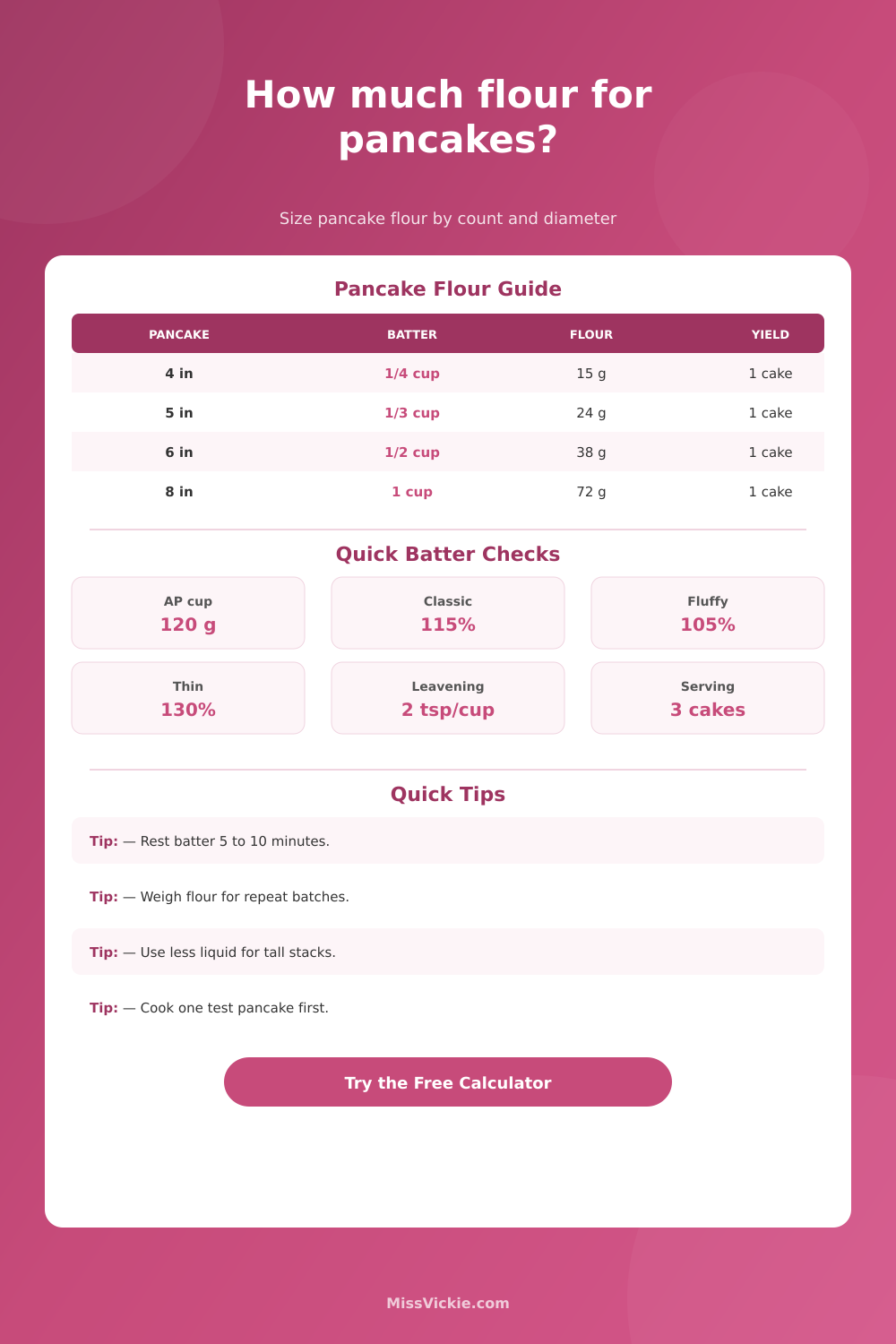
| Pancake Diameter | Typical Batter Per Pancake | Approx Flour Per Pancake | Best Serving Count | Griddle Note |
|---|---|---|---|---|
| 3-inch silver dollar | 2 tablespoons batter | 7 to 9 g flour | 5 to 6 pancakes per serving | Use a spoon or small scoop for even rounds. |
| 4-inch small pancake | 1/4 cup batter | 14 to 18 g flour | 3 to 4 pancakes per serving | Good size for kids, snacks, and mixed brunch plates. |
| 5-inch medium pancake | 1/3 cup batter | 22 to 28 g flour | 3 pancakes per serving | The most common home breakfast stack size. |
| 6-inch large pancake | 1/2 cup batter | 35 to 44 g flour | 2 pancakes per serving | Leave extra room so the pour can spread evenly. |
| 8-inch diner pancake | About 1 cup batter | 68 to 82 g flour | 1 to 2 pancakes per serving | Cook lower and longer so the center sets. |
| Flour Type | Grams Per Cup | Pancake Texture | Hydration Adjustment | Best Use |
|---|---|---|---|---|
| All-purpose flour | 120 g | Balanced and reliable | Use the selected hydration as written. | Everyday pancakes, waffles, and stored dry mix. |
| Cake flour | 114 g | Very tender and soft | May need slightly less liquid after resting. | Fine-crumb pancakes and short stacks. |
| Whole wheat flour | 113 g | Hearty and absorbent | Add about 5% more liquid or rest longer. | Nutty breakfast pancakes and freezer batches. |
| Self-rising flour | 113 g | Soft with built-in lift | Skip most added baking powder. | Fast pancakes when the flour is fresh. |
| Buckwheat blend | 120 g | Earthy and tender | Works best blended with all-purpose flour. | Buttermilk pancakes and savory stacks. |
| Gluten-free cup-for-cup flour | 125 g | Varies by starch blend | Rest 10 minutes before judging thickness. | Gluten-free pancakes with measured hydration. |
| Dry Mix Amount | All-Purpose Flour | Baking Powder | Expected 5-Inch Pancakes | Classic Liquid Later |
|---|---|---|---|---|
| 1 cup flour base | 120 g flour | 2 tsp | 4 to 5 pancakes | About 140 ml liquid plus egg and fat. |
| 2 cups flour base | 240 g flour | 4 tsp | 9 to 10 pancakes | About 275 ml liquid plus egg and fat. |
| 3 cups flour base | 360 g flour | 2 tbsp | 13 to 15 pancakes | About 415 ml liquid plus eggs and fat. |
| 5 cups flour base | 600 g flour | 3 tbsp plus 1 tsp | 22 to 25 pancakes | About 690 ml liquid plus eggs and fat. |
| 10 cups flour base | 1200 g flour | 6 tbsp plus 2 tsp | 45 to 50 pancakes | About 1.4 L liquid plus eggs and fat. |
| Hydration Choice | Liquid Per 100 g Flour | Batter Feel | Spread On Griddle | When To Use |
|---|---|---|---|---|
| Low hydration | 105 g liquid | Scoopable and thick | Needs help spreading | Tall fluffy pancakes, add-ins, and slow griddles. |
| Buttermilk-thick | 110 g liquid | Thick but pourable | Small, controlled spread | Buttermilk pancakes and tender stacks. |
| Classic hydration | 115 g liquid | Pourable ribbon | Moderate round spread | Everyday pancakes and most boxed-style mixes. |
| Loose pour | 125 g liquid | Thin pour | Wider, flatter cakes | Larger diner pancakes and fast cooking batches. |
| Thin batter | 135 g liquid | Very loose | Spreads quickly | Thin pancakes, crepe-like cakes, and rolled fillings. |
🧂 Leavening and Batter Reference
Good for thin pancakes or recipes with beaten eggs.
Balanced rise for classic all-purpose pancake batter.
Use with thicker batter and a short rest before cooking.
Add a little baking soda when acidic dairy is the liquid.
💡 Pancake Flour Tips
Then there’s the waste: The first pancake is always a test batch. It’s your way to gauge the heat, the consistency, the cooperation level of the batter. Pour it out, let it flow across the pan and instantly you know, too much liquid? Is there not enough lift? That’s where most folks fail: They’ll assume its their wrist technique and not realize it has nothing to do with what happens in side the mixing bowl.
To get ratio correct, first you need to know how flour work in a pancake. It’s the skeleton; too little, and you’re not making anything but wet eggs and milk; too much, and you’ll wind up with hockey pucks.
The Secret to Perfect Pancakes
By plugging in diameter of your preferred pancake and number you want to make, our calculator takes care of math for you (no more conversions and coefficients to worry about). It converts a vague idea such as “family breakfast” to actual cups and grams. It turns out: You’re building a structure that must be both tender and able to hold its own air.
You also need to consider kind of flour. All-purpose is the dependable workhorse; it’s got enough protein to maintain its shape but not too much to get tough. More soft flours like cake creates a tender crumb, but are sometimes delicate on a crowded griddle. Hearty flours like whole wheat add flavor and heft, but drinks up more moisture. Switching to whole wheat without changing hydration will result in dried-out pancakes before they even start browning. The tool considers these variations in absorption, you don’t have to remember how much water each grain absorb.
Another big lever to pull is hydration. Bakers think in percentages, while most home cooks thinks in terms of cups of milk. For a classic batter, liquid should weigh roughly 115 percent as much than the flour. That’s called 115 percent hydration.
When you lower that number, your batter will be thick and scoopable which is ideal for making those fluffy, tall stacks. Raise that number and you’ll have a loose pour that will spread out wide and thin. It is perfect for those diner style plate. You might think thickness is all about how much batter people are scooping up but really it’s all about how much liquid is hiding in their scoop.
That structure also has to be matched by the leavening. Pancake bubbles comes from baking powder. You need less lift for a good pancake if your batter is thin; more if it’s thick and heavy. Based off how much flour you use (and what type) the calculator will adjust its estimate of leavening needed to suit the kind of lift you’re after. Under-leavened pancakes is flat, so this matters. Over-leavened pancakes are metallic-tasting and fall apart once cooled.
There’s no getting around resting the batter; give it at least 5 minutes (10 would of been preferable). This is when the gluten relaxes and the flour fully hydrates. If you cook it right away, the flour hasn’t absorbed enough liquid which results in a tight, chewy pancake. When rested, the batter smoothes out and you can make more predictable final pour. Notice how the batter ribbons from spoon when you try to pull it back? It shouldn’t splash; it should do this. That’s what you’re looking for, and it means your pancakes will spread more predictably onto the hot surface.
Use first pancake as your final calibration. This is not an exact science. Your eggs might be larger or smaller than average. Your baking powder might differ by brand. The humidity in your kitchen can affect everything. When testing the pancake, if it’s too runny (meaning you get a pancake that’s too thin) your batter is too wet. Add a spoonful of flour. If it’s too thick (it’ll sit up high on the griddle, looking doughy), add a splash of milk. Adjust, wait, adjust again, and repeat.
Breakfast shouldn’t be a test of your chemical knowledge, it should be a reward. Making good pancakes isn’t rocket science or pastry magic, but it do require respect for the ratio. There’s some math involved, and that takes the stress out of making pancakes. Know how much water you’re using? How about flour weight? That’s what matters, and from then on, its all timing and temperature.
Pour them, let them bubble, flip them, and eat them. And yes, the first pancake may yet end up in the garbage, but it’ll taste damn good.