Flour Cups to Grams Calculator
Convert flour cups into grams with separate logic for flour type, measuring cup, spooned or scooped method, sift state, humidity, target grams, and recipe scaling.
Load common baking scenarios, then adjust the cup method, flour style, humidity, target weight, and scaling factor for your own recipe.
Conversion Breakdown
These tables use level US cups as the baseline. The calculator adjusts them for scooping, sifting, larger cup measures, humidity, and recipe scaling.
| Flour Type | 1/4 Cup | 1/2 Cup | 1 Cup | 2 Cups |
|---|---|---|---|---|
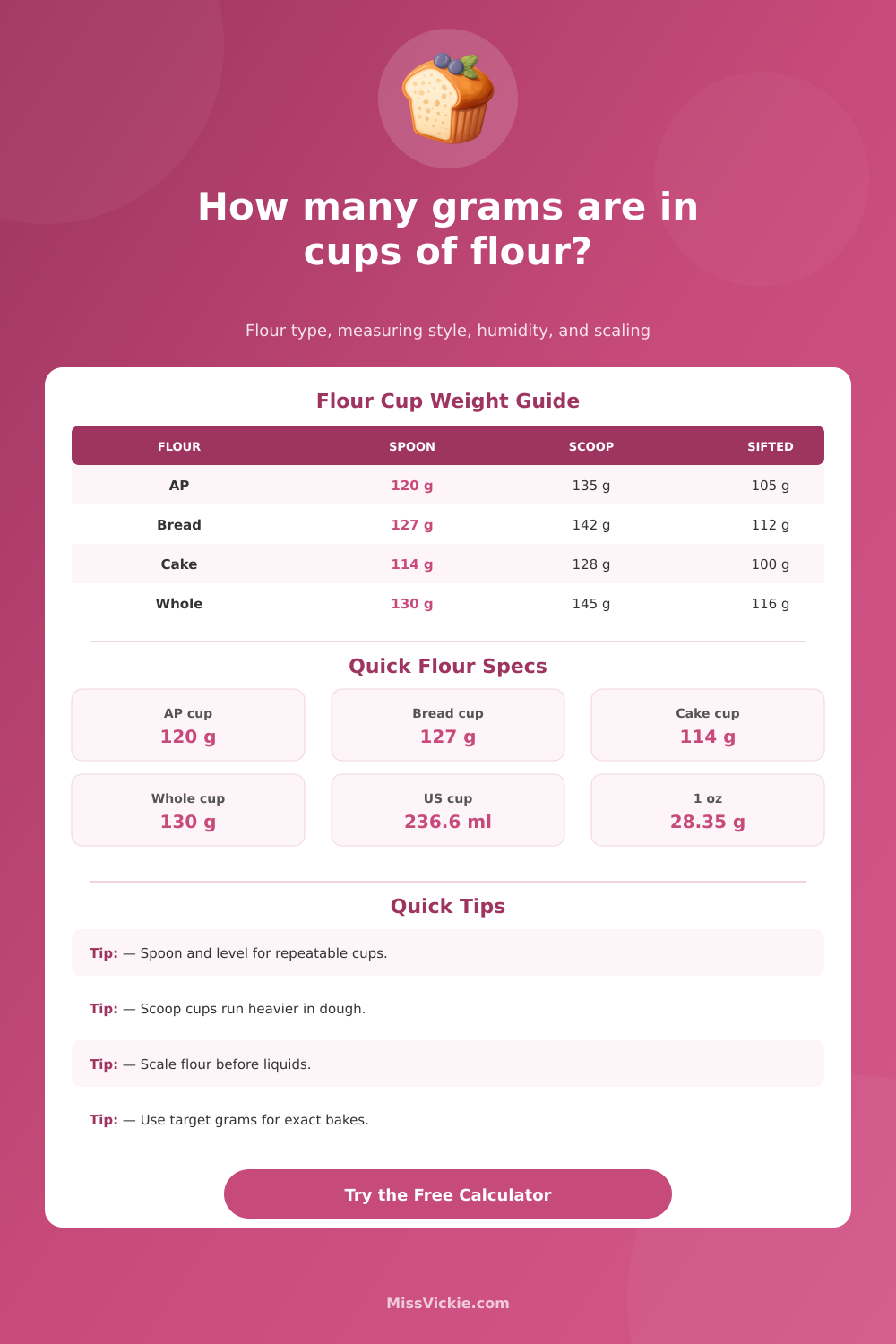
| All-purpose flour, spooned | 30 g | 60 g | 120 g | 240 g |
| Bread flour, spooned | 32 g | 64 g | 127 g | 254 g |
| Cake flour, spooned | 29 g | 57 g | 114 g | 228 g |
| Pastry flour, spooned | 27 g | 55 g | 110 g | 220 g |
| Whole wheat flour, spooned | 33 g | 65 g | 130 g | 260 g |
| Rye flour, spooned | 26 g | 51 g | 102 g | 204 g |
| Method | Typical Factor | AP Flour Cup | Best For |
|---|---|---|---|
| Aerated spoon cup | 0.96x | 115 g | tender cakes, biscuits, pancakes |
| Spoon and level | 1.00x | 120 g | repeatable home baking |
| Dip and sweep | 1.08x | 130 g | older recipes using cup volume |
| Scooped from bag | 1.13x | 136 g | dense cookies or quick breads |
| Packed cup | 1.20x | 144 g | rare flour directions only |
| Sift and Moisture | Factor | Why It Changes | When To Use |
|---|---|---|---|
| Sifted before measuring | 0.88x | more air in the cup | fine cakes, angel food, delicate pastry |
| Stirred before measuring | 0.97x | loosens settled flour | everyday spoon and level recipes |
| Measured then sifted | 1.00x | same weight, smoother texture | recipes that say one cup flour, sifted |
| Settled pantry flour | 1.04x | compacts during storage | bagged flour stored for weeks |
| Very humid pantry | 1.03x | absorbed moisture adds weight | humid kitchens and coastal storage |
| Recipe Scale | 2 Cups AP | 3 Cups Bread | 1.5 Cups Cake |
|---|---|---|---|
| Half batch | 120 g | 191 g | 86 g |
| Standard batch | 240 g | 381 g | 171 g |
| Double batch | 480 g | 762 g | 342 g |
| Triple batch | 720 g | 1143 g | 513 g |
Balanced wheat flour for cookies, muffins, sauces, and everyday baking.
Higher protein and slightly heavier cups for chewy loaves and pizza dough.
Soft and fine flour that weighs less per cup for light cake structure.
Bran and germ make the cup heavier and more thirsty in dough.
Baking recipe often use the unit of cup. This is because when a person is following along with a recipe, it is likely that the person will reach for a measuring cup and fill the measuring cup with the ingredient being measured. However, the weight of flour that fill that measuring cup can vary.
For example, one cup of flour can weigh between 96 gram and 167 gram. This weight varies based on the type of flour that is use and how it is packed into the measuring cup. These differing weights can have a significant impact on the end product; too much flour by weight can make a cake too heavily to eat or bread dough too soft.
Convert Cups of Flour to Grams
To help avoid these issues caused by varying weights, a person can use a flour cup to grams calculator to determine the weight of the flour that a recipe require in grams using specific variable. The type of flour that the recipe will use is one of the variable that the calculator can select. For instance, if all-purpose flour is selected, the flour will weigh approximately 120 grams per cup.
However, bread flour have a different weight than all-purpose flour because of the differences in the density of the two types of flour. Additionally, cake flour has a lower mass than all-purpose flour because of the fine texture of the flour. Other types of flour, such as whole wheat flour, contain more mass than all-purpose flour because of the bran and germ that is present in the flour.
Finally, almond flour weigh differently than other flours because it is made with nuts instead of wheat. The way that flour is measured into the recipe is another of the variable in the calculator. For example, using the spoon and level method to measure flour will result in approximately 120 gram of all-purpose flour per cup.
Using the dip and sweep method will result in around 130 gram of all-purpose flour per cup. Scooping the flour directly from the bag will result in around 136 gram of all-purpose flour per cup. Conversely, using an aerated spooning method to fluff the flour will result in around 115 gram of all-purpose flour per cup.
Another of the variable is whether the flour will be sifted before measuring or after the flour is measured. If the flour is to be sifted before measuring, it will contain more air and will weigh less. If the flour is to be measured first and then sifted, the weight of the flour will be the same, but it will be smooth.
Finally, the humidity level in the kitchen where the recipe will be made can affect the weight of the flour. Flour absorbs moisture from the air. Therefore, the flour may weigh more in a humid kitchen then in a dry climate.
These variable can be accounted for in the calculator. Other variable that can be entered into the calculator are recipe scaling and buffer percentage. Doubling a recipe may require additional flour to be used to dust baking sheet or to roll dough.
Using a buffer percentage will ensure that a person does not run out of flour while baking. Additionally, there is a target-gram mode on the calculator that allows a person to enter the total number of grams of flour that they would like to use in the recipe. The calculator will account for the different variable and display the number of cup of flour that will contain the targeted gram of flour.
Two reference table are present on the calculator that list the weight of different amounts of flour of different types. The table list the weight of flour in grams for amounts of flour that are measured in quarter-cup unit, half-cup unit, and full-cups. These table display the weight of flour of different types when measured with different method and when sifted with different method.
These table allow a person to see the weight of flour of different types prior to measuring it themselves. Many home baker have experienced recipe failure due to incorrect measurement of flour. The other ingredient may be present in the recipe as described in the recipe, but the resulting dough may feel different from the recipe expectation.
This issue is avoided in professional kitchen because each ingredient is weighed prior to being used in the recipe. However, most home cook use cup of flour instead of gram due to habit. The flour cup to grams calculator can help a person translate the cup measurement of flour to gram measurement to help ensure accuracy in the recipe.
The calculator may also be of assistance to a person in adapting recipe from different cookbook. Many cookbook published many years ago used the dip and sweep method to measure flour, while modern cookbook may use the spoon and level method. Additionally, international recipe may use cup of metric flour, while US recipe use standard US cup of flour.
The flour cup to grams calculator can account for each of these difference. An additional use of this calculator is to record the gram weight of flour of a successful recipe. By writing the gram weight and cup measurement of flour needed for a specific recipe, a person can input those same variable into the calculator to ensure that they start with the same weight of flour as they used in the successful recipe.
Over time, this will allow for the creation of a database of the weight of different type of flour with different method and condition. Eventually, this will allow for the removal of guesswork from baking flour in recipes. While both the volume (represented by the cup) and weight of flour are way to describe the amount of flour needed to be included in a recipe, these two variable only match with each other when specific condition are used.
For instance, the weight of flour will differ based on the type of flour that is use and how it is measured. By using this calculator, a person can choose the type of flour and the method of measuring flour, then the calculator can provide the weight in grams of that flour. Using flour in grams instead of cup will allow for more precise result for the dough that is prepared and the baked good that are created from those recipe.