Fish sauce, lime, sugar, sodium, dipping sauce, and marinade planner
Fish Sauce Ratio Calculator
Calculate fish sauce tablespoons and milliliters for stir-fries, noodle bowls, dipping sauce, dressing, marinades, soups, curries, servings, protein weight, sodium intensity, lime, sugar, and water balance.
📌Fish Sauce Ratio Presets
Start with a familiar use, then fine-tune dish type, servings, protein weight, sodium intensity, lime, sugar, dilution, and whether the sauce is used as a marinade or dip.
⚖Dish, Servings, Protein, And Balance Inputs
Balanced fish sauce ratio
Your calculated fish sauce balance will appear here.
Ratio Breakdown
Flavor Balance
Cooking Cues
🥣Serving And Sauce Reference
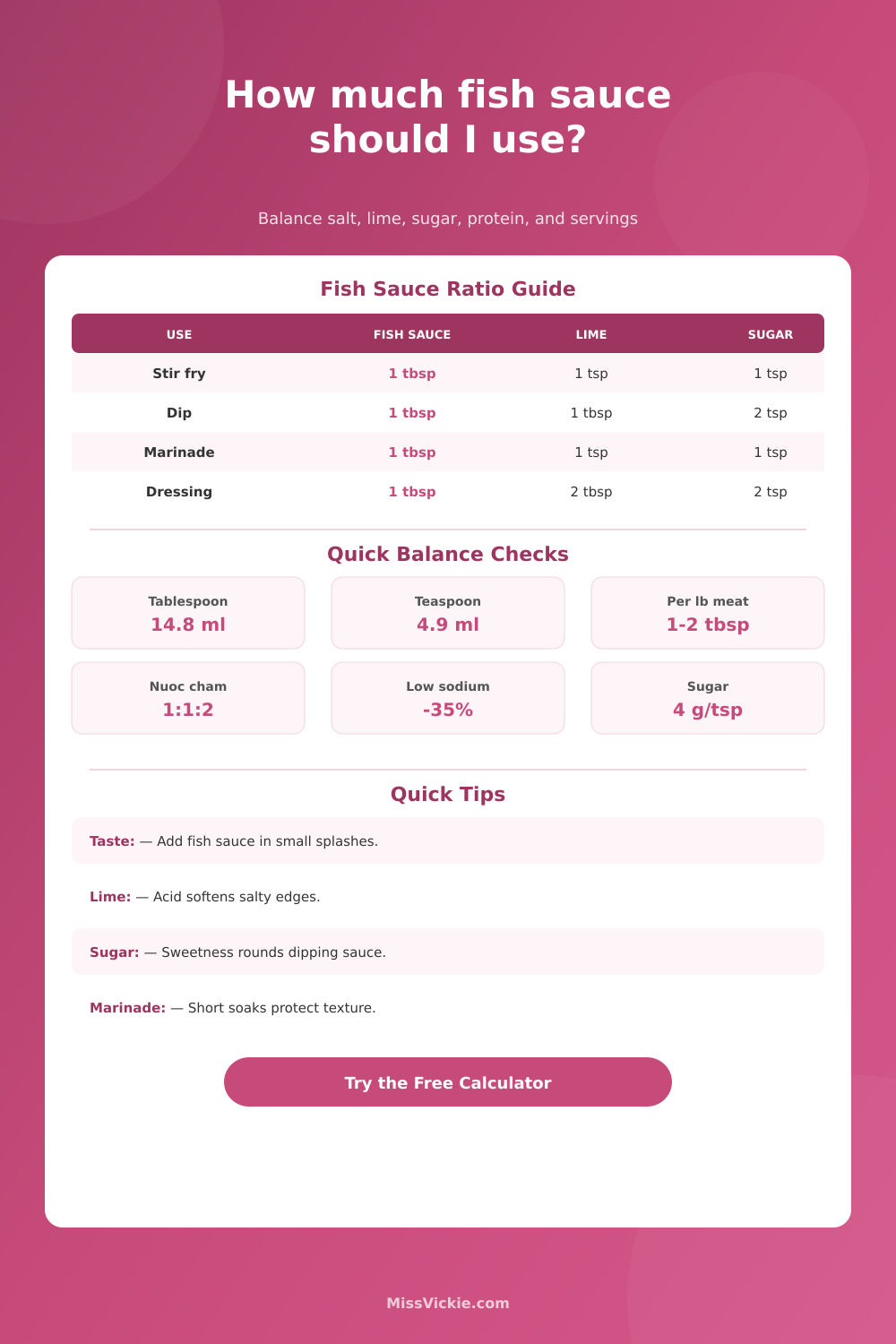
About 14.8 ml fish sauce for a small stir-fry or dip base.
Common marinade range before lime, sugar, and aromatics.
Fish sauce, lime, and water before sweetness adjustment.
Approximate granulated sugar weight per level teaspoon.
📊Flavor Balance Tables
Fish Sauce Starting Ratios
| Use | Starting Fish Sauce | Lime or Acid | Sugar | Water |
|---|---|---|---|---|
| Stir-fry seasoning | 1 tbsp per 3 to 4 servings | 1 to 2 tsp | 1 tsp | 0 to 1 tbsp |
| Dipping sauce | 1 tbsp base | 1 tbsp | 2 tsp | 2 tbsp |
| Protein marinade | 1 to 2 tbsp per pound | 1 to 2 tsp | 1 to 2 tsp | 1 tbsp |
| Noodle salad | 1 tbsp per 2 servings | 1.5 to 2 tbsp | 2 tsp | 1 tbsp |
| Soup seasoning | 1 tsp per cup broth | Optional | Optional | Broth volume |
Sodium And Brand Strength Guide
| Style | Typical Sodium | Flavor Cue | Best Use | Adjustment |
|---|---|---|---|---|
| Thai fish sauce | 1400 mg/tbsp | Bold salty aroma | Stir-fry, curry | Use balanced rate |
| Vietnamese fish sauce | 1300 mg/tbsp | Rounded savory | Dips, dressings | Add lime slowly |
| Filipino patis | 1500 mg/tbsp | Assertive salt | Soups, stews | Start lower |
| Low sodium | 850 mg/tbsp | Milder salinity | Table sauce | May need more acid |
| Vegan alternative | 950 mg/tbsp | Umami and sweet | Vegetables, tofu | Taste for sweetness |
Marinade Vs Dipping Sauce Balance
| Mode | Fish Sauce Goal | Acid Goal | Sugar Goal | Hold Time | Texture Cue |
|---|---|---|---|---|---|
| Quick marinade | Season surface | Light brightness | Light browning | 10 to 30 min | Meat still flexible |
| Long marinade | Lower salt | Lower acid | Moderate sugar | 1 to 4 hr | No cured texture |
| Dipping sauce | Salty backbone | Equal or higher | Round and sweet | Serve now | Pourable and bright |
| Cold dressing | Background savor | Higher acid | Moderate sugar | 10 min rest | Glossy, not harsh |
| Soup seasoning | Light final salt | Optional garnish | Usually none | End of cook | Broth tastes rounded |
💡Fish Sauce Ratio Tips
Fish sauce sodium varies by brand and label. The calculator estimates planning ratios for cooking and seasoning, not a medical sodium limit.
There are few pantry items that has such a polarizing effect as fish sauce. To some people, it reaks of feet. They’re right; it does. But when used properaly, this ingredient give a rich and umami-rich quality to whatever you put it on. Proteins and vegetables in particular benefit from hit of fish sauce.
Too much of it, though, makes your dish a salt bomb. In the home kitchen, most of us treat fish sauce just as we would table salt. We don’t. Fish sauce is a dense, powerful liquid with a lot of punch in very small quantities.
How to Use Fish Sauce
“Add a splash to taste,” most recipes say. If you’ve been cooking with fish sauce for three decades, that’s fine. But if you’re trying to strike a balance between umami-rich components for the first time (like in a complex dipping sauce), it’s not going to cut it. Plug in how much protein you’re cooking, and what level of saltiness you want, into the calculator up top, and the calculator will do the math for you… No more guesswork about conversions or coefficients. It’s turning an instinct into a plan. It doesn’t replace having to taste the finished product, of course, but it starts you there without panic mode.
Sweet + Acid + Salt = Tension: This is the heart of fish sauce as an ingredient. The salt and umami from the fish sauce are balanced by sour acid cut from lime juice or vinegar and rounded out with sweetness. More sauce? Usually means more lime and just a bit more sugar to keep things in balance. It does, all based off what kind of dish you are making. Cold noodle salads require one kind of balance, while a hot stir fry needs another. Why? Because when it’s hot, the sharp, alcohol notes cook off, leaving only pure savoriness. When it’s cold, like in a dressing, those notes is there, so the dish requires more sweetness and acidity to combat its raw punch. That’s why the tool will compute the proportions for you based on your dish.
Marinades are no different from other seasonings except people tend to forget about them. Marinades pull moisture from the protein through osmosis. For example, if you soak your meat in fish sauce, the longer it sits with more sauce, the more moisture come out. Let it sit too long with too much salt and you don’t just season your meat, you cure it. That is why the calculator takes into account marinade time. With a shorter soak of say ten minutes, you can get away with more. With an over night, you need to be far more light handed. It’s one of those small details that makes a difference. Flavor penetration, not jerky.
Brands also differ widely in sodium content. Vietnamese brands tend to be rounder, more savory. Thai fish sauces tends to be more aromatic and sharp. Patis from the Philippines can get pretty assertive. Since a tablespoon of one brand may have as much salt as a tablespoon and a half of another, you choose the type that is closest to yours so it can estimate number of servings to keep the whole dish within reasonable bounds. If you’re not watching your sodium but don’t want a salty surprise at the end of the meal, this is good for you.
Then there’s the logic of dipping sauces. Fish sauce is simply diluted with sugar, lime and maybe a bit of chile. 1:1:2, right? Wrong. You want a ratio closer to 1:1:2, meaning more water than fish sauce, and then adjust with sugar until it’s just right. It should be bright and pourable. If it is too thick, it coats the tongue and overwhelms the food. Too little, too watery, and it loses its character. Use the tool to thin it out and adjust the amount, then use it as a guide to find that perfect balance.
If you’re making something that simmers, toss in your fish sauce early, as this will allow time for the heat to distribute the flavor throughout and mellow out some of the funkiness. If you want to use it as part of a finishing sauce or stir fry, add near the end so that it keeps its aroma. Don’t over-salt. Because there’s already plenty of sodium in the fish sauce, taste the dish before adding more salt. Most recipes make a mistake by topping off with table salt or soy sauce.
Recipes are all about balance of flavor, not about recipe measurements. The calculator provides a start. You then use that to adjust depending on your own preferences, the freshness of limes, and brands of ingredients. Taste and adjust from there. That’s how you learn it. What you want is for the fish sauce to become invisible as an element and visible as the secret behind what makes everything else taste so good. You should of used this sooner.