Fish Doneness Temperature Calculator
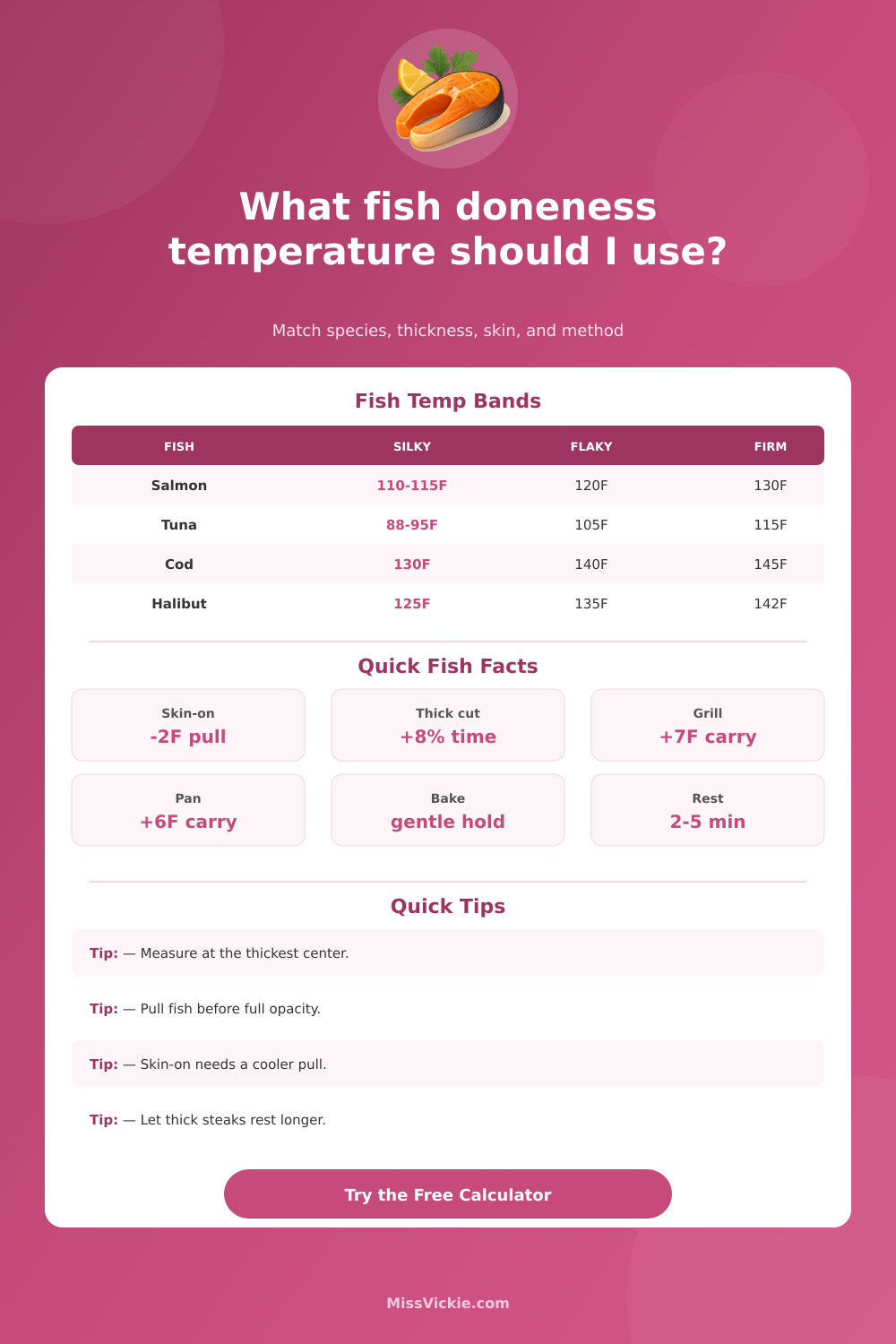
Match species, thickness, skin, and method so salmon stays silky, cod turns flaky, and thick steaks pull before overcooking takes over.
Each preset loads a real fish scenario with species, cut style, thickness, skin state, heating method, and a practical resting plan.
Full Breakdown
These tools make fish temperature checks more accurate, especially when you are working with thin fillets, skin-on portions, or grill heat.
Use this table to compare common fish and the texture bands that work best for each species.
| Species | Silky | Moist | Flaky | Firm |
|---|---|---|---|---|
| Salmon | 110-115F | 118-122F | 124-128F | 130F+ |
| Tuna | 88-95F | 96-102F | 103-110F | 115F+ |
| Cod | 128-132F | 133-137F | 138-142F | 145F |
| Halibut | 122-126F | 127-132F | 133-138F | 142F |
| Trout | 112-116F | 117-121F | 122-126F | 130F |
| Tilapia | 126-130F | 131-135F | 136-140F | 142F |
| Sea bass | 120-124F | 125-129F | 130-135F | 139F |
| Mahi mahi | 123-127F | 128-132F | 133-137F | 140F |
| Swordfish | 118-122F | 123-128F | 129-133F | 136F |
| Haddock | 129-133F | 134-138F | 139-143F | 145F |
Thickness is the biggest timing driver, but method and heat shift the window in different directions.
| Thickness | Bake 350F | Pan 375F | Grill 425F | Notes |
|---|---|---|---|---|
| 0.5 in | 4-5 min | 3-4 min | 3-4 min | Thin and quick |
| 0.75 in | 6-7 min | 5-6 min | 5-6 min | Watch edges |
| 1.0 in | 8-10 min | 6-8 min | 7-8 min | Most fillets |
| 1.5 in | 11-14 min | 9-11 min | 10-12 min | Steak-like cuts |
| 2.0 in | 15-18 min | 12-14 min | 13-15 min | Thick steaks |
Use the ideal heat and carryover columns to see why bake, pan-sear, and grill behave so differently.
| Method | Ideal Heat | Carryover | Time Bias | Best For |
|---|---|---|---|---|
| Bake | 350-375F | 4-5F | Gentle | Even fillets |
| Pan-sear | 375-400F | 6-7F | Fast | Skin-on crisping |
| Grill | 425-450F | 7-8F | Faster | Steaks and halves |
| Broil | 500F | 8-9F | Very fast | Quick finish |
| Steam | 212F | 2-3F | Slow | Delicate flesh |
| Poach | 180F | 1-2F | Slowest | Ultra tender |
Best for even cooking, sheet-pan batches, and thicker fillets that need a softer finish.
Best for skin-on salmon, trout, and other fillets where crust and fast pull timing matter.
Best for swordfish, mahi mahi, and halibut steaks that need structure plus smoke.
Best for a quick finish when the flesh is close and you only need surface color.
Temperature is the anchor, but color, flake shape, and juice appearance confirm the final stop point.
| Cue | What You See | Texture Read | Best Use |
|---|---|---|---|
| Glassy center | Bright and soft | Silky | Tuna and salmon |
| Just opaque | Edges set first | Moist | Trout and bass |
| Flake split | Fork opens cleanly | Flaky | Cod and tilapia |
| Firm resistance | No translucency | Firm | Steaks and halibut |
Cooking fish properly require an understanding of the effect of cooking temperature on fish proteins. When fish proteins is overcooked, the proteins tighten and squeeze out moisture from the fish. This leads to the fish becoming dry and chalky when overcooked.
If the protein is cooked to a correct temperature, the proteins will remain in the structure of the fish, preserving the moisture and allowing the fish to remain tender. To ensure that the fish is cooked to the correct temperature without overcooking it, use an thermometer to monitor the internal temperature of the fish. Because different types of fish has different amounts of fat, each type of fish will have a different cooking method.
How to Cook Fish to the Right Temperature
Salmon has a high amount of fat in its structure, which allow it to stay moist for a longer period of time. Cod is leaner than salmon and will become dry very easy. The thickness of the fish will also impact the cooking process.
Thick fillet will take longer to cook than thin fillets because heat will take longer to reach the center of a thick piece of fish. Fish with the skin on will also cook differently from those that dont have the skin on the fish. The skin will act as insulation that will allow the heat to reach the flesh of the fish more slow.
You should avoid cooking the fish to the final target temperature. After removing the fish from the heat source, the fish will continue to carryover cook and reach the target temperature. Remove the fish from the heat source when the internal temperature of the fish are between five and seven degrees below the target temperature.
Allow the fish to rest for the proper amount of time for the juices to redistribute throughout the fish. Thin fillets should rest for approximately two minutes while thick steaks should rest for five minutes. If you do not allow the fish to rest, the edges of the fish will be overcooked due to the continued movement of heat toward the center of the fish.
The cooking method will also alter the amount that the temperature of the fish will rise once you stop cooking the fish. If you use a baking method to cook the fish, the rise in temperature will be low as the heat is distributed slowly allowing the fish to cook to the target temperature slowly. This method will result in a carryover cooking rise of four or five degree.
Pan-searing the fish will result in a high carryover cooking rise of six or seven degrees. Grilling the fish will result in the highest rise of seven or eight degrees. Steaming or poaching the fish will result in the slowest rise of one or two degrees.
Therefore, the temperature at which you pull the fish from the heat will change based off the cooking method for the fish. You can use visual cues to determine the doneness of the fish. However, the most accurate method to determine when the fish is done cooking is measuring it’s internal temperature.
Tuna is best when cooked to rare doneness where the center of the fish will have a glassy center. Trout and bass are best when the edges are opaque while the center is still raw. Cod and tilapia are best when cooked through to the center and will flake into clean layer.
Swordfish is best when the fish is cooked firm enough that there is no translucency left in the flesh. However, these visual cues are not the most accurate method to determine doneness. Use a thermometer to measure the internal temperature of the fish.
To avoid making mistake when cooking fish, use a thermometer to probe the thickest part of the fish. Probing the thin tail end of the fish will provide a lower temperature reading of the fish and may result in overcooking the center of the fish. Another mistake you must avoid is not considering the starting temperature of the fish.
Fish that start at a lower internal temperature will take longer to reach the target temperature than fish that are at room temperature. Lastly, pulling the fish when it reaches full opacity may indicate that the fish will be overcooked as the carryover cooking will continue to cook the fish even after you have taken it off the heat source.