Age, sex, calories, current intake, meals, soluble fiber, insoluble fiber, and food sources
Fiber Intake Calculator
Estimate a daily fiber target, how much more you need, a realistic meal split, soluble and insoluble fiber balance, and food-source servings to close the gap.
Choose a common eating pattern, then adjust age, sex, calories, current fiber, meals, and source focus to match your day.
Fiber Intake Breakdown
Cooked beans, lentils, peas, chili, dal, and bean soups usually close the largest fiber gaps fastest.
Oats and barley are useful when you want more soluble fiber at breakfast or in savory grain bowls.
Chia, flax, pumpkin seeds, and psyllium-style foods are compact but need enough fluid and gradual portions.
Raspberries, pears, apples with skin, oranges, and avocado add fiber without needing a full cooked meal.
Broccoli, peas, carrots, leafy greens, and potatoes with skin work best when portions are generous.
Whole wheat pasta, bran cereal, bulgur, quinoa, and brown rice help, though labels vary a lot by brand.
Bowls, soups, tacos, salads, and oatmeal can combine legumes, grains, fruit, vegetables, nuts, and seeds.
Packaged wraps, bars, cereals, and breads should be entered from the Nutrition Facts fiber line.
| Age And Sex Group | Daily Fiber Reference | Calculator Use | Planning Note |
|---|---|---|---|
| Children 1-3 | 19 g/day | Age-based reference | Use child feeding guidance for very young children. |
| Children 4-8 | 25 g/day | Age-based reference | Build fiber through ordinary foods and fluids. |
| Girls 9-18 | 26 g/day | Age and sex reference | Meal patterns and total calories still matter. |
| Boys 9-13 | 31 g/day | Age and sex reference | Higher calorie needs can raise the calorie-rule target. |
| Boys 14-18 | 38 g/day | Age and sex reference | Often needs several meals with grains, beans, fruit, or vegetables. |
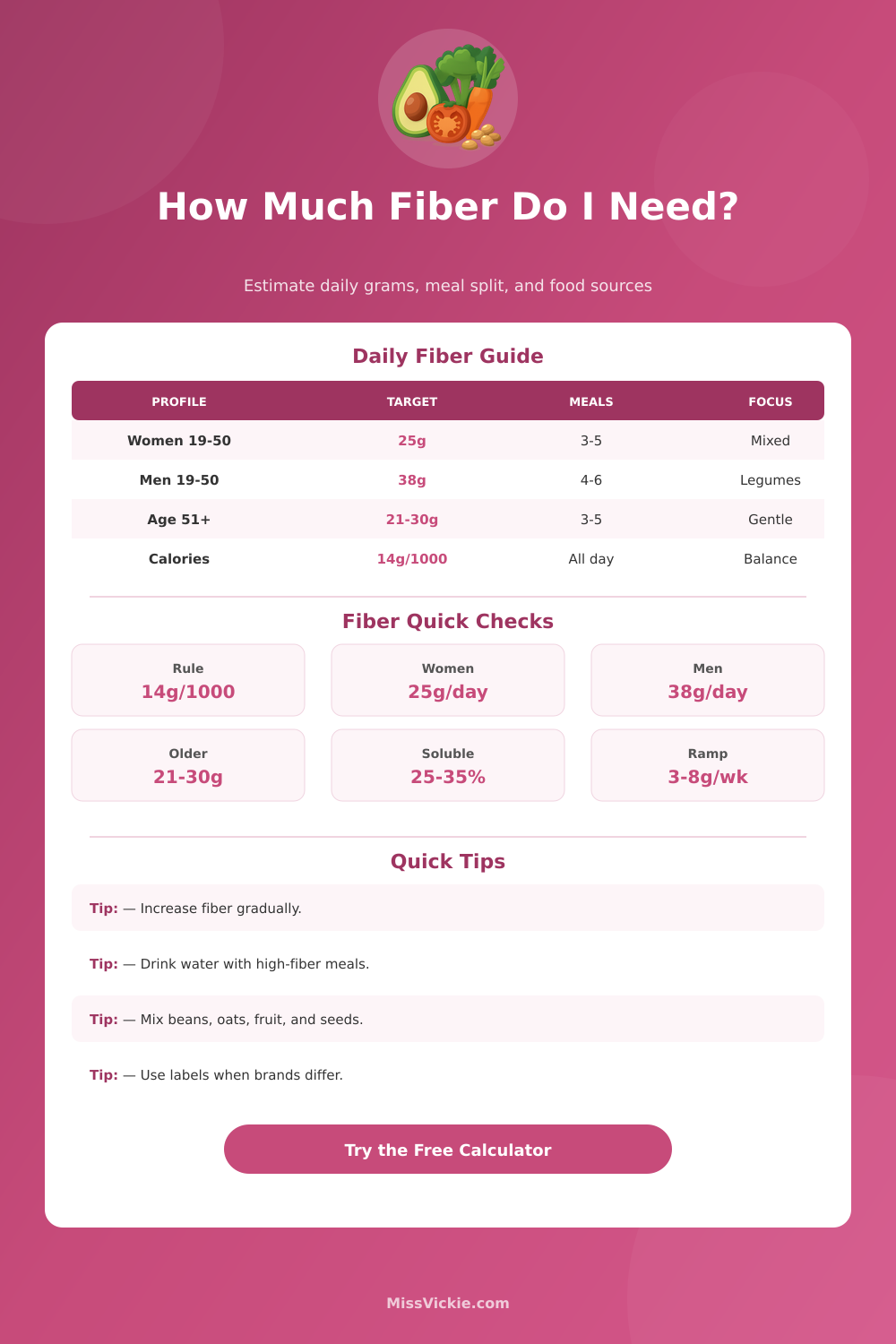
| Women 19-50 | 25 g/day | Adult reference | Compare with 14 g per 1,000 calories. |
| Men 19-50 | 38 g/day | Adult reference | Large gaps are easier to close with legumes and grains. |
| Age 51 and older | 21 g women, 30 g men | Older adult reference | Comfort, appetite, chewing, and fluids can affect pacing. |
| Food Source | Typical Portion | Fiber Per Portion | Soluble Tendency |
|---|---|---|---|
| Lentils, cooked | 1 cup | 15-16 g | Moderate soluble, high insoluble |
| Black beans, cooked | 1 cup | 14-16 g | Moderate soluble, high insoluble |
| Chia seeds | 2 tablespoons | 8-10 g | Gel-forming soluble texture |
| Rolled oats, dry | 1/2 cup | 4 g | Higher soluble beta-glucan style fiber |
| Raspberries | 1 cup | 8 g | Mixed soluble and insoluble |
| Broccoli, cooked | 1 cup | 5 g | Mostly insoluble with some soluble fiber |
| Whole wheat pasta | 1 cup cooked | 5-7 g | Mostly insoluble grain fiber |
| Daily Gap | Gentle Next Step | Food Example | Meal Split Idea |
|---|---|---|---|
| 3-5 g short | Add 3 g | Fruit, oats, vegetable side, or small seed topping | Add to one meal or snack. |
| 6-10 g short | Add 3-5 g first | Oats with berries, beans in soup, or extra vegetables | Split across two meals. |
| 11-18 g short | Add 5 g first | Lentils, beans, chia, bran cereal, or mixed bowl | Split across three meals. |
| 19 g or more short | Increase in stages | Use several food families rather than one huge serving | Spread across the full day. |
| Fiber Type | Common Sources | Calculator Split | Practical Kitchen Note |
|---|---|---|---|
| Soluble fiber | Oats, barley, beans, apples, citrus, chia, flax | Usually 25-40% of total fiber in the estimate | Often creates a softer or gel-like texture in foods. |
| Insoluble fiber | Wheat bran, vegetable skins, whole grains, nuts, many vegetables | Usually the larger share of mixed-food fiber | Often adds bulk and texture to meals. |
| Mixed fiber meals | Bean chili, lentil soup, berry oats, grain bowls, salads | Balances source tendency with the selected emphasis | Most real meals contain both types. |
| Label foods | Cereal, wraps, bars, breads, supplements | Uses your entered fiber and soluble estimate | Check labels because added fibers vary by product. |
Many peoples may notice that they begin to feel better with the inclusion of more plant in there diet. However, most people are unaware of the specific amount of fiber that they need to consume daily. One method of determining the amount of fiber that you should consume daily is with the use of a fiber intake calculator.
A fiber intake calculator take the information that you provide, such as your age, sex, the amount of calories that you consume, the amount of fiber that you consume daily, the number of meals that you consume daily, and the focus of the foods that you consume, and turns that information into the amount of fiber that you should consume daily. The information that you provide to the calculator indicates different aspect of your dietary needs. For instance, your age and your sex indicate the needs of your body based off established references for those individuals.
How to Use a Fiber Intake Calculator
The total amount of calories that you consume daily is used to calculate the amount of fiber that you should consume with the target of fourteen gram of fiber for every one thousand calories that you consume daily. The amount of fiber that you consume daily will help to determine the amount of fiber that you still need to consume to reach your target. Your meal count will help the fiber intake calculator to provide an even split of fiber to each of your meal so that you can avoid any digestive discomfort that may result from consuming all of the fiber that you require from your daily diet in one meal.
Finally, your focus on the foods that you consume will determine the amount of soluble fiber and insoluble fiber that you consume daily. The fiber calculator will adjust for these food sources and calculate the amount of each type of fiber that you should consume daily. The number that the fiber intake calculator determines for the amount of fiber that you should consume daily is not the number that you should aim for each day, but the daily fiber target is a planning number.
The daily fiber target will allow you to determine the gap between the fiber that you consume daily and the fiber that you should consume daily. This gap will allow you to determine whether or not you need to increase the amount of fiber that you consume with a specific meal. For instance, if you calculate that you need an additional three gram of fiber daily, you may choose to add beans to your lunch or seeds to your breakfast.
Furthermore, the soluble and insoluble fiber calculation will allow you to understand whether the foods that you eat daily are high in soluble fiber or high in insoluble fiber. This information can be especially useful for those who are looking for specific effects on their digestion with the fiber that they consume. The fiber that you need daily may change for reasons that are outside of the information that you provide to the fiber calculator.
For instance, if you are pregnant or breastfeeding, the fiber that you need to meet your bodys needs change from your daily needs. Additionally, the way that you split the fiber within your diet may have to change as adults, as the body needs to digest the food at a different rate. The amount of calories that you consume daily will change the fiber that you need; the higher the calories, the more fiber your body requires.
The same is true for lower-calorie diets. The fiber intake calculator also ask for your dietary pace. Most individuals should consume fiber at a slow pace.
If you increase the amount of fiber that you consume at once, you may experience discomfort in your digestive system. Three to five gram of fiber per week is the slowest that most people should increase the amount of fiber that they consume each day. The fiber intake calculator allows you to see this slow pace within the recommendation of fiber that you should consume daily.
Most meals contains fiber from more than one food source. The food comparison that is included in the fiber calculator will reflect the fiber content from each food component. For instance, a meal that contains lentils, grains, and vegetables will contain more fiber than a meal that contains only one of these meal components.
Furthermore, the fiber intake calculator allows you to select mixed whole foods as one of the sources of fiber for your diet. The benefit of using mixed whole foods is that they contain the balance of soluble and insoluble fiber. Most cooks use this food type for meals that are prepared each day.
You should not aim to reach the fiber target that the fiber intake calculator calculate for each day individually. Instead, calculate the average amount of fiber that you consume over a period of several day. It is possible that your fiber consumption is lower on two of the days than on one day.
The fiber intake calculator allows you to view the gap for each day, as well as the next-step amount of fiber that you should consume. As you track the amount of fiber that you consume, you will eventually be able to remember how much fiber is in half a cup of lentils or a cup of raspberries. The portion size indicated in the fiber intake calculator will help you to learn about the fiber content in each food.
Once you are aware of the fiber content in foods, you will no longer need to utilize the fiber intake calculator to determine the fiber content that you should consume with each meal. Increased consumption of fiber requires increased consumption of fluid. Although the fiber intake calculator does not ask for the fluid that you consume daily, increasing the amount of fluids that you drink with each meal will aid in the movement of fiber through your body.
Most people will experience less discomfort in their digestive systems if they increase their water consumption with each meal. Additionally, the slow rate at which the fiber intake calculator recommends that you increase the amount of fiber that you consume will control the rate at which you increase your fluid consumption. The difference between a low-fiber diet and a high-fiber diet is due to the food that you consume daily.
By increasing foods that contain fiber, such as oats or barley that can be consumed for breakfast daily, you can increase the fiber that you consume daily. The fiber intake calculator can indicate which foods will have the most impact on your daily fiber consumption. Your ultimate goal should be to consume fiber daily from foods like beans, whole grain, fruit, and vegetables.
By becoming accustomed to the amount of fiber that your body requires daily from these food groups, you will no longer have to utilize the fiber intake calculator to determine the amount of fiber that you should consume daily.