🦫 Fermentation Time Calculator
Find exact fermentation timelines for bread, yogurt, beer, wine, kombucha, kimchi & more
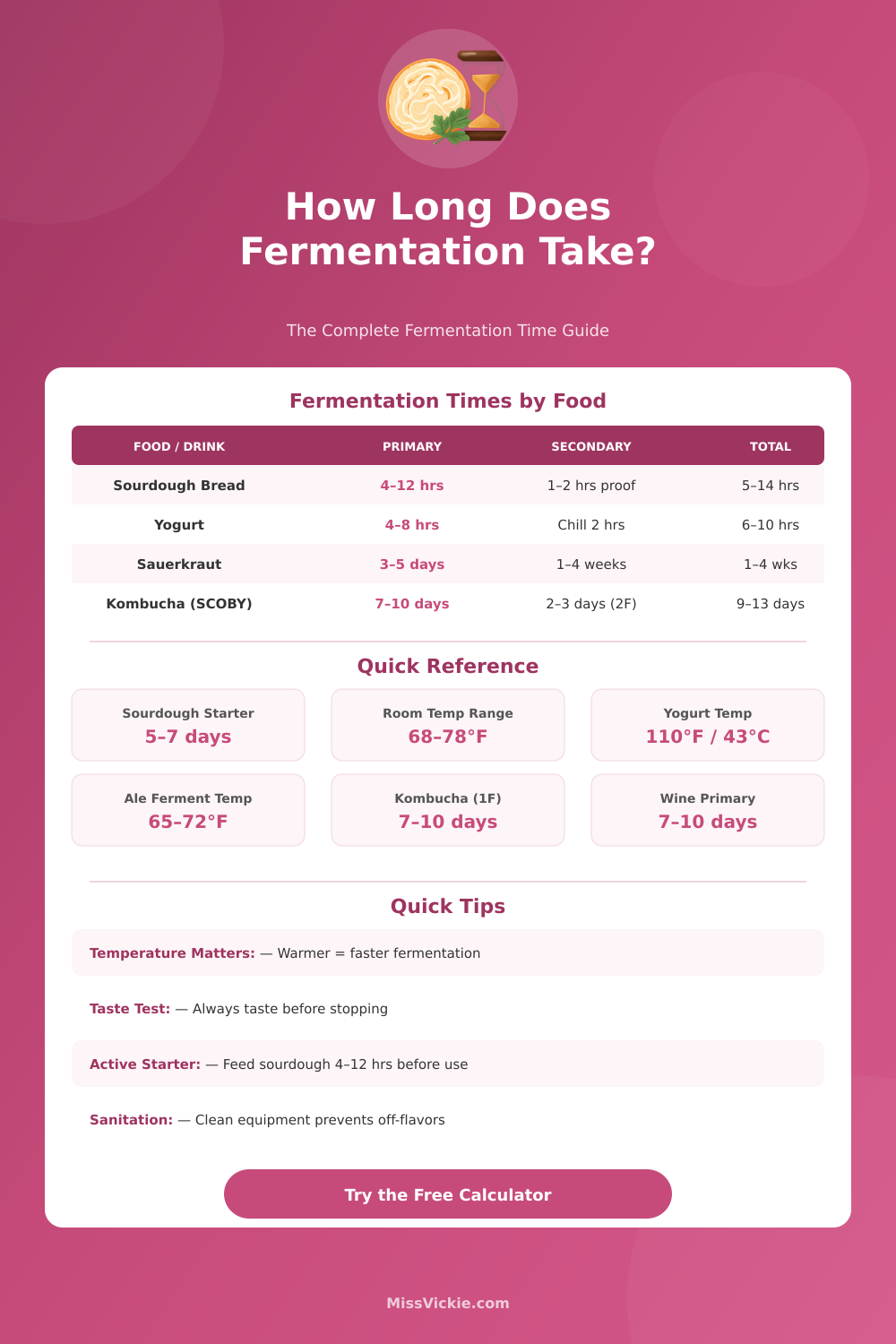
| Food / Drink | Primary | Secondary | Ideal Temp |
|---|---|---|---|
| Sourdough Bread | 4–12 hours | 1–2 hr proof | 75–80°F |
| Sourdough Starter (new) | 5–7 days to activate | Feed every 12–24 hrs | 70–75°F |
| Yogurt | 4–8 hours | Chill 2+ hrs | 110°F (43°C) |
| Milk Kefir | 18–24 hours | 2nd ferment 12 hrs | 65–75°F |
| Sauerkraut | 3–5 days | 1–4 weeks | 65–75°F |
| Kimchi | 1–2 days | 3–5 days (fridge) | 65–70°F |
| Quick Pickles | 24–48 hours | 3–5 days fridge | 65–75°F |
| Kombucha (1F) | 7–10 days | 2–3 days (2F) | 72–80°F |
| Ale / Pale Ale | 7–14 days | 7–14 days | 65–72°F |
| Lager | 10–14 days | 4–6 weeks (lager) | 48–55°F |
| Table Wine | 7–10 days | 2–4 weeks | 65–75°F |
| Mead / Honey Wine | 14–28 days | 1–3 months | 65–72°F |
| Miso | 3 months | 3–12 months | 60–70°F |
| Temperature Range | Effect | Best For | Watch Out For |
|---|---|---|---|
| Below 60°F (<15°C) | Very slow / stalled | Long-age miso, cold crash | Stalled fermentation |
| 60–65°F (15–18°C) | Slow, clean flavor | Lagers, sauerkraut | Extended timeline |
| 65–72°F (18–22°C) | Moderate, balanced | Ales, wine, sauerkraut | Monitor activity |
| 72–80°F (22–27°C) | Fast, active | Sourdough, yogurt, kombucha | Off-flavors if too hot |
| 80–90°F (27–32°C) | Very fast | Yogurt (ideal 110°F) | Risk of bad bacteria |
| Above 90°F (>32°C) | Potential failure | Yogurt only (110°F) | Kills yeast / cultures |
| Stage | What Happens | Signs It's Ready | Action |
|---|---|---|---|
| Lag Phase | Microbes acclimate, no visible activity | Slight aroma change | Keep warm, wait 6–24 hrs |
| Primary (Active) | Rapid gas, CO2 bubbles, yeast/bacteria multiply | Bubbling, rising dough, tangy smell | Maintain temperature |
| Secondary (Conditioning) | Flavor development, clarification, carbonation | Sediment settles, flavor mellows | Transfer to secondary vessel |
| Final / Packaging | Activity slows, flavors meld | Target flavor, pH, or gravity reached | Bottle, jar, or serve |
At its core, fermentation happens when microbes, bacteria, yeast and fungi, break down food and form entirely new flavors and useful substances during the process Here the secret: it works without oxygen. So it is anaerobic. Those germs take sugar and, through their own chemical processes, change it into something entirely different.
Folks use this process for thousands of years, at least 10,000 years. Old civilizations found that you can use microbial cultures to preserve foods, make alcoholic drinks, and boost nutrition in yogurt and tempeh.
How Fermentation Works and Why It Is Good
The main difference between fermentation and decay is the control. During intentional fermentation, you work with precise types of bacteria or fungi, that do not produce dangerous or poisonous things. Decay?
It is random growth without any guarantee. And yes, here food becomes poisionous. Real fermentation is planned.
You put the right germs in the right conditions and let them work, changing raw food into something delicious and safe.
That biting, almost addictive sour taste in sauerkraut and kimchi? It comes directly from fermentation. Just as important is what happens under the surface: fermentation stops dangerous bacteria in their tracks, while it creates ideal conditions for the good germs.
They are probiotics, mostly Lactobacilli, the same bacteria as in yogurt, sauerkraut and many other naturally fermented foods.
Fermented hot sauce work by means of lactic acid bacteria, that naturally live on skins of fruits and vegetables like chili peppers. They like low-oxygen, salty environments. The salt is important, you dose it exactly, so that the bacteria can work, while nothing bad take over the control.
Sake production is a whole other game. It starts with polished rice grains, that ferment together with koji, a special mold full of enzymes, that break down protein and starch in the rice. You add the koji after washing and steaming the rice, and later everything ferments until someone can filter it.
Meenwhile, something like imperial stout, beer with ale yeast and lot of alcohol; can require more than a year to ferment. Lager yeast extend the process even more, adding weeks or months.
Eating fermented foods give you prebiotics and probiotics from whole, unprocessed sources. From my experience, putting ferments in three meals a day, half a pickle at lunch, maybe a quarter cup of sauerkraut at dinner, is enough for most. You do not need huge portions.
It is better to start slowly, for instance yogurt in the morning, kimchi at lunch, sauerkraut at night. Around four to six servings daily seem to help against inflammation and for variety of gut bacteria.
Kimchi ferment quickly at room temperature. Usually between 24 and 48 hours after prep. Some pickles end in only three days, others require weeks to evolve.
Cabbage sits in the middle, requiring four to seven weeks depending on the desire for sourness.Cabbage sits in themiddle.