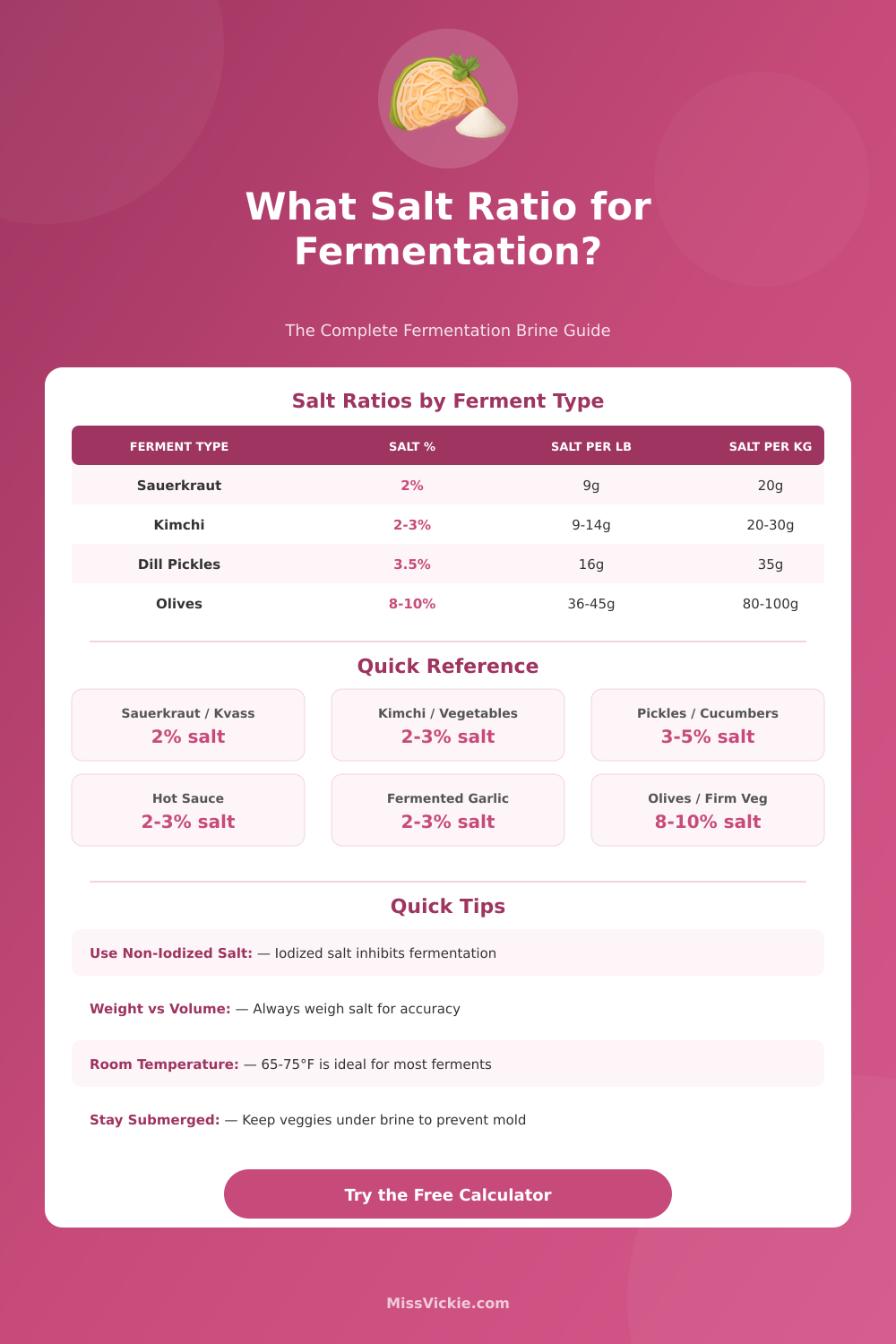
🧂 Fermentation Salt Ratio Calculator
Calculate exact salt amounts for safe, flavorful lacto-fermented vegetables and brines
| Ferment | Salt % | Per lb (g) | Per kg (g) | Approx Tsp/lb |
|---|---|---|---|---|
| Sauerkraut | 2% | 9g | 20g | 1.5 tsp |
| Kimchi | 2.5% | 11.3g | 25g | 2 tsp |
| Hot Sauce / Peppers | 2% | 9g | 20g | 1.5 tsp |
| Carrots / Root Veg | 2% | 9g | 20g | 1.5 tsp |
| Curtido (slaw) | 2% | 9g | 20g | 1.5 tsp |
| Mixed Vegetables | 2.5% | 11.3g | 25g | 2 tsp |
| Ferment | Salt % | Per qt (g) | Per liter (g) | Approx Tsp/qt |
|---|---|---|---|---|
| Pickles / Cucumbers | 3.5% | 33g | 35g | 2.5 tsp |
| Fermented Garlic | 2.5% | 24g | 25g | 1.75 tsp |
| Firm Vegetables | 3% | 28g | 30g | 2 tsp |
| Olives (curing brine) | 9% | 85g | 90g | 6 tsp |
| Peppers / Chiles | 3% | 28g | 30g | 2 tsp |
| Green Beans | 3.5% | 33g | 35g | 2.5 tsp |
| Salt Type | Weight per Tsp | Notes | Fermentation Safe? |
|---|---|---|---|
| Fine Sea Salt | ~6g | Dissolves quickly, ideal | ✅ Yes |
| Kosher Salt (Morton) | ~7.2g | Denser, measure by weight | ✅ Yes |
| Kosher Salt (Diamond Crystal) | ~4.8g | Light flakes, measure by weight | ✅ Yes |
| Pickling Salt | ~6g | Fine grain, no additives | ✅ Best choice |
| Himalayan Pink Salt | ~6g | Trace minerals, works well | ✅ Yes |
| Iodized Table Salt | ~6g | Iodine inhibits bacteria | ❌ Avoid |
| Salt with Anti-Caking Agent | ~6g | Can cloud brine | ⚠️ Not ideal |
Salt from minerals consists almost entirely of sodium chloride… NaCl for short. It breaks in two main parts: sodium makes more than 40 percent and chloride fills the other 60 percent.
Except giving taste to foods, salt plays important role in the kitchen, it ties ingredients, stabilizes textures and acts as natural preservative. Here why bacteria simply can not live in places with high amounts of salt Your body genuinely requires salt to work, and you carry around a good amount of it now.
Salt: Where It Comes From and How to Use It
Where does table salt genuinely come from? Most of it is mined from underground salt deposits that stay here for ages. Sea salt on the other hand has trace minerals and natural iodine, although that does not necessarily make it healthier.
Fact: table salt is buried sea salt from millions of years ago. Before you added iodine to salt to help public health, and now more than 90 percent of American families use iodized salt. Do not disregard average iodized tabelsalt, because it is the main source of iodine for many folks in their diet.
Strolling through the salt aisle in store, you find kosher salt, sea salt, table salt and pink Himalayan salt all together. From pure chemical viewpoint all of them are sodium chloride. But tasting them, you feel big differences.
The size of grains alters how salt feels on the tongue and affects the taste. Fine grains dissolve quickly, while coarse ones take more time. In soup however the size does not matter…
Both kinds dissolve entirely.
With big grains oversalting happens less easily. If recipe wants tablespoon of kosher salt, but you have only table salt, half tablespoon usually suffice. There are two main kinds: salts for cooking and salts for finishing.
Pink Himalayan salt and smoked flakes project well on steak.
Salt belongs in almost every dish. Problem is, that it requires time, actual time, to dissolve and spread in the food. Dense meat like venison can handle a whole day of salting, and the more long salt stays, the better.
Early pinch in stew helps vegetables quickly soften.
In baking salt acts cleverly, it brakes the fermentation, so that it does not run. It gives also the expected taste, even in simple breads. While autolyse, when flour and water only rest, you mix salt.
Right amount of salt at every stage is key for good cook and genuinely worth the effort.
Adults aim for less than 2 300 mg of sodium daily, what matches around one teaspoon of table salt. The typical American however consumes around 3 400 mg every day. A lot above the advisded limit.
Adults should aimfor less than 2 300 mg of sodium daily.