🌿 Fiber in Fava Beans Calculator
Calculate exact fiber content from fava beans by serving size, form & daily intake goals
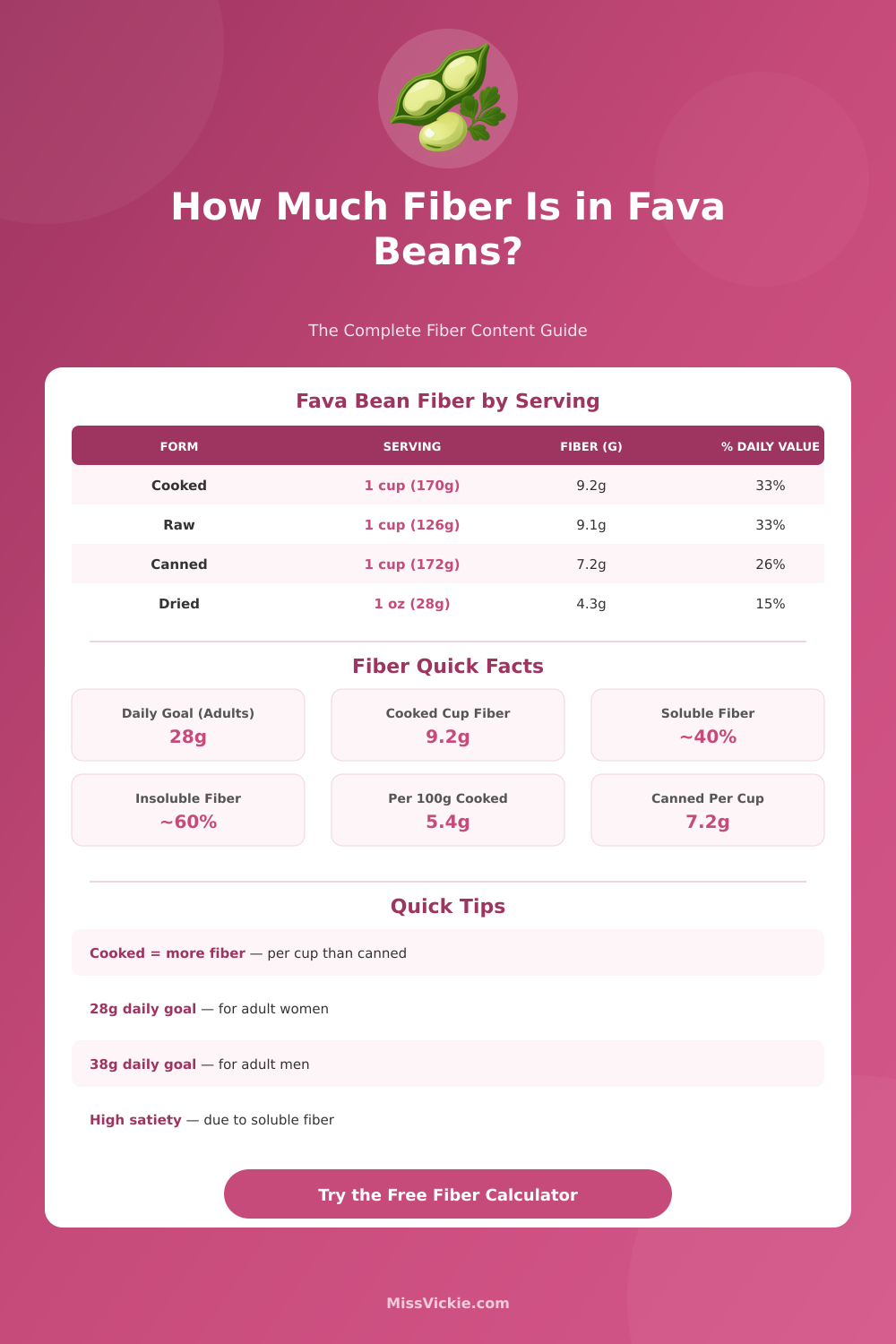
| Form | Serving Size | Weight (g) | Fiber (g) | % Daily Value* |
|---|---|---|---|---|
| Cooked (Boiled) | 1/4 cup | 42g | 2.3g | 8% |
| Cooked (Boiled) | 1/2 cup | 85g | 4.6g | 16% |
| Cooked (Boiled) | 1 cup | 170g | 9.2g | 33% |
| Cooked (Boiled) | 100g | 100g | 5.4g | 19% |
| Raw (Fresh) | 1/2 cup | 63g | 4.5g | 16% |
| Raw (Fresh) | 1 cup | 126g | 9.1g | 33% |
| Canned (Drained) | 1/2 cup | 86g | 3.6g | 13% |
| Canned (Drained) | 1 cup | 172g | 7.2g | 26% |
| Dried (Uncooked) | 1 oz | 28g | 4.3g | 15% |
| Dried (Uncooked) | 1/4 cup | 46g | 7.0g | 25% |
*Based on 28g Daily Value for adults. Source: USDA FoodData Central.
| Group | Daily Goal (g) | 1 Cup Cooked Fava = % Goal | Cups Needed/Day |
|---|---|---|---|
| Women (19–50) | 25g | 37% | ~2.7 cups |
| Women (51+) | 21g | 44% | ~2.3 cups |
| Men (19–50) | 38g | 24% | ~4.1 cups |
| Men (51+) | 30g | 31% | ~3.3 cups |
| Children (4–8) | 25g | 37% | ~2.7 cups |
| Teens (14–18) | 26–38g | 24–35% | ~2.8–4.1 cups |
| General Adult (FDA) | 28g | 33% | ~3.0 cups |
| Bean Type | Fiber per 100g (Cooked) | vs. Fava Beans |
|---|---|---|
| Fava Beans | 5.4g | — Baseline |
| Black Beans | 8.7g | +61% more |
| Kidney Beans | 6.4g | +19% more |
| Chickpeas | 7.6g | +41% more |
| Lentils | 7.9g | +46% more |
| Navy Beans | 10.5g | +94% more |
| Edamame | 4.2g | -22% less |
fava beans know under several different names. One also calls them broad beans, fava beans or horse beans. The scientific name of them is Vicia faba, and they belong to the family of peas and beans, Fabaceae.
The seeds measure around 2 to 3 cm in length and appear in various colours between that yellow, green, brown, black and purple.
All About Fava Beans
Those beans one mostly grows as food for folks. Moreover, they well work as a cover crop, because they restore nitrogen in the ground. Like this they work great for gardening.
On the other hand, their growth can be a bit hard. They hardly form fruits if the daily temperatures pass 80 degrees Fahrenheit during the flowering. In Mediterranean regions they grow during winter and spring, planted in autumn, with only little need of water in the wet season.
fava beans rank among the most heavily used beans globally, and their history extends through thousands of years. They form a basic part of the Mediterranean kitchen. These beans do not carry gluten and are a legume with high content of fiber.
In them there are proteins, carbohydrates, nutritious fiber, potassium, magnesium and plant based iron. Moreover, they store folic acid from the group of B-vitamins, what matters for the making of blood cells and for the nervous system. Green fava beans have natural antioxidants, chiefly polyphenols, that helps too protect the cells of the body.
Fava beans are also rich in manganese and copper, two nutrients that can slow the loss of bones. Against some other species of beans, fava beans store more protein and fiber, while they have fewer fat and fewer calories.
In cooking, one should prepare fresh beans like vegetables. They do not need to cook them as strongly as dried beans. Easy way is remove them from the pods, blanch in salt water, later jump in a pan with olive oil, onion and salt.
For dried fava beans one must first soak them quite a lot longer than cook.
fava beans well go with olive oil and work for salads. From them one can prepare hummus, that one serves with various stuff. In the Levant one commonly serves fresh fava beans dug and jumped with lot of olive oil until they become very soft, later one adds taste with onion and coriander.
One can also mash them and spread on bruschetta or mix in crushed potatoes. During the start of spring, when they are tender and sweet, one can eat the whole pod. Cooked fava beans well taste dressed with olive oil, lemon peel, salt and pepper.
After cooking they are soft, with nutty flavour and smooth texture. They have nicebrght green colour.
One remarkable detail is, that the eating of big amounts can create troubles for some people. Those, that has absence of G6PD, can suffer favism, that is acute hemolytic anemia. Substances in fava beans called vicine and convicine cause oxidative tension in red blood cells.
Roasted fava beans can last in room temperature until six months. Frozen and dried fava beans are available also.