Baking Powder for Expired Cake Mix Calculator
Estimate how much fresh baking powder to add to an expired boxed cake mix using box weight, months past the date, mix style, leavening fade, added powder, pan size, altitude, eggs, oil, and water.
Start with a real box situation: each preset loads an age, mix type, pan, altitude, and egg-oil-water pattern so the rescue math is about old cake mix lift, not a from-scratch cake formula.
Expired Mix Rescue Breakdown
| Months past date | Sealed cool box | Warm or opened box | Rescue approach |
|---|---|---|---|
| 0 to 6 months | Usually retains most lift | Small fade possible | Add a small top-up only if the mix has been stored warm. |
| 6 to 12 months | Moderate fade | Noticeable fade | Whisk in fresh powder before adding eggs, oil, and water. |
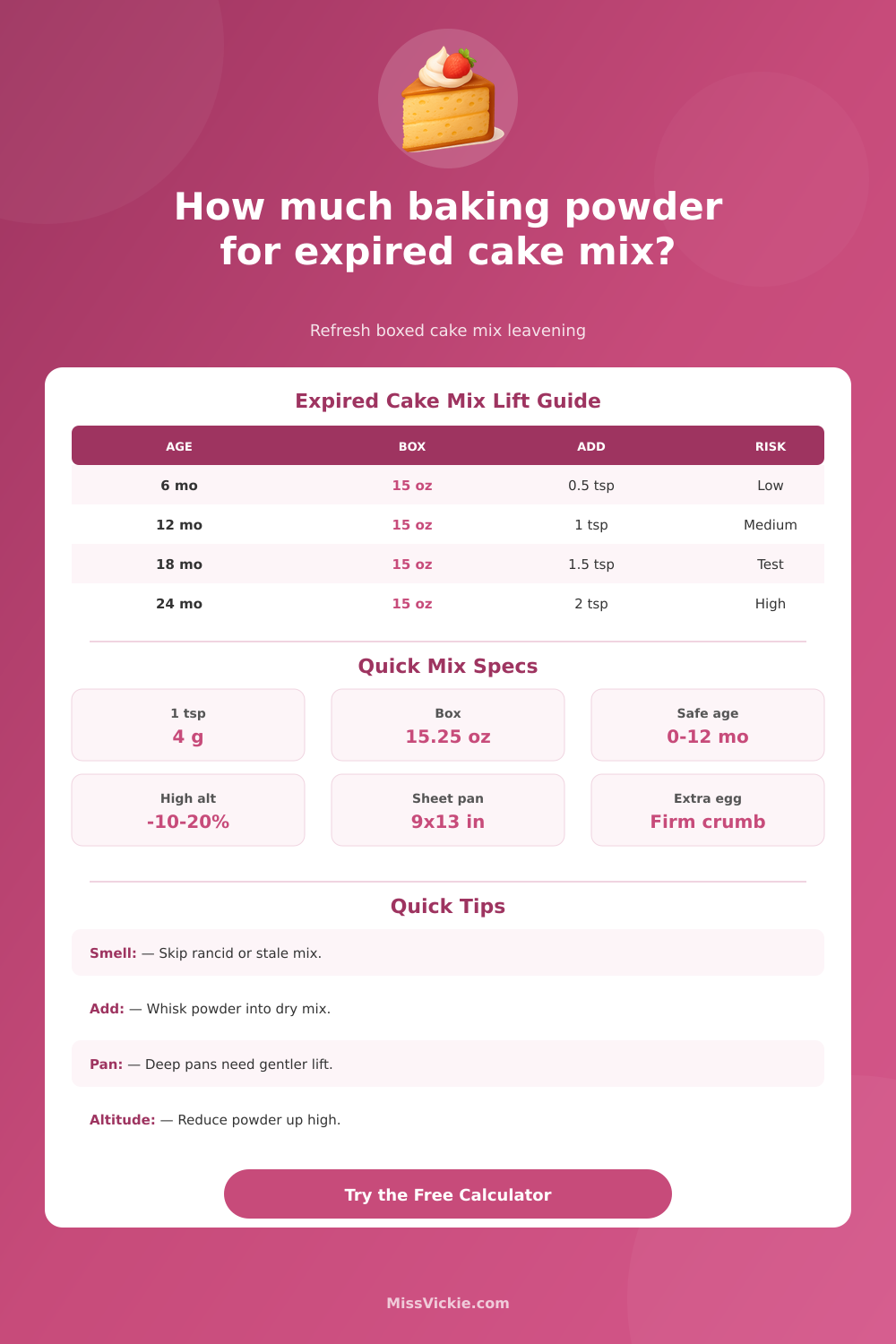
| 12 to 24 months | Significant fade | High flat-cake risk | Use a measured top-up and choose sheet cake or cupcakes. |
| Over 24 months | Unreliable lift | Very unreliable lift | Test-bake a few cupcakes first; discard stale or rancid mix. |
| Mix or batter change | How it affects lift | Calculator adjustment | Practical note |
|---|---|---|---|
| Chocolate mix | Cocoa and darker batters can feel heavier. | Slightly higher fresh-powder equivalent. | Do not double the leavening; bitterness shows quickly. |
| Gluten-free mix | Starches need clean lift but collapse if over-expanded. | Higher base, cautious pan-depth factor. | Prefer cupcakes or a shallow pan for very old boxes. |
| Extra egg | Adds structure and can hold a refreshed rise. | Small reduction in risk, firmer crumb note. | Good for old yellow and chocolate mixes. |
| Extra water | Thins batter and speeds gas movement. | Reduces recommended top-up slightly. | Thin batter plus extra powder can sink in the center. |
| Extra oil or sour cream | Heavier batter needs support but sets slower. | Small increase with a collapse warning. | Use the lower end in deep pans. |
| Condition | Why it matters | Adjustment direction | Best use |
|---|---|---|---|
| Thin 9 x 13 sheet | Batter sets faster and has less center weight. | Allows a modest top-up. | Good choice for older but still pleasant-smelling mix. |
| Two round layers | Standard boxed-cake depth. | Uses balanced rescue math. | Best for boxes under about 18 months past date. |
| Deep bundt or loaf | Center sets slowly and can collapse. | Restrains added powder. | Use a younger box or test as cupcakes first. |
| Above 3500 ft | Gas expands faster before structure sets. | Reduces top-up by altitude band. | Fill pans lower and avoid extra liquid. |
This calculator is an tool that will allow you to determine the amount of fresh baking powder that you will need to add to an old cake mix. Cake mix that contain an old leavening agent will often cause the cake to fail to rise from the baking pan. Too little baking powder will result in a flat cake, yet too much baking powder can lead to a bitter cake or one with a collapsed center.
The first variable to enter into the calculator is the age of the cake mix. Cake mixes that contain leavening agent will often lose some of the strength of that leavening agent with the passage of time. A cake mix that is six months old may experience a small loss of leavening strength, but a mix that is twelve month old past its date will have lost more of it’s leavening strength.
How Much Baking Powder to Add to Old Cake Mix
Mixes that are more than two year old may have such an unreliable original leavening strength that adding more baking powder will not ensure the setting of the cake within the baking pan. The number of months past its date that it has been sitting represents the age of the cake mix. The second variable to enter into the calculator is the weight of the cake mix box.
The amount of original baking powder within a box of cake mix will vary based off the weight of the mix. For instance, a 15-ounce box will contain a different amount of baking powder than a 30-ounce box of the same cake mix. Thus, the weight of the box allows for the recipe suggestions to include the correct amount of baking powder to each box of cake mix.
The third variable to enter is the type of cake mix that you will use. Different types of cake mixes has different densities. For instance, chocolate cake and spice cake mixes are typically heavy with cocoa and spice powders that will inhibit the amount of lift that the baking powder may contribute to the baked good.
Gluten-free cake mixes may use additional starches that may collapse if you add too much baking powder to the mix. Angel food cake mix may have a structure to its composition that will not be able to stand the amount of baking powder that may be necessary for mixes that are low in leavening strength. The fourth variable to be entered is the storage condition of the cake mix.
As with any ingredient, the storage condition can impact the strength of the leavening agents in the mix. If the cake mix has been stored in a cool, sealed container in a pantry, the leavening agents will retain their strength. If, however, the cake mix has been stored in an area that is warm and moist, like in a warm kitchen pantry or with the bag open to the air, the humidity may have reduce the strength of the leavening agents over time.
The fifth variable to be entered into the calculator is the shape and depth of the baking pan that you will use for the cake, as well as the altitude at which the cake is to be baked. The shape and depth of the baking pan can impact the way that the gas created by the baking powder interacts with the structure of the cake to set. Thin cakes will allow for more gas to expand than deep pans.
Finally, the amount of expansion of the gas that is created by the baking powder decreases at lower altitudes, and increases with higher altitudes. Thus, the higher the altitude at which the cake is to be baked, the less baking powder that will be needed. The sixth variable to be entered into the calculator is any other ingredients that may be added to the cake mix.
Eggs will contribute to the structure of the cake, allowing it to contain more baking powder. Oil will increase the weight of the cake mix, requiring the addition of more baking powder. Water, when added to the mix will make the batter thinner, allowing the baking powder to make the batter too softly; thus, more baking powder will cause the batter to over-expand.
The calculator will provide information regarding the amount of baking powder that will need to be added to the cake mix, the total amount of baking powder that will be contain within the cake mix, and the strength of the original leavening agents within the mix. Furthermore, the calculator will provide a check to ensure that the pan that you will use is compatible with the amount of baking powder that will be added to the mix. Finally, the calculator will also provide a warning message should the age of the cake mix be too great, or should the altitude be too high relative to the amount of baking powder that may be required.
Beyond the variables that are to be entered to calculate the amount of baking powder that should be added to the cake mix, the calculator can also be used to perform “what-if” analyses of those variables. For instance, changing the storage condition of the cake mix will allow the user to see in what way different storage condition will change the amount of baking powder that is required. Changing the number of egg that are to be used will allow the user to see the effect upon the amount of baking powder that is required.
Thus, the calculator allows the user to gain an understanding of each of the variables that impact the setting of the cake within the baking pan. By mastering each of these variables, the user may eventually be able to prepare a cake without the use of the calculator. Thus, the addition of this baking powder calculator will assist in the baking process by allowing the user to add a measured amount of baking powder to the mix to prevent the resulting cake from being flat, and to remove the guesswork involve in adding the ingredient to the cake mix.