
When you order a flat white you expect to get something different then what you’d get if you ordered a latte. Less milk in the flat white! What arrives for you is a tiny little cup with very little foam on top. You might find it tastes exactly like your usual coffee. Same caffeine content. Same taste. Same caffeine content.
The problem? When we orders at coffee shops, most of us don’t know that we’re ordering by volume and by texture. We think we’re ordering by flavor and by strength.
How to Choose Your Perfect Coffee Drink
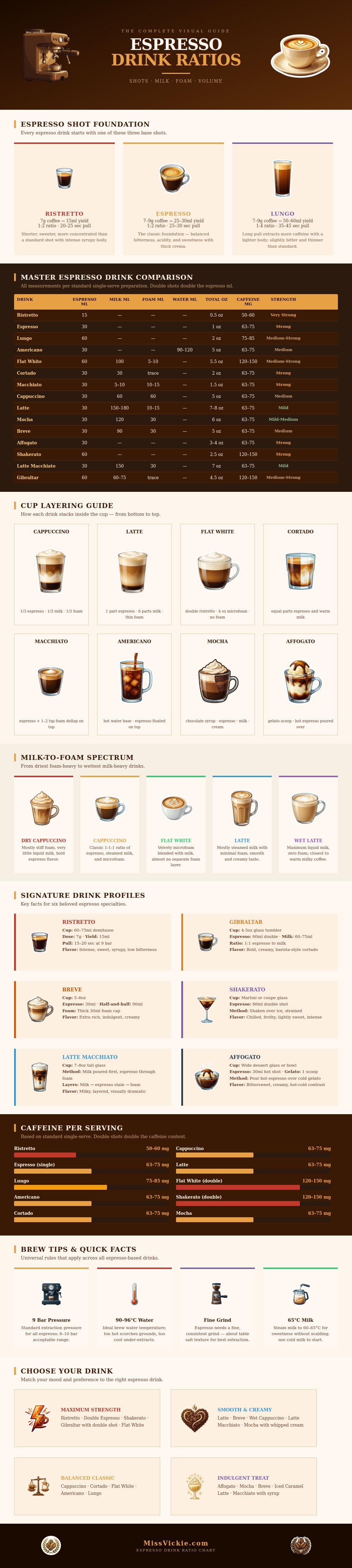
The reason a latte is different from a cappuccino isn’t because of the coffee in the cup. It’s because of the different textures with lattes having a thin layer of microfoam while cappuccinos are defined by stiff foam. You need to forget the name on the menu and consider the ratio.
The base extraction used in every kind of espresso-based beverage is a combination of one of three things… Knowing which one your barista use makes all the difference. There’s the standard espresso, made at a 1:2 ratio between grounds and water; about thirty milliliters brewed over twenty-five seconds. It has a balance of sweetness and acidity.
Then there’s the ristretto, a short pull that grabs onto those sweeter compounds but stops the flow before any bitter oils comes through, resulting in a syrupy, intense beverage. Too many home brewers thinks their coffee tastes weak when it actualy stopped extracting too soon. Letting it go long will brew up something called a lungo. A lungo has more caffeine than say an espresso shot, but it also pulls out more of the harsh, bitter tannins of coffee, resulting in a dry, almost bitter taste.
While a ristretto or lungo could of been made automatically on most commercial machines, it takes some care on the part of the barista to make them. The standard shot is safe, and it’s consistent.
The type of milk used finishes off the flavor of the coffee. Visual charts shows the ratio of ingredients in each type of drink. For example, a Gibraltar and a cortado are similar ideas, just served in different cups. Both have nearly no foam and cut the bitter flavors of the espresso by topping them with equal parts warm milk. They is smooth and strong.
Meanwhile, a latte has a thin layer of microfoam floating atop a large volume of steamed milk. In this drink the espresso remains, though it plays a smaller role compared to the dairy. If you like your coffee creamy and gentle, opt for a latte. If you’d like to experience the milk increasing the characteristics of bean, go for a flat white or cortado.
Note the height of the foam. A pile of rigid foam signals a dry cappuccino: an airy, lightweight experience despite its strong espresso foundation. Conversely, a wet latte will be liquidy and dense. And then there’s the lesser known breve, which replaces regular milk with half-and-half. Half-and-half contains a greater percentage of fat and results in a cup that’s richer and indulgent, sandwiched between a latte and dessert. Heavier, sweeter, and more decadent different than your usual orders, the breve can easily get overlooked since folks aren’t aware that it’s a staple menu item at many shops.
Caffeine addicts also fret about caffeine anxiety. But again, it’s simple math. A bigger cup doesn’t mean more caffeine, sure. However, if it only has one shot of espresso, it’ll have roughly the same amount of caffeine; sixty-three to seventy-five milligrams, as any other drink with a single shot. This is true whether it is diluted in water as an Americano or splashed with foam as a macchiato. You can dilute the strength by adding water, but you won’t change the amount of stimulant.
But to lessen the amount of stimulant, take away the coffee grounds. Drinks such as the Gibraltar or the shakerato are double-shots, so they just has twice the caffeine because they have twice the amount of extracted bean in them.
The trick with espresso ratios is knowing what you like in your mouth. If you prefer something bold and light, get a dry cappuccino. If you’re craving mild sweetness and warmness, go for a latte. Those words on the menu aren’t magical; they describe certain proportions. When you know how these drinks work, you’ll never have to guess again, you’ll create exactly the drink you want. From there, it’s no longer “give me a strong coffee,” but rather “make me this exact combination of taste and texture.” This change in how you think turns an automatic habit into an experience you naturaly enjoy.