Espresso Brew Ratio Calculator
Dial in espresso by solving dose, yield, or ratio while accounting for basket size, roast level, drink style, extraction time, and preferred strength.
Load a common bar setup, then adjust dose, yield, basket size, roast, drink style, extraction time, and strength for your own machine.
Espresso Brew Breakdown
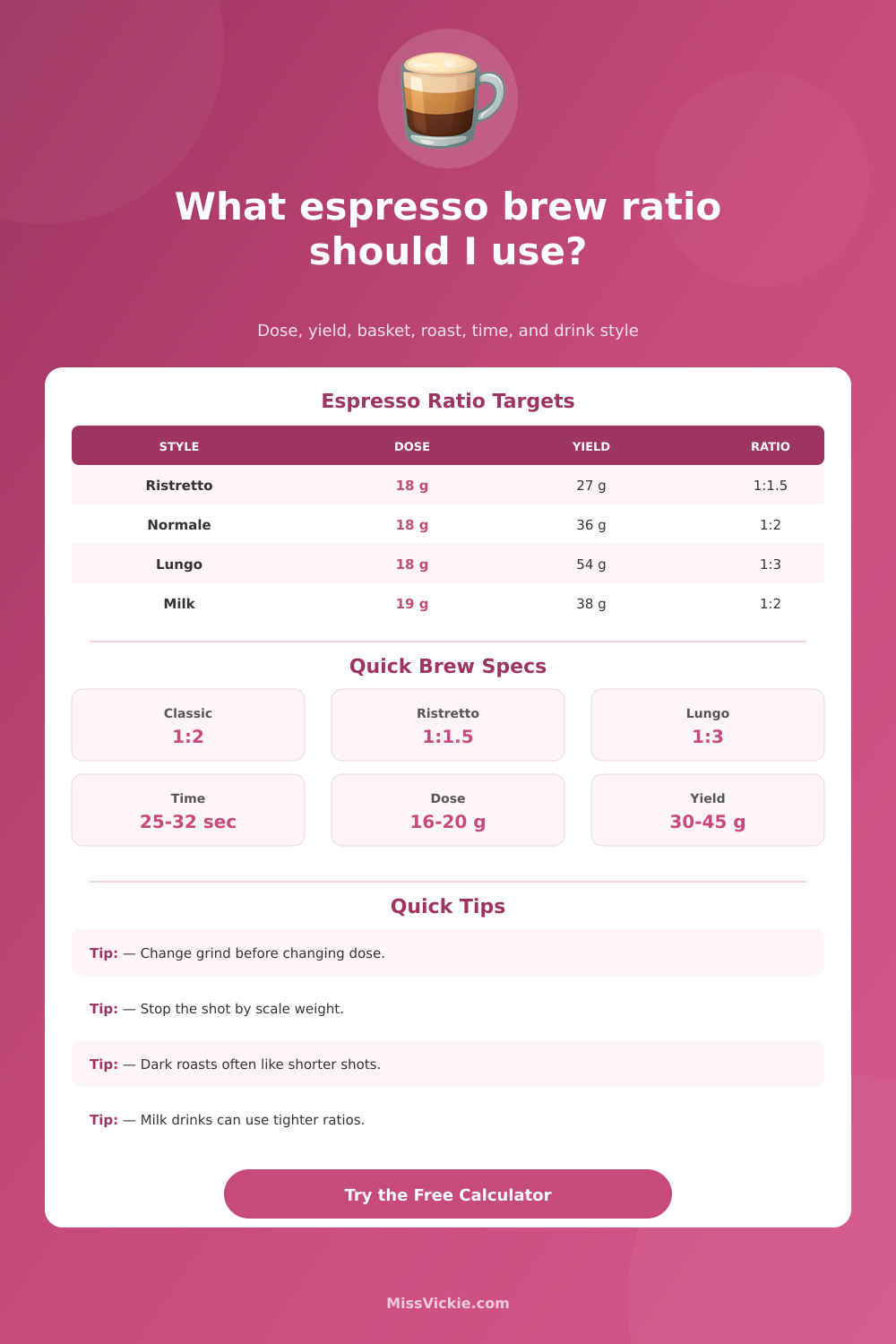
| Shot Style | Typical Dose | Yield Target | Brew Ratio |
|---|---|---|---|
| Ristretto | 16-20 g | 22-32 g | 1:1.2 to 1:1.7 |
| Normale espresso | 16-20 g | 32-42 g | 1:1.8 to 1:2.2 |
| Modern light roast | 18-21 g | 45-58 g | 1:2.4 to 1:2.8 |
| Lungo | 14-18 g | 42-60 g | 1:2.8 to 1:3.5 |
| Milk drink base | 18-21 g | 30-42 g | 1:1.7 to 1:2.2 |
| Basket | Comfort Dose | Risk Zone | Best Use |
|---|---|---|---|
| Single basket | 7-10 g | Below 6 g or above 11 g | Single straight espresso |
| Small double | 14-16 g | Above 17 g | Traditional double |
| Double basket | 16-20 g | Below 15 g or above 21 g | Daily espresso and milk drinks |
| Precision double | 18-22 g | Above 23 g | Modern specialty recipes |
| Triple basket | 20-24 g | Below 19 g or above 25 g | Large milk drinks |
| Deep triple | 24-28 g | Above 30 g | High output service shots |
| Time | Common Taste | Likely Cause | First Adjustment |
|---|---|---|---|
| Under 20 seconds | Sharp, thin, sour | Grind too coarse or dose too low | Grind finer or add 0.5 g |
| 20-24 seconds | Bright and light | Fast flow for classic espresso | Finer grind, same yield |
| 25-32 seconds | Sweet and balanced | Normal extraction range | Adjust by taste only |
| 33-40 seconds | Heavy, dry, bitter edge | Flow is restricted | Grind coarser or lower dose |
| Over 40 seconds | Harsh or stalled | Too fine, too much coffee, or puck issue | Coarser grind and check prep |
| Roast or Goal | Ratio Direction | Time Range | Flavor Aim |
|---|---|---|---|
| Light roast | Longer, 1:2.4 to 1:2.8 | 28-36 seconds | Clarity, fruit, less sourness |
| Medium roast | Classic, 1:1.9 to 1:2.3 | 25-32 seconds | Sweetness and balance |
| Dark roast | Shorter, 1:1.5 to 1:1.9 | 22-29 seconds | Lower bitterness, round body |
| Bold strength | Shorter or higher dose | 24-31 seconds | Syrup body and milk presence |
| High clarity | Longer and clean | 28-35 seconds | More separation and sweetness |
Balanced sweetness, body, and finish with a classic double basket.
Dense and sweet with less yield, useful when bitterness appears early.
Slightly open shot carries through dilution without tasting hollow.
Tight double or double ristretto keeps coffee flavor present in milk.
Balanced espresso works well against foam and a compact milk volume.
Use a bold base or larger dose so the drink does not taste too milky.
Shorter yield gives syrupy intensity beside equal-ish steamed milk.
Short, concentrated espresso stays clear under a small spoon of foam.
The espresso brew ratio is the relationship between the amount of ground coffees that is in the basket and the weight of the liquid espresso that comes out of an espresso machine. The espresso brew ratio can be expressed as single number to indicate the relationship between the two variables. You calculate the espresso brew ratio by dividing the weight of the liquid espresso (the yield) by the weight of the ground coffee (the dose) that was used in the espresso machine.
For example, if the espresso brew ratio is 1:2, then the yield will be twice the weight of a dose. If the dose are 18 grams, then the yield should weigh 36 grams of espresso. The dose of ground coffee is important in determining the physical space that the ground coffee will take up within the basket.
What Is Espresso Brew Ratio and How to Use It
If the dose is too low for the size of the basket (especially double basket espresso machines), then the water will pass quick through the coffee grounds to extract the espresso, resulting in a fast shot of espresso. If the dose is too high for the size of the basket, the coffee will create a puck that resist the passage of the water through it, resulting in a slow shot of espresso. In addition to the size of the basket, there is also the space for the brewed espresso to exit the machine.
If there is low headspace within the machine (space between the coffee puck and the screen), then there is very little space for the espresso to exit the machine. Extra headspace provide more physical space for the espresso to exit the machine. The roast level of the coffee will impact the espresso brew ratio that is used when brewing espresso.
Light roast coffees contain more gas, and it takes longer for these coffees to release the sweetness from the coffee. Dark roast coffees release the soluble compounds in the coffee quick, which means the dark roast coffee can become bitter if it remains in contact with the water. Because the chemistry of the coffee is different based on the roast level, the brew ratio and extraction time of espresso needs to be adjusted to match the type of roast coffee beans that are being use to brew the espresso.
The style of coffee drink that is to be prepared will impact the espresso brew ratio that is used in the preparation of the coffee. For instance, a flat white uses a 1:2 (or tight) espresso brew ratio to allow the espresso to stand up to the milk when poured into the flat white. A latte uses a longer espresso brew ratio because it contains more milk than a flat white.
An Americano requires a higher yield of espresso than a straight shot of espresso because it is diluted with water. A calculator can be used to determine the different espresso brew ratios for each style of coffee drink; the calculator provides a starting point for adjusting the espresso brew ratio. Extraction time is the amount of time that the water is in contact with the coffee.
For medium roast coffee beans, the extraction time for espresso should be between 25 and 32 seconds with a 1:2 espresso brew ratio. If the extraction time is too fast, the espresso will often taste sour because the water did not have enough time to extract the sugars from the coffee. If the extraction time is too slow, the espresso will often taste bitter because too much compounds were extracted by the water that passed through the coffee.
If the extraction time is too fast, then a finer grind of coffee should be used. Coarser grounds should be used if the espresso shots take too long to brew. The last of the five variables to decide is the target strength of the espresso.
If the target is to produce a soft and sweet espresso shot, then a longer espresso brew ratio should be used. For those who desire a bold espresso taste, a shorter espresso brew ratio or higher dose of ground coffee should be used. For espresso shots with high clarity of flavor, a longer espresso brew ratio should be used.
While the espresso strength target will determine the setting of the calculator, the target strength of the espresso should be chosen after the choice of roast level and drink style. The weight should stop the espresso shot rather than time or visual observation of the espresso shot. The target weight of the espresso shot should be set on a scale.
Starting the espresso machine pump will start the brewing process, and the espresso shot should be allowed to run until the scale indicate that the espresso shot has reached the target weight. By stopping the espresso shot by weight rather than time, the brew ratio becomes a plan. Prior to adjusting the espresso brew ratio, the extraction time must first be ensured to be within the correct amount of time.
If the espresso shot extraction time is too slow or too fast, adjusting the espresso brew ratio will not provide the desired flavor for the espresso shot. Adjusting the size of the ground coffee will fix the extraction time; adjusting the espresso brew ratio will fix the taste after the extraction time is correct.