☕ Caffeine in Espresso Beans Calculator
Estimate caffeine content by bean count, weight, or number of espresso shots
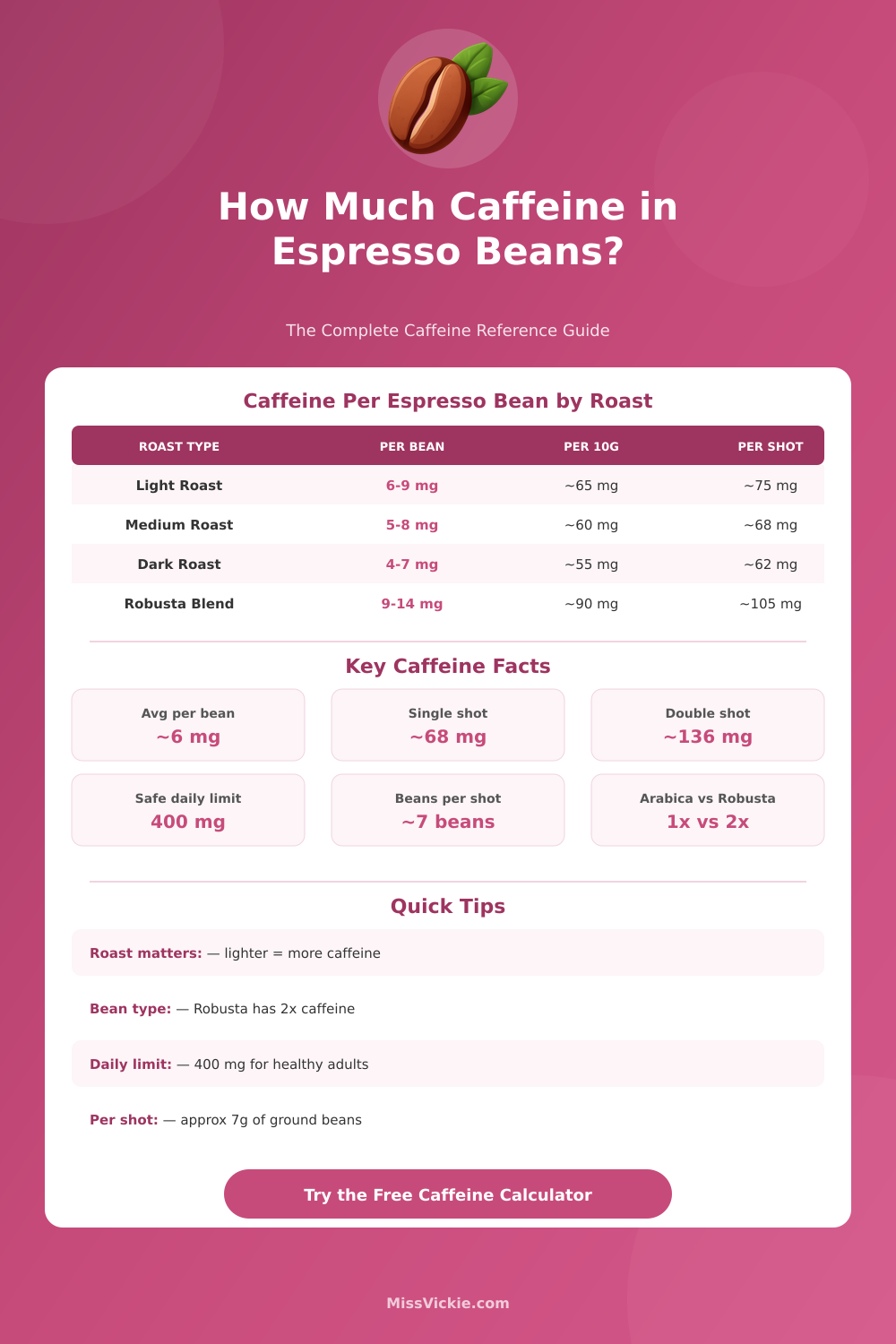
| Bean Type | Roast | Caffeine/Bean (mg) | Caffeine/10g (mg) | Caffeine/oz (mg) |
|---|---|---|---|---|
| Arabica | Light | 6–9 | 63–75 | 180–213 |
| Arabica | Medium | 5–8 | 58–68 | 164–193 |
| Arabica | Dark | 4–7 | 53–62 | 150–176 |
| Robusta | Light | 10–16 | 100–130 | 284–369 |
| Robusta | Medium | 9–14 | 90–115 | 255–326 |
| Robusta | Dark | 8–12 | 80–100 | 227–284 |
| Blend (70/30) | Medium | 6–10 | 65–82 | 184–233 |
| Shot Type | Dose (g) | Volume (ml) | Arabica (mg) | Robusta (mg) |
|---|---|---|---|---|
| Ristretto | 7g | 15–20ml | 55–65 | 100–120 |
| Single Shot | 7–9g | 25–35ml | 60–75 | 110–135 |
| Double Shot | 14–18g | 50–70ml | 120–150 | 220–270 |
| Triple Shot | 21–27g | 75–105ml | 180–225 | 330–405 |
| Lungo | 7–9g | 60–100ml | 65–80 | 115–145 |
| Serving Size | Bean Count | Bean Caffeine (mg) | Chocolate Caffeine (mg) | Total (mg) |
|---|---|---|---|---|
| Small snack | 5 beans | ~30 | ~15 | ~45 |
| Typical serving | 10 beans | ~60 | ~30 | ~90 |
| Large snack | 20 beans | ~120 | ~60 | ~180 |
| 1 oz bag (~28g) | ~28 beans | ~168 | ~84 | ~252 |
| 2 oz bag (~57g) | ~56 beans | ~336 | ~168 | ~504 |
| Weight (g) | Weight (oz) | Approx. Bean Count | Arabica Caffeine (mg) | Robusta Caffeine (mg) |
|---|---|---|---|---|
| 5g | 0.18 oz | ~5 | ~32 | ~58 |
| 7g | 0.25 oz | ~7 | ~45 | ~82 |
| 10g | 0.35 oz | ~10 | ~64 | ~117 |
| 14g | 0.49 oz | ~14 | ~90 | ~163 |
| 28g | 1 oz | ~28 | ~179 | ~326 |
| 57g | 2 oz | ~57 | ~365 | ~664 |
| 100g | 3.5 oz | ~100 | ~640 | ~1165 |
Espresso beans do not really form a separate kind of beans. Really espresso is only a way to prepare coffee, not the coffee itself. One can use any beans from any region, kind or origin to create espresso.
Whether that be single origin or mixed, it does not matter. What sells under the label “espresso beans” simply are special recipes or brand names. Usually it is made up of dark roasts and sometimes a mix from Robusta and Arabica.
What are espresso beans?
Compared with usual coffee beans, espresso beans on average use longer roasting, one grinds them more finely and prepares under pressure. That results in a very dense and tasty shot, that one drinks alone or as a base for milk drinks. Espresso started in Italy and evolved to one of the favourite ways to prepare coffee around the globe.
Average serving stays small, almost 25 to 30 ml, with dark body cvoered by light foam.
In the supermarkets beans for espresso roast usually very dark. Even so no law requires such dark roasting. Medium roast works well also.
Traditional European espresso commonly prepares from more dark roasts, with high share of Arabica over Robusta to balance the bitterness. Level “Full City” of roast is typical for espresso, that results less dark then French or Italian roasts.
Bean labelled as espresso can prepare also as filtered coffee, French press or any other way. Buying fresh beans of any kind and grinding them well just before preparing, one gets espresso taste much more rich. Beans roasted between seven and twenty-one days before tend to work best.
Fresh coffee holds more gas, what creates resistance during drawing the shot.
Individual espresso shot uses 7 to 8 grams of coffee, what matches about 55 beans. Double shot requires around 14 grams or about 110 beans. One must expect a bit of difference according to size of the beans and level of roast.
According to taste, there is big variety. African beans or light roasts tend to be fruity and flowery. Brazilian beans usually bring nuts and sweet hints.
Some espresso mixes have traces of dried fruits, almond and honey. Others twist chocolate with softness of brown sugar. Try experimenting with grind size, tamping and temperature until everything works out.
The beans themselves form one of the main elements for good espresso. Find a bean, that well fits and answers to own taste, that is themain target.
Chocolate covered espresso beans form a popular food. About 8 to 12 of them match the caffeine in one cup of prepared coffee. Good amount to eat is around 5 to 10 beans, to reach a nice caffeine boost without too much of it.