Equilibrium Bacon Cure Calculator
Size an equilibrium bacon cure from meat weight and added water, including salt percentage, Cure #1 ppm, sugar, spices, thickness-based cure days, bag turnover, smoke loss, and finished salt estimate.
🥓Equilibrium bacon presets
Pick a starting plan, then adjust the meat weight, added water, Cure #1 ppm, salt, sugar, spice, thickness, bag turn interval, and smoke loss for your slab.
⚖Calculator units
🥩Meat, water, and thickness
🧂Salt, Cure #1, sugar, and spice targets
⏱Cure days, bag turnover, and smoke loss
Equilibrium bacon cure plan
Detailed cure breakdown
Enter your bacon cure details, then calculate.
📊Equilibrium cure reference cards
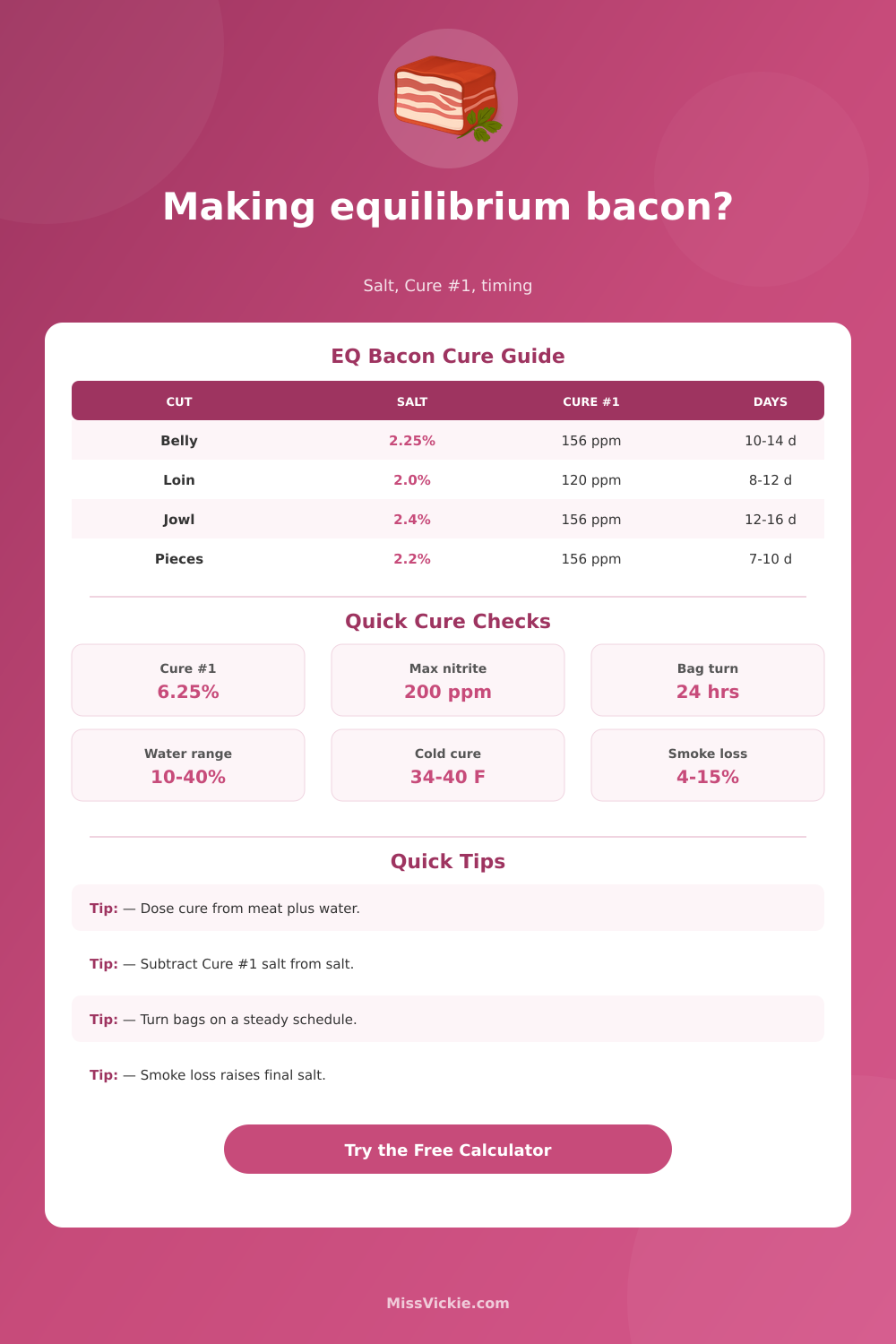
Common bacon range before final smoke concentration.
Typical planning range, with 200 ppm as a common upper check.
Enough water to dissolve cure without diluting the plan too far.
Daily turning keeps bag brine moving over all meat surfaces.
📘Cut and thickness timing table
| Bacon cut | Typical thickness | EQ cure time | Notes for turnover and smoke loss |
|---|---|---|---|
| Pork belly slab | 3.5 to 5 cm / 1.4 to 2 in | 10 to 14 days | Turn daily; warm smoke often loses 6 to 10% after draining. |
| Extra-thick belly | 5.5 to 7 cm / 2.2 to 2.8 in | 14 to 18 days | Add cushion time and massage brine into the thick end when turning. |
| Canadian bacon loin | 4 to 6 cm / 1.6 to 2.4 in | 8 to 12 days | Lean meat loses less fat but can dry quickly during hot smoking. |
| Jowl bacon | 4 to 6.5 cm / 1.6 to 2.6 in | 12 to 16 days | Curves and fat pockets benefit from steady bag repositioning. |
| Belly ends or pieces | 2 to 3.5 cm / 0.8 to 1.4 in | 7 to 10 days | More exposed edge area means faster equilibration and drying. |
🧪Salt and Cure #1 calculation table
| Target item | Calculation base | Formula used | Why it matters |
|---|---|---|---|
| Total salt | Meat plus added water | System weight x salt percent | Equilibrium cures dose the whole closed cure system. |
| Cure #1 | Meat plus added water | System weight x ppm / nitrite fraction | Standard Cure #1 uses 6.25% nitrite for ppm math. |
| Plain salt | Total salt minus Cure #1 salt | Total salt - Cure #1 x 93.75% | Prevents Cure #1 salt from making the cure saltier than intended. |
| Final salt estimate | Retained salt and finished meat | Retained salt / finished weight | Smoking and drying remove water, so finished salt percentage rises. |
✅Practical cure notes
Weigh accurately: Cure #1 should be weighed on a gram scale that can resolve small amounts, especially for small bacon batches.
Use a closed system: Equilibrium math assumes the meat, water, salt, sugar, and Cure #1 stay together until the cure is done.
Turn the bag: Daily turning or massaging moves brine across thick ends, skin edges, seams, and folded corners.
Check the final salt: Heavy smoke loss concentrates salt, so a mild cure can taste stronger after drying.
The Equilibrium curing also alters your bacon making mindset. Because it’s a weighted cure, the salt, sugar, and nitrates will all spread into meat (and any water added to bag). They spread based off their ratio to everything else in the bag. It’s an all-in-one-closed-system method: meat plus whatever water is added are treated like one. So instead of calculating the salt, sugar, and nitrites by weight of the meat alone, you do them by total weight (meat+water). That eliminates much of old guesswork. You’ll know exactly how salty finished slab will be before it touches the smoker.
This is where you take charge. Your inputs determines the process. How much water? That determines the rate of cure and wiggle room on the timeline. Too little water, and you risk having an overly concentrated brine up top. Too much, and you’ll prolong the number of days until salt has a chance to even out.
How Equilibrium Curing Works
And then there’s thickness. As it turns out, that matters more than many might think. A belly with a thickness of four centimeters will complete faster then a belly with a thickness of six centimeters. That’s why the calculator I created (above) factors in your chosen cut and adjusts starting time accordingly. Then there’s temperature. It’s a constant. Maintain your cure somewhere between about thirty-four and forty degrees Fahrenheit, and not only will the bacteria slows its growth, but so will the salt, even if at a manageable pace.
Once you have those numbers you know what to do next, the outputs tells you what that should of be. Cure #1 is sized to reach desired nitrite level throughout the whole system. Plain salt has had the salt content of the curing mix deducted. Cure days and turn count is based on the thickness, size of container, and additional buffer days you desire. Turns ensures the brine moves around folds & fat pockets so it doesn’t stall anywhere. The final salt estimate gives an idea of how much salt is left on meat after rinsing, draining, and losing moisture during smoking. Remember, smoke also removes water; this raises the proportion of remaining salt. This tells you if your initial target was mild enough for type of bacon you’re aiming at.
Common mistakes usualy come from treating equilibrium curing like a scaled-up wet brine. A person adds some water but doesn’t change overall salt level. Or they skip the turn schedule and wonder why it didn’t all taste the same. That’s where this tool helps: it makes you put every variable in the same equation, so it keeps you from making common errors.
But there is space left for judgement. How much spice do you think will fit with the flavors you are trying to achieve? How much sugar? What kind of smoke style do you think would work best? Does that match what you have available to dry? That consistency pays off. If I want to make a larger batch, for example, I can do it again. I could also make one with smaller bellies, or even one with less salt so I can play with the final salt concentration and know the nitrites will end up where I want them. It makes this a project you can schedule around, not something you has to do every single year.