Eggs Per Pound Meatball Calculator
Scale whole eggs, beaten egg volume, crumbs, panade liquid, and meatball yield for beef, pork, turkey, lamb, chicken, veal, and blended meatball batches.
🍳 Meatball Batch Presets
Choose a real meatball style, then adjust meat weight, egg size, binder amount, moisture level, target texture, and meatball size.
⚖ Meatball Mix Details
Meatball egg ratio
Enter a meatball batch to calculate the egg, binder, liquid, and yield.
Egg Ratio Breakdown
Binder, Moisture, And Yield
📊 Fast Meatball Batch Checks
🥚 Egg Size Reference
| Egg Size Or Product | Approx Edible Weight | Approx Beaten Volume | Meatball Use | Practical Measuring Note |
|---|---|---|---|---|
| Medium egg | 44 g without shell | About 2 2/3 tbsp | Small batches when large eggs would over-bind | Use 1 medium for about 0.8 to 1 lb of balanced meat mix. |
| Large egg | 50 g without shell | About 3 1/4 tbsp | Most meatball recipes and scaling formulas | One large egg per pound is firm; 3/4 egg per pound is tender. |
| Extra large egg | 56 g without shell | About 3 2/3 tbsp | Lean turkey, chicken, or dry crumb mixes | Use a little less than the count if converting from large eggs. |
| Jumbo egg | 63 g without shell | About 4 tbsp | Large party batches where fractions are easy | One jumbo egg binds about 1 1/4 lb classic meatball mix. |
| Large egg yolk | 18 g yolk only | About 1 tbsp | Rich tender meatballs without extra watery white | Two yolks can replace one whole egg for a softer bite. |
| Liquid whole egg | 50 g per large egg | 3 tbsp per large egg | Precise measuring for odd weights | Measure the calculator volume directly from the carton. |
Egg weights reflect common USDA size standards by total shell egg class; edible weights and tablespoons are practical kitchen approximations for beaten eggs.
🍖 Meatball Style Ratio Table
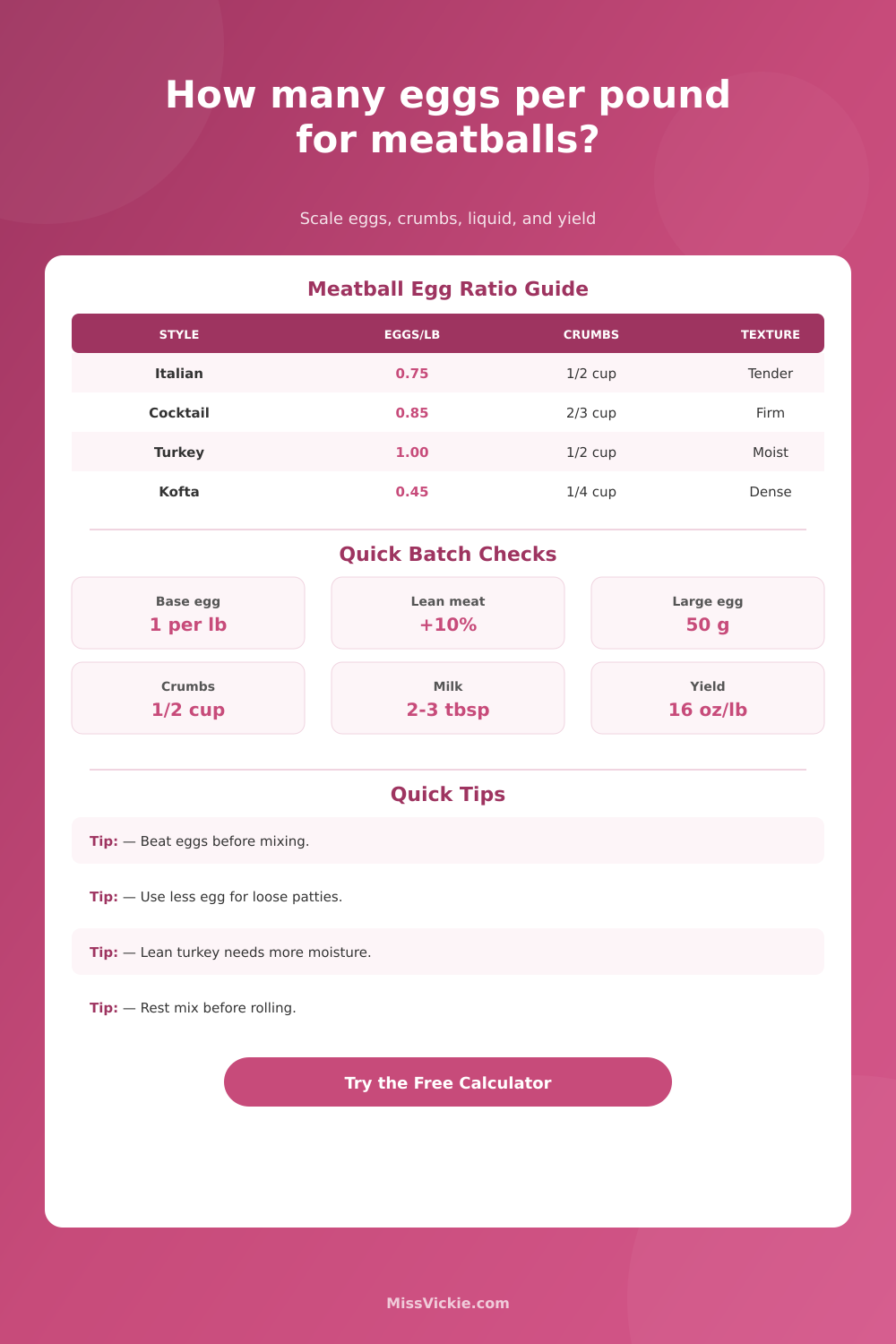
| Meatball Style | Useful Egg Ratio | Binder Per Pound | Liquid Per Pound | Best Texture Target |
|---|---|---|---|---|
| Tender Italian sauce meatballs | 0.70 to 0.85 large egg per lb | 1/3 to 1/2 cup crumbs | 2 to 3 tbsp milk or water | Soft enough to simmer without becoming rubbery. |
| Swedish dinner meatballs | 0.85 to 1.00 large egg per lb | 1/2 cup fine crumbs | 3 to 4 tbsp milk or cream | Fine, tender, and firm enough for skillet turning. |
| Cocktail or buffet meatballs | 0.90 to 1.10 large egg per lb | 1/2 to 2/3 cup dry crumbs | 2 to 3 tbsp liquid | Firm enough to hold on picks and trays. |
| Lean turkey or chicken meatballs | 0.95 to 1.15 large egg per lb | 1/2 cup crumbs or oats | 3 to 5 tbsp liquid | Moist, cohesive, and protected from dry heat. |
| Lamb kofta or kebab shaped mix | 0.35 to 0.55 large egg per lb | 0 to 1/4 cup crumbs | 0 to 2 tbsp liquid | Dense enough to grip skewers or hold oblong shapes. |
| Cheese stuffed meatballs | 0.95 to 1.15 large egg per lb | 1/2 cup crumbs | 1 to 2 tbsp liquid | Firm shell around filling, with less added liquid. |
🍞 Binder And Panade Reference
| Binder Choice | Usual Amount Per Pound | Liquid Pairing | Egg Effect | Meatball Texture Note |
|---|---|---|---|---|
| Fresh bread crumbs | 1/2 to 3/4 cup | 1 to 2 tbsp milk | Needs slightly less egg than dry crumbs | Softest bite for sauce meatballs and veal blends. |
| Dry bread crumbs | 1/3 to 1/2 cup | 2 to 4 tbsp milk | Baseline egg setting | Classic pantry binder with predictable absorption. |
| Panko crumbs | 1/2 to 2/3 cup | 3 to 5 tbsp milk | May need a touch more beaten egg | Light texture, but dry flakes should hydrate before rolling. |
| Cracker crumbs | 1/3 to 1/2 cup | 1 to 3 tbsp liquid | May need less salt and standard egg | Good for baked and buffet meatballs. |
| Quick oats | 1/3 to 1/2 cup | 3 to 5 tbsp milk or broth | Usually needs a full egg per lb | Rest the mix longer so oats soften. |
| Cooked rice | 1/3 to 2/3 cup | 0 to 2 tbsp liquid | Lower egg if rice is sticky | Useful for gluten free or porcupine style meatballs. |
📏 Common Batch Scaling Table
| Raw Meat Weight | Tender Sauce Meatballs | Firm Baked Meatballs | Lean Poultry Meatballs | Approx Classic Yield |
|---|---|---|---|---|
| 1 lb meat | 3/4 large egg, or 2 1/2 tbsp beaten | 1 large egg | 1 large egg plus extra liquid | 12 to 14 medium meatballs |
| 2 lb meat | 1 1/2 large eggs, or 5 tbsp beaten | 2 large eggs | 2 to 2 1/4 large eggs | 24 to 28 medium meatballs |
| 3 lb meat | 2 to 2 1/2 large eggs | 3 large eggs | 3 to 3 1/2 large eggs | 36 to 42 medium meatballs |
| 5 lb meat | 4 large eggs, lightly beaten | 5 large eggs | 5 to 6 large eggs | 60 to 70 medium meatballs |
| 10 lb meat | 7 to 8 large eggs | 10 large eggs | 10 to 11 large eggs | 120 to 140 medium meatballs |
🧪 Egg Ratio Comparison Grid
Soft meatballs for gentle simmering after browning.
Balanced hold with crumbs, herbs, onion, and cheese.
Better for baking, reheating, and tray service.
More binding and moisture for turkey or chicken.
💡 Meatball Mixing Tips
Use it to calculate how much egg is needed per pound of meatballs. Just enter weight of meat you’re using plus which texture you prefer. Your results is a precise ratio. That way, you use the right amount of egg. This ensures the meatballs aren’t too loose or to dry.
For most cooks, it’s either a whole egg or nothing at all. Here the calculator consider the egg a changing amount instead of a set amount. You may need different amounts depending on whether you want a meatball on a toothpick or one cooked until tender in tomato sauce. The former has to be sturdier to withstand being skewered, while the other will be looser and need fewer binder.
How Much Egg to Use in Meatballs
The calculator take this into consideration by looking at the meat’s fat content. Fatty ground beef holds onto moisture better than leaner meats such as turkey, which is why a higher percentage of binding ingredients is used in recipe for tenderness.
What matters are which binder you use. Oats and breadcrumbs soak up some of the moisture in the egg (and any milk). Dry breadcrumbs will absorbs more moisture than fresh breadcrumbs. This helps keep meat moist. So if you are using fresh breadcrumbs then perhaps you require slightly less egg? It all depends on what sort of binder you choose and this will change your required liquid ratio (see table below). Changing the type of breadcrumb (e.g., swapping dry panko for fresh) without altering amount of egg can be fatal. The panko soaks up the binder, resulting in a looser meat mixture. Be sure to adjust the egg amount when switching breadcrumb types.
With leaner meats you have issues. Poultry like ground chicken and turkey are lower in fat compared to pork and beef. What does fat do? It lubricate the mixture. If there is not enough fat, you may end up with a dry and crumbly mixture based off ingredients used. Why use an egg at all? An egg add moisture but also some structure. More egg are required with poultry. This is because you are not just binding the meat, you are also adding moisture. A bit more yolk can help here. Yolk has richness and fat while egg white adds water which will dilate the flavor. This subtle change improve the finished texture.
Finally, we must let it rest. After mixing, set aside in bowl for at least ten minutes. Why? There is two reasons. The breadcrumbs soak up the moisture, but more importantly, the proteins relaxes. You don’t want to form your meatballs and then have them disintegrate as they cook. Give the binding agents time to do their job. Whether you’re making a pound or a ten-pound batch this is essential. The principles is identical. Bind with purpose; rest patiently.
There’s no mystery about how much egg is needed; simply understand the physical properties of what you’re working with, you should of known that.