Egg noodle yield, broth absorption, and soup balance
How Many Egg Noodles For Chicken Noodle Soup Calculator
Calculate dry egg noodles for chicken noodle soup by servings, bowl size, noodle cut, soup style, broth ratio, chicken load, vegetables, cooking method, and leftover plans.
Choose a real soup scenario, then adjust the noodle weight, broth target, holding buffer, and absorption settings for your pot.
Soup Balance Breakdown
| Noodle Type | Dry Per Classic Bowl | Cooked Yield | Broth Absorbed | Best Use |
|---|---|---|---|---|
| Wide dry egg noodles | 1.5 oz / 43 g | About 2.7x dry weight | 0.34 cup per dry oz | Balanced chicken noodle soup |
| Medium dry egg noodles | 1.4 oz / 40 g | About 2.8x dry weight | 0.30 cup per dry oz | Clearer soup with smaller bites |
| Extra-wide egg noodles | 1.6 oz / 45 g | About 2.6x dry weight | 0.38 cup per dry oz | Rustic bowls and short holds |
| Homestyle thick noodles | 1.8 oz / 51 g | About 2.5x dry weight | 0.42 cup per dry oz | Hearty soup with extra broth |
| Fresh egg noodles | 2.2 oz / 62 g fresh | About 1.6x fresh weight | 0.18 cup per fresh oz | Fast-cooking delicate soup |
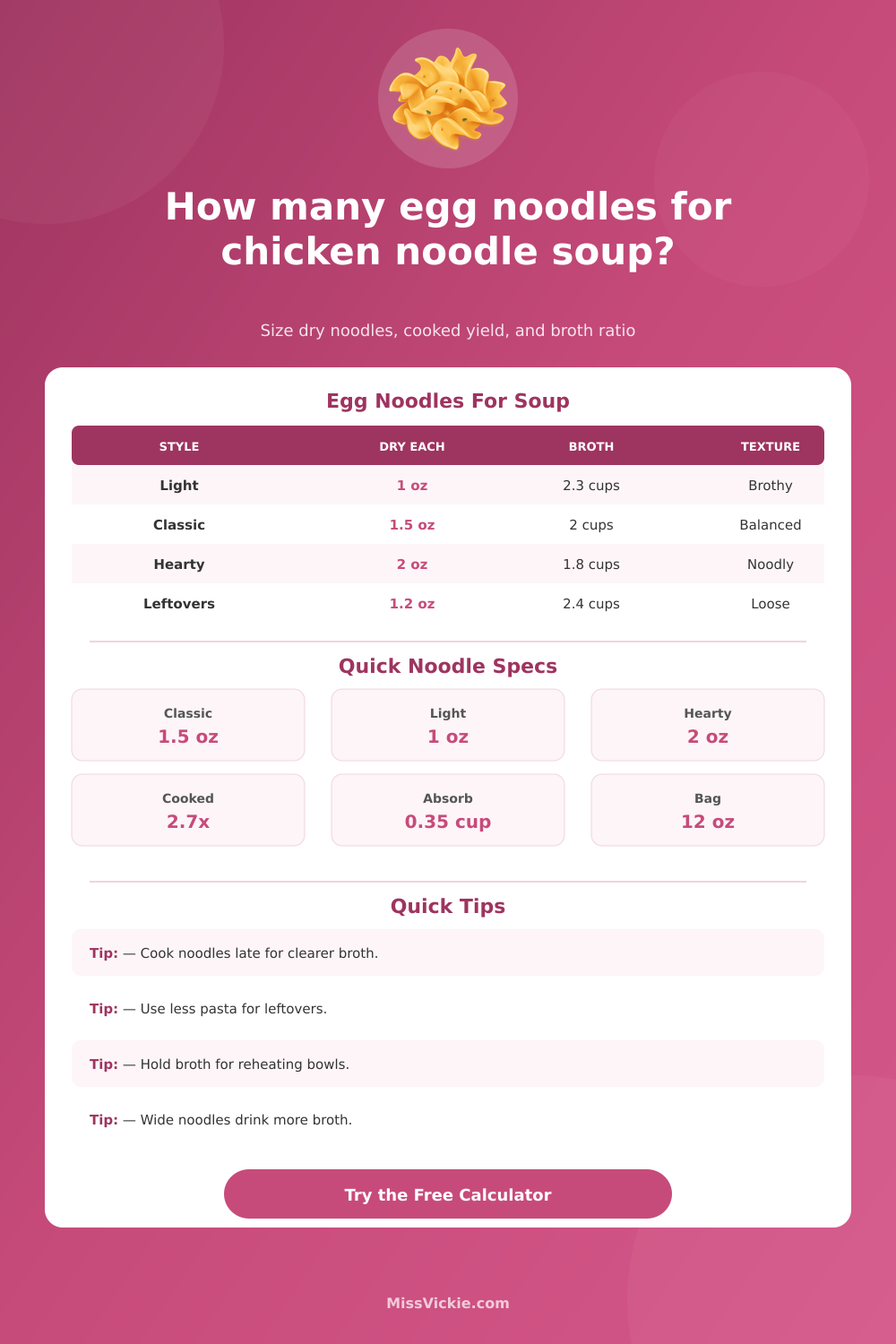
| Soup Style | Dry Noodles Each | Starting Broth Each | Finished Texture | Leftover Advice |
|---|---|---|---|---|
| Light and brothy | 0.9 to 1.1 oz | 2.2 to 2.5 cups | Loose broth with small noodle share | Good as-is for next day |
| Classic balanced | 1.25 to 1.75 oz | 1.9 to 2.2 cups | Noticeable noodles without crowding | Hold back broth if storing |
| Hearty noodle-forward | 1.8 to 2.2 oz | 1.8 to 2.1 cups | Thick bowl with generous noodles | Add broth before reheating |
| Buffet or holding warm | 1.1 to 1.4 oz | 2.3 to 2.7 cups | Stays spoonable longer | Cook noodles separately if possible |
| Servings | Light Noodles | Classic Noodles | Hearty Noodles | Classic Broth Start |
|---|---|---|---|---|
| 4 bowls | 4 oz / 113 g | 6 oz / 170 g | 8 oz / 227 g | 9 to 10 cups |
| 6 bowls | 6 oz / 170 g | 9 oz / 255 g | 12 oz / 340 g | 13 to 15 cups |
| 8 bowls | 8 oz / 227 g | 12 oz / 340 g | 16 oz / 454 g | 18 to 20 cups |
| 12 bowls | 12 oz / 340 g | 18 oz / 510 g | 24 oz / 680 g | 27 to 30 cups |
| 16 bowls | 16 oz / 454 g | 24 oz / 680 g | 32 oz / 907 g | 36 to 40 cups |
| Cooking Method | Noodle Adjustment | Broth Adjustment | Why It Matters |
|---|---|---|---|
| Cook in soup | Use normal amount | Add full absorption allowance | Noodles season well but drink broth. |
| Add late | Use normal amount | Slightly less absorption | Cleaner texture for same-day serving. |
| Cook separately | Use 5% more if rinsed | Use less absorption allowance | Best for leftovers and clear broth. |
| Hold warm | Use 10% fewer noodles | Add a larger buffer | Prevents a pot of swollen noodles. |
Use when chicken and broth should lead the bowl.
The best starting point for most chicken noodle soup.
Choose this for a filling main-dish soup.
Lower noodles leave room for overnight absorption.
When preparing a pot of chicken noodle soup, one must decide how many egg noodle to add to the pot. The amount of egg noodles that are added to the chicken noodle soup are important due to the fact that egg noodles will absorb the liquid in which they are cooked. Adding too few egg noodles to the chicken noodle soup will result in the soup have a thin and watery flavor.
Adding too many egg noodles to the chicken noodle soup will cause the egg noodles to absorb all of the broth in the pot, resulting in a thick and dense pot of soup. Egg noodles has a tendency to swell and soften when cooked in hot broth. Thus, chicken noodle soup will thicken once the egg noodles are added to the broth due to the liquids that the noodles absorb.
How Many Egg Noodles to Use in Chicken Noodle Soup
The fact that egg noodles absorb broth is essential to the preparation of such a soup. The wide egg noodles absorb broth at a rate of approximately one-third of a cup of liquid for each ounce of dry egg noodles. Fine egg noodles will absorb less of the broth then the wide noodles.
The egg noodles absorb an amount of broth that becomes more apparent once the soup is removed from the stove. The chicken noodle soup may appear to be the correct thickness while cooking on the stove, however, the noodles will continue to absorb the broth while the soup rests, causing the soup to thicken after standing for fifteen minute. Furthermore, if the broth is placed into the refrigerator, the soup will thicken even more.
In these cases, one must consider the thickening of the broth after the soup has been cooked. A calculator is provided which mathematically determines the amount of egg noodles and broth that should be used to prepare the chicken noodle soup. In order to utilize the calculator, a person must provide the number of servings that will be prepared, the size of the bowls in which the soup will be served, the type of egg noodles that are to be used, and the amount of time that the soup will sit after it is cooked.
The calculator accounts for the amount of broth that the egg noodles will absorb, as well as the amount of broth that will evaporate while the soup simmers. Furthermore, the calculator includes a buffer in the event that the soup will be cooked for a large number of individuals, or if the soup will be packed into lunch. Each of the variable input into the calculator has an impact upon the amount of broth and egg noodles that the calculator calculates.
For instance, the number of egg noodles that are required if the egg noodles are cooked separately will differ from the amount of egg noodles if the soup is simmered together. Additionally, the number of egg noodles that are required will change if the size of the bowls change, the weight of the egg noodles change, or the volume of the broth change. The most common setting for the amount of egg noodles that are added to the pot is the classic range.
Such a range of egg noodles is likely to work well in a variety of situations. For instance, a cook adds an amount of egg noodles that provides enough noodles to be visibly present in the pot, but which does not overwhelm the chicken and the vegetables that are included in the chicken noodle soup. A lighter setting of egg noodles can be used if it is desired to have the broth of the soup be the main flavor of the soup.
A heartier setting of egg noodles can be used if the preparation of the soup is to be consumed as a complete meal. In the situation in which the soup is to be prepared in advance and stored, the setting of egg noodles that is used will be a portion that is reduced from the classic amount of egg noodles. This ensures that the soup will not thicken to the point of becoming a stew while resting in the pot overnight.
The cooking methods will also have an impact upon the amount of egg noodles that are cooked in the broth. Methods of simmering the egg noodles directly into the broth will cause the egg noodles to absorb more of the broth than methods that add the egg noodles to the broth during the last ten minutes of cooking. Furthermore, if the egg noodles are to be cooked separately from the broth, this cooking method is the most reliable method of cooking the chicken noodle soup so that it can be stored or reheated.
The calculator adjusts the amount of broth and the amount of egg noodles according to the cooking methods that are selected. The amount of chicken and vegetables that are to be included in the pot will also impact the amount of broth that should be prepared. The carrots, celery, and onions that are sautéed into the broth displace broth.
Additionally, the large chunks of chicken will displace some of the broth that is prepared for the pot. The finished bowl size is one variable that the calculator asks of the cooks to account for these variables. Storage plans for the soup will also impact the amount of broth that is prepared.
Broth will thicken if stored in the refrigerator. Thus, if the broth is to be prepared for the same individual that is cooking the pot, a higher ratio of egg noodles can be used. However, the ratio can be adjusted to include more broth and fewer egg noodles if the broth is prepared to be stored in the refrigerator or placed into a slow cooker.
A rest or hold setting within the calculator allows for the cook to account for the thickening of the broth overnight. Within the article, there are reference tables that help to determine the interaction between type of noodle, style of chicken noodle soup, and the number of servings of the chicken noodle soup that are to be prepared. The tables estimate the yield of the chicken noodle soup recipes based off the number of bags of egg noodles that are cooked.
Additionally, the tables include the amount of broth that will be absorbed by the egg noodles. While the taste of the chicken noodle soup can be tasted while it is on the stove, the reference tables are helpful in providing an estimation of the amount of broth that will be absorbed by the egg noodles, especially if the amount of broth is to be underestimated. Before utilizing the calculator, a person must first make a decision as to the flavor and texture of the chicken noodle soup that is to be prepared.
For instance, if the preparation of the chicken noodle soup will include a light amount of egg noodles, more broth will be used in the preparation of the soup. If the goal is to prepare a thick pot of chicken noodle soup, more egg noodles will be prepared. The calculator helps the cook to prepare the chicken noodle soup according to the desired eating experience, ensuring that the cook only must make corrections to the soup to which the egg noodles are added.
Its a process that should of been simple, but its complex. Your going to recieve a lot of help from the tool, though the broths temperature doesnt always stay the same during teh cooking process. Naturaly, some liquid dissapears.