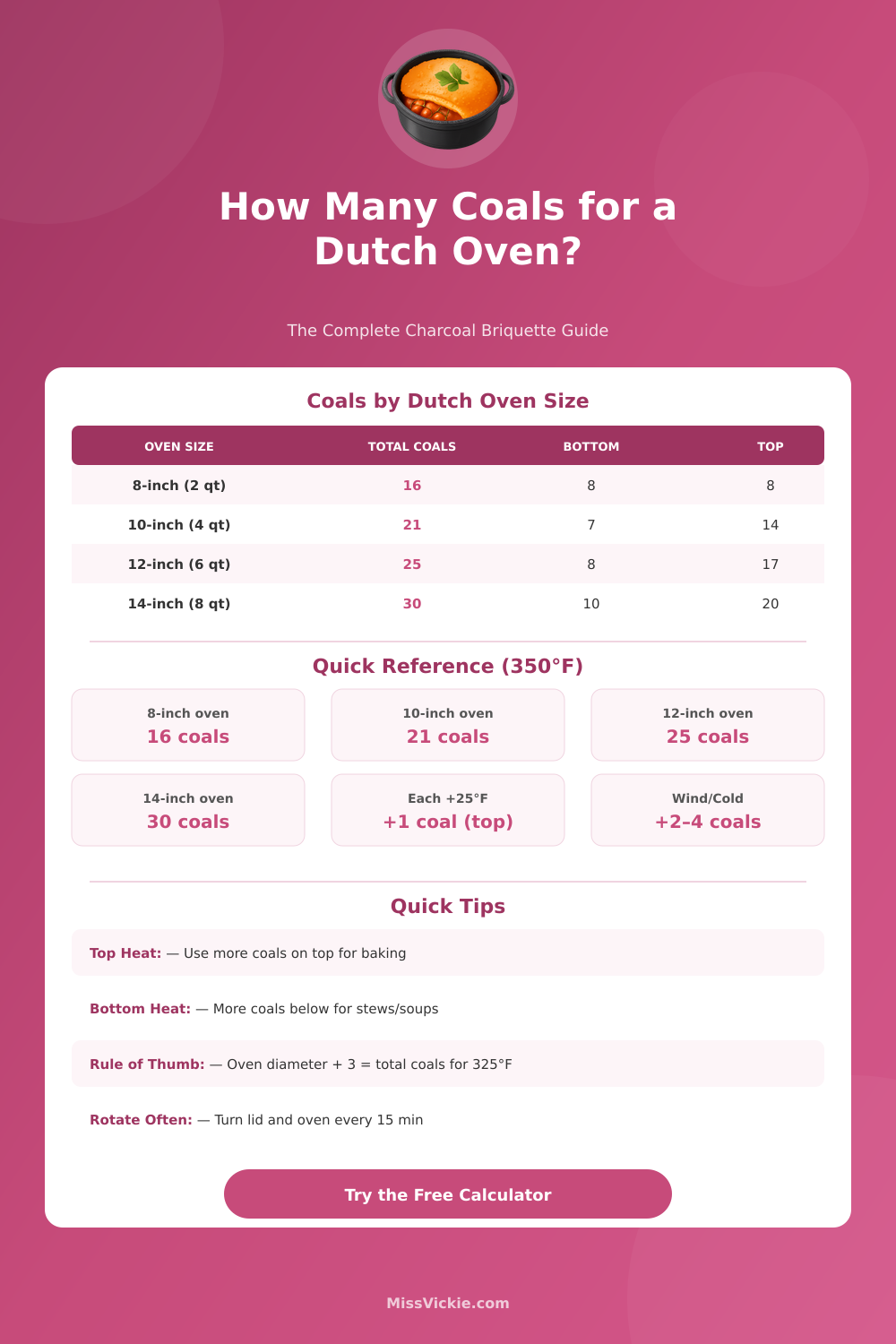
🔥 Dutch Oven Coal Calculator
Find the exact number of charcoal briquettes for any dutch oven size, temperature, and cooking method
| Temperature | Total Coals | Top Coals | Bottom Coals |
|---|---|---|---|
| 300°F | 22 | 14 | 8 |
| 325°F | 23 | 15 | 8 |
| 350°F | 25 | 17 | 8 |
| 375°F | 27 | 18 | 9 |
| 400°F | 29 | 19 | 10 |
| 425°F | 31 | 21 | 10 |
| 450°F | 33 | 22 | 11 |
| Cooking Method | Top Coals | Bottom Coals | Best For |
|---|---|---|---|
| Baking | ~68% | ~32% | Bread, cakes, cobblers |
| Roasting | ~50% | ~50% | Meats, vegetables |
| Stewing / Simmering | ~25% | ~75% | Soups, chili, stews |
| Frying / Boiling | 0% | 100% | Deep fry, boiling water |
| Oven Size | 300°F | 325°F | 350°F | 375°F | 400°F |
|---|---|---|---|---|---|
| 8-inch | 14 | 15 | 16 | 18 | 20 |
| 10-inch | 19 | 20 | 21 | 23 | 25 |
| 12-inch | 22 | 23 | 25 | 27 | 29 |
| 14-inch | 27 | 28 | 30 | 32 | 34 |
| 16-inch | 32 | 33 | 35 | 37 | 39 |
Coal is made up of black or dark black rock that burns easily. It stores mainly carbon, together with few amounts of hydrogen, sulphur, oxygen and nitrogen. More than 50 percent of its mass forms carbon material, while more than 70 percent of the volume.
Deposits of plants, called peat, compact deeply to create it.
Coal: What It Is, How It Forms and How We Use It
Coal belongs to fossil fuels. It came from remains of plants before millions of years. During huge periods of time, deposits from remains of plants lodged deeply in the ground.
The heat and pressure from that depth altered peat slowly into Coal. That process lasted a really long time.
One finds four main kinds of Coal. They are called anthracite, bituminous, subbituminous and lignite. The class is judged according to the carbon content and the amount of haet, that it delivers.
Every kind serves other targets and burns in different modes.
In the whole world Coal ranks as the second main energy source, only after crude. It is the most commonly used fuel to produce electricity. Besides electricity, it applies mainly in factories, for instance to make steel.
Coal powered the Industrial Revolution during the 19th century. Today it still serves in power plants and heavy industrial processes, because it costs little and one easily gets it.
Coal is sold in various sizes, and that matters a lot because of the way it burns. The biggest is broken Coal, that one commonly puts in industrial boilers; it has size of around 8 to 12 centimetres. Nutty Coal, a bit smaller, works well in gravity-fed stokers.
Its medium size ensures stable burning and good warm spread. Kinds like rice, buckwheat and barley are used in automatic stokers, where machines put the Coal in the furnace. Manually fired boilers tolerate mixes from various sizes, although one mostly burns nut.
Pea Coal delivers less heat, but burns more long because of bottom air flow.
Different small sizes show different levels of moisture. Buckwheat has around 6 percent of moisture, rice 7 percent and barley 8 percent. They store from 10 to 13 percent of ash and from 82 to 86 percent of pure carbon.
Coal even so does not lack in problems. In some regions heavy trucks with Coal wreck the roads, that never get fixed. Mining risks dangers, and the dusty particles risk the health.
Without a mask black snot appears already the same day, and Coal dust builds up under the eyes.
Natural gas now costs less then Coal, and that change pushes Coal to decline in many areas. Even so lands like China still build new Coal plants. Coal maybe will reach its peak soon globally, whatcould lead to sinking output in coming years.