🔥 Dutch Oven Charcoal Calculator
Calculate exactly how many charcoal briquettes you need for any dutch oven size and temperature
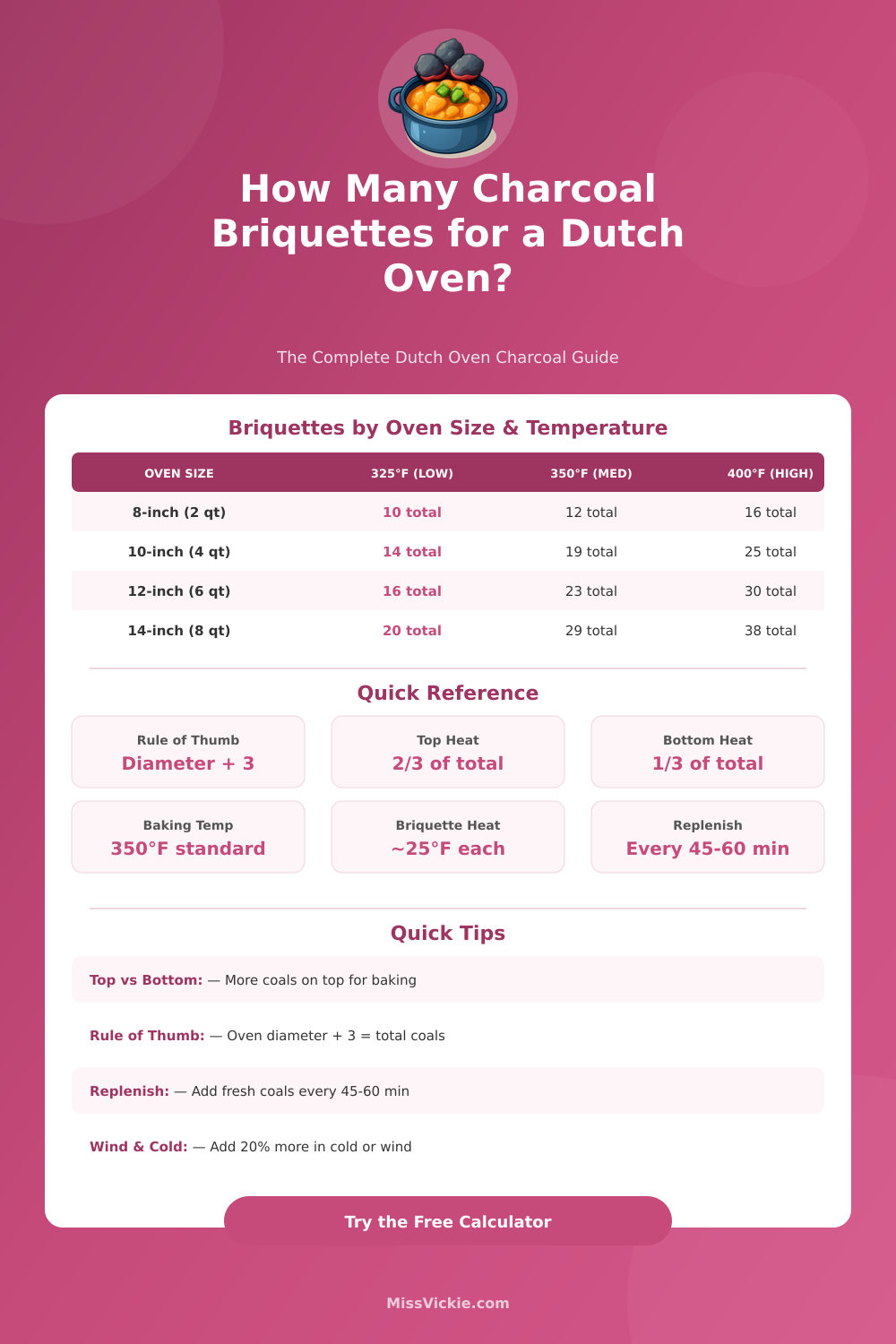
| Oven Size | 250°F | 300°F | 325°F | 350°F | 375°F | 400°F |
|---|---|---|---|---|---|---|
| 8-inch (2 qt) | 8 | 9 | 10 | 12 | 13 | 15 |
| 10-inch (4 qt) | 11 | 13 | 15 | 19 | 21 | 23 |
| 12-inch (6 qt) | 13 | 16 | 18 | 23 | 25 | 28 |
| 14-inch (8 qt) | 16 | 19 | 22 | 29 | 31 | 35 |
| 16-inch (12 qt) | 19 | 23 | 26 | 34 | 37 | 41 |
| Cooking Method | Top Coals | Bottom Coals | Ratio (Top:Bottom) | Best For |
|---|---|---|---|---|
| Baking / Bread | 2/3 of total | 1/3 of total | 2:1 | Bread, cakes, biscuits, pies |
| Stew / Roast | 1/2 of total | 1/2 of total | 1:1 | Stews, soups, pot roasts |
| Frying / Boiling | 1/3 of total | 2/3 of total | 1:2 | Frying, boiling, sauteing |
| Simmer | 1/4 of total | 3/4 of total | 1:3 | Long slow simmers, beans |
| Condition | Adjustment | Extra Briquettes (12" at 350°F) | Notes |
|---|---|---|---|
| Normal (60-80°F) | None | 0 extra | Use standard count |
| Cold (below 40°F) | +25% | ~6 extra | Ground insulation helps |
| Windy | +20% | ~5 extra | Shield with windbreak |
| Cold & Windy | +40% | ~9 extra | Windbreak strongly advised |
| High Altitude (>5000 ft) | +10% | ~2 extra | Lower oxygen, less heat |
Charcoal is black, lightweight stuff from carbon, that one makes by means of strongly hot treatment of wood or other plant materials with only a bit of oxygen. This method removes from the material all water and volatile parts. Traditionally one calls it Charcoal burning, and the whole process is pyrolysis.
In short words wood adjusts into purer carbon form, without those smoky or ashy bits, that stay after normal burning. So Charcoal has bigger energy density than average timbers, hence it burns more strongly and effectively.
What Charcoal Is and How to Use It
For grilling exist two mainstream kinds of Charcoal: rolls and blocks. Blocks are made up of regular Charcoal mixed with binders. It commonly carries sawdust, wood chips and other wooden waste, what makes them cheap and eco-friendly.
Rolls of Charcoal are more liked for grilling, because they give to the foods real smoke taste. Some brands use dense fruit wood, that burns more steadily and warm, while it produces fewer smoke and ash. That variant also escpaes the sparks and crackle, that one finds in other fuels.
Grilling by means of Charcoal require some minutes of waiting. When one lights the Charcoal, it requires around twenty to thirty minutes, so that it burn until white ash. Only later it is ready four use.
Gas grills simply require to turn the knobs and press button. However the taste of Charcoal surpass everything.
If one arranges the Charcoal in grill on one side, one creates warm zone and cool zone. It is handy, when sharply flares the fire, because one can simply move the food to the indirect area. For usual cook enough two to three pounds of Charcoal, so around thirty to forty blocks.
The amount ranges according to the duration of cook and the used methods.
Except grilling, activated Charcoal has several other uses. It is special Charcoal with bigger absorbing pores than the usual. Toothpaste with activated Charcoal removes marks from the teeth, but many average toothpastes do the same.
It does not bleach the teeth beyond basic marks. Activated Charcoal helps also as natural cleaner for the skin, because it removes toxins and dirt while it softens peeling. Tablets with activated Charcoal bind unwanted stuff and gases in thedigestive system.
Some creative cooks even mix Charcoal powder in bread. Exist rolls from bamboo Charcoal, although they look a bit special. Blocks from coconut work for baking on little Charcoal grill, without that they add taste of Charcoal to the bread.