🍝 MissVickie pasta conversion
Dry Pasta Grams to Cups Converter
Convert dry pasta by shape, then scale spaghetti, penne, rigatoni, or orzo between grams and cups with kitchen-friendly precision.
Each preset loads a realistic dry pasta scenario, from pantry boxes to dinner batches, then runs the converter automatically.
Pick the shape first, then choose how you measured it. Dry pasta packs differently by cut, so the shape selector matters.
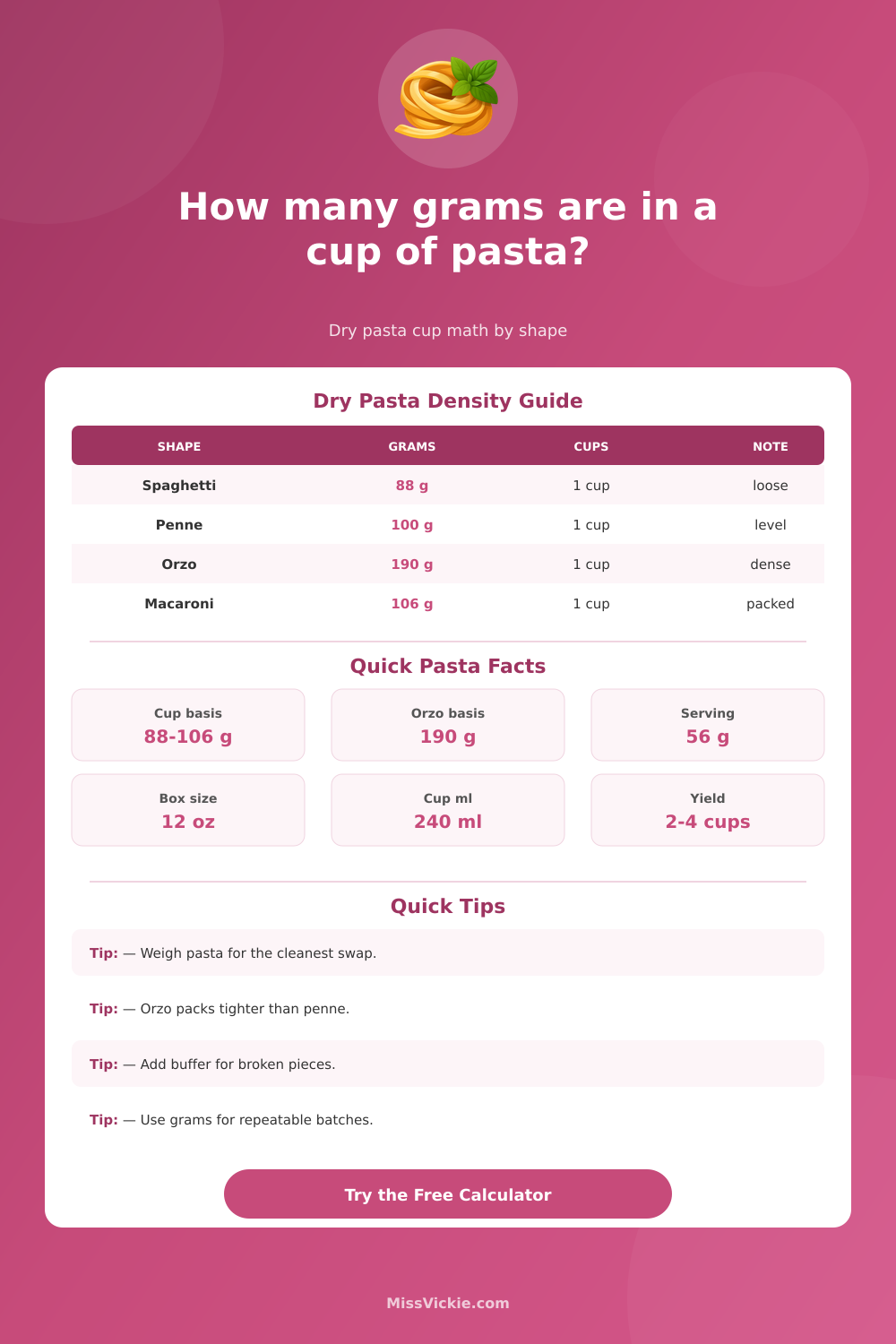
These quick cards show the rough dry weight of one cup for common shapes. Orzo is much denser than long noodles.
Spaghetti is a light, airy cup.
Penne is the easy level-cup baseline.
Orzo packs tightly and weighs more.
Macaroni often sits near the middle.
Use this table when you want a shape-aware starting point for cups, grams, and short notes about how the cup behaves.
| Shape | 1 Cup Dry | 100 g Equals | Note |
|---|---|---|---|
| Spaghetti | 88 g | 1.14 cups | Light strands, loose scoop |
| Linguine | 90 g | 1.11 cups | Flat noodle, easy to layer |
| Fettuccine | 92 g | 1.09 cups | Wide ribbons, moderate pack |
| Penne | 100 g | 1 cup | Great baseline for most boxes |
| Rigatoni | 96 g | 1.04 cups | Ridged tubes trap air |
| Fusilli | 94 g | 1.06 cups | Spirals settle with shaking |
| Macaroni | 106 g | 0.94 cups | Elbows compact a bit more |
| Farfalle | 92 g | 1.09 cups | Bows bridge long and short |
| Orzo | 190 g | 0.53 cups | Very dense, tiny grains |
| Ditalini | 110 g | 0.91 cups | Short tubes, tidy measure |
These portion targets help when you are scaling a dinner plan or checking how many people a dry amount will cover.
| People | Dry Pasta | Cups Penne | Notes |
|---|---|---|---|
| 1 serving | 56 g | 0.56 cups | Classic 2 oz portion |
| 2 servings | 113 g | 1.13 cups | Light lunch for two |
| 4 servings | 227 g | 2.27 cups | Standard dinner batch |
| 6 servings | 340 g | 3.40 cups | One 12 oz box |
| 8 servings | 454 g | 4.54 cups | One pound bag |
Package labels are often printed by weight, so this table translates common box sizes into approximate dry cups by shape.
| Package | Grams | Spaghetti Cups | Penne Cups |
|---|---|---|---|
| 8 oz box | 227 g | 2.58 cups | 2.27 cups |
| 12 oz box | 340 g | 3.86 cups | 3.40 cups |
| 1 lb bag | 454 g | 5.16 cups | 4.54 cups |
| 2 lb bulk | 907 g | 10.31 cups | 9.07 cups |
If you only need a rough cup estimate, these shortcuts convert common spoon measures for the main pasta styles.
| Measure | Spaghetti | Penne | Orzo |
|---|---|---|---|
| 1 cup | 88 g | 100 g | 190 g |
| 1/2 cup | 44 g | 50 g | 95 g |
| 1 tbsp | 5.5 g | 6.3 g | 11.9 g |
| 1 tsp | 1.8 g | 2.1 g | 4.0 g |
Useful when you want a kitchen estimate and the shape is already chosen.
Best for repeatable cooking, especially with brand changes or mixed shapes.
Handy when the pantry says 12 oz or 1 lb instead of cups.
Great for deciding how many people a dry amount can cover.
In order to properly measure dry pasta, it is first important to understand the concept of density in relation to the different shapes that pasta can come in. Density refer to the weight of a substance relative to it’s volume. Because the shape of pasta can impact the density of the pasta, pasta of different shapes will have different weights within the same measuring cup.
For instance, an cup of long pasta shapes like spaghetti will weigh approximately 88 grams, while a cup of short pasta shapes like penne will weigh approximately 100 grams. Even more denser is small shaped pasta like orzo, which weighs approximately 190 grams per cup. These varying weights indicates that one cup of spaghetti will not contain the same amount of pasta as one cup of orzo.
How to Measure Dry Pasta
To ensure accuracy in the measurement of pasta, one of the best ways to accomplish this is through the use of a kitchen scale. Kitchen scales will measure the weight of the pasta being measured, which is a consistenly measurement. Volume, on the other hand, can be inconsistent due to the way in which the pasta is pour into the measuring cup.
If the pasta is shaken into the measuring cup, the pasta will settle and appear to be more dense than if the pasta is scooped into the cup with fewer vibrations. The weight of a single serving of dry pasta is approximately 56 grams, and this measurement is consistant regardless of the shape of the pasta. Thus, if a cook weighs pasta with a kitchen scale, the number of grams of pasta provided will always be the same than the number of grams of pasta that was measured.
If a kitchen scale isnt available to measure the pasta, measuring cups can be used to approximate the amount of pasta needed. Measuring cups, however, are less precise than kitchen scales. When measuring with measuring cups, the cook must decide whether the cook will scoop the dry pasta into the cup with loose scoops (which will yield a less weight of pasta) or with level scoops (which will yield a greater weight of pasta).
For instance, two and a half level cups of spaghetti will contain approximately 225 grams of dry pasta, which is enough for four person. However, 225 grams of penne will fill fewer measuring cups then the same weight of spaghetti due to the differences in the densities of these pasta shapes. Thus, cooks must be aware of these differences when measuring pasta without a kitchen scale.
Another factor to consider when cooking pasta is how much pasta will be cooked after the pasta is boiled in water. Long pasta noodles, like spaghetti, will expand to become four times the volume when cooked as when it was dry. Short pasta noodles, like penne, will increase in volume but to a lesser extent; one cup of dry penne will yield only approximately two cup of cooked penne.
Thus, cooks must calculate how much dry pasta is needed based off the number of people to be fed, and also consider the expansion of the pasta when cooked to ensure that each person will recieve enough pasta to eat. One of the mistake that many cooks can make is ignoring the shape and weight of the pasta. If the shape of the pasta is ignored, cooks may add too much sauce or too little pasta to the recipe.
If the pasta is not weighed according to the number of people that will eat the recipe, then there may not be enough pasta for each person. Lastly, the density of the pasta can vary according to the brand of pasta or if the pasta is fresh rather than dry. To avoid these mistakes, cooks should of use kitchen scale when precision in the amount of pasta is needed.
Volumes can be used for speed and conveniance in cooking. However, pasta cooks should always remember that the shape of the pasta can impact how much pasta will fit into a measuring cup.