Turkey dry brine salt, timing, shape, and rest
Dry Brine Turkey Salt Per Pound Calculator
Calculate dry brine salt from turkey pounds, kosher salt brand density, target salt percentage, surface coverage, brine hours, pre-salted adjustment, drip loss, and rest time.
Choose a real turkey scenario, then fine tune salt brand, target percentage, shape, skin exposure, sugar, herbs, prior salting, drip loss, and carving rest.
Your Turkey Dry Brine Plan
Salt amount, spoon conversion, brine timing, and rest schedule will appear here.
Full Dry Brine Breakdown
Classic holiday shape with thicker breast and slower salt migration near joints.
Flattened shape exposes more surface and usually seasons faster and more evenly.
Legs, thighs, wings, and breast pieces dry brine quickly because surfaces are separated.
Lean white meat benefits from moderate salt and careful rest after roasting.
| Salt Type | Approx Grams Per Tablespoon | Texture | Use In This Calculator |
|---|---|---|---|
| Diamond Crystal kosher | About 8 g | Large, flaky crystals | Good for visible, even dry brine coverage. |
| Morton coarse kosher | About 15 g | Denser coarse crystals | Use fewer tablespoons than Diamond for the same salt grams. |
| Fine sea salt | About 18 g | Fine, compact grains | Measure carefully because spoon volume packs more salt. |
| Table salt | About 18 g | Small uniform grains | Best weighed in grams for turkey dry brines. |
| Coarse sea salt | About 13 g | Irregular coarse grains | Crush very large crystals before rubbing under skin. |
| Turkey Situation | Target Salt Percent | Per Pound Salt | Best Use |
|---|---|---|---|
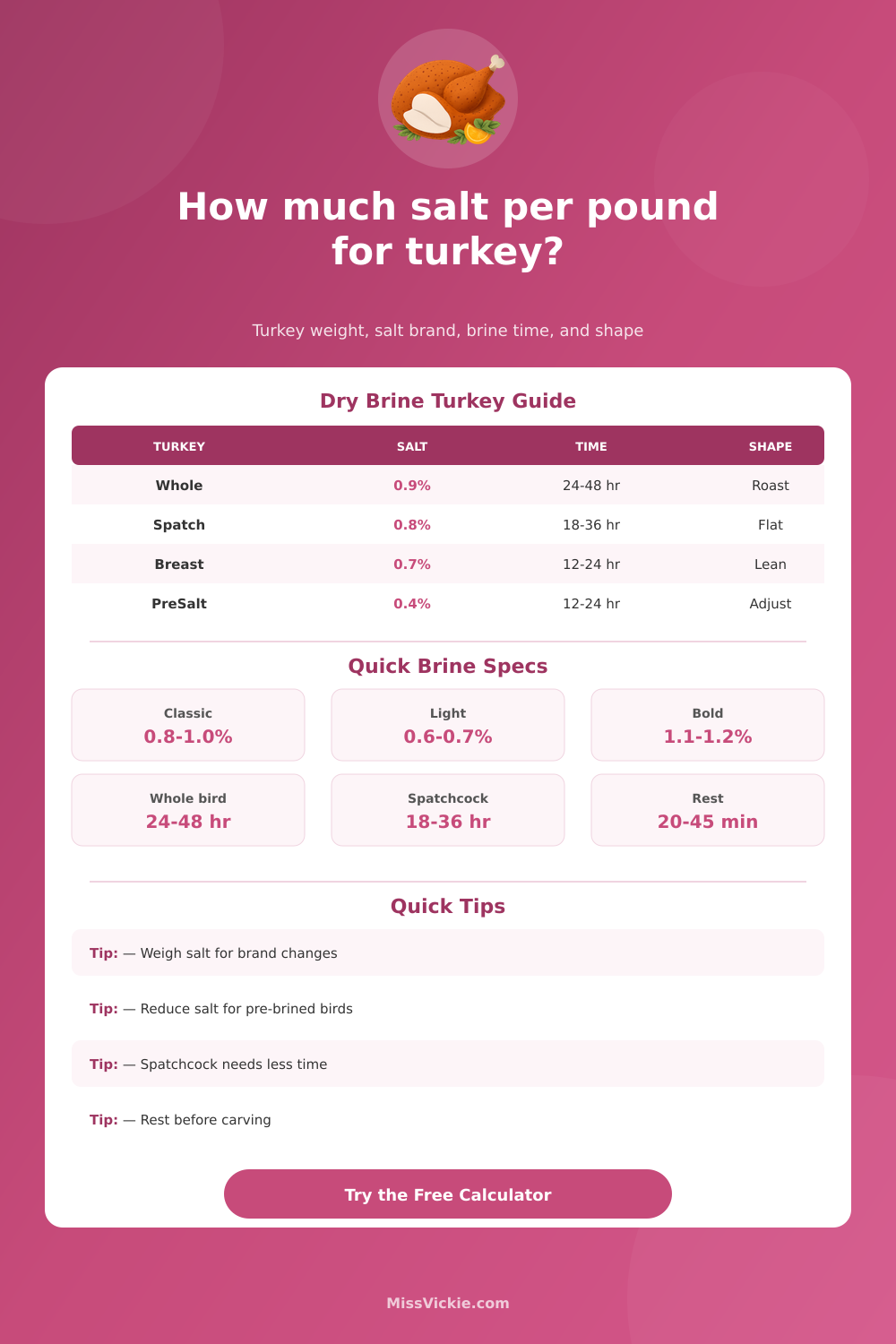
| Lightly seasoned whole turkey | 0.6% to 0.7% | 2.7 to 3.2 g/lb | Good for sensitive eaters or salty gravy plans. |
| Classic dry brined turkey | 0.8% to 1.0% | 3.6 to 4.5 g/lb | Balanced seasoning for most whole roasted turkeys. |
| Bold holiday seasoning | 1.1% to 1.2% | 5.0 to 5.4 g/lb | Works with large birds, unsalted stock, and mild sides. |
| Pre-brined or enhanced turkey | 0.3% to 0.5% | 1.4 to 2.3 g/lb | Use only after checking the label for added salt solution. |
| Turkey Weight or Cut | Minimum Time | Preferred Time | Fridge Method |
|---|---|---|---|
| 6 to 9 lb breast or parts | 8 to 12 hr | 12 to 24 hr | Uncovered on a rack after the surface looks moist. |
| 10 to 14 lb whole turkey | 18 to 24 hr | 24 to 48 hr | Rub under skin, then refrigerate uncovered. |
| 15 to 20 lb whole turkey | 24 hr | 36 to 60 hr | Turn once if the tray collects heavy purge. |
| Spatchcock turkey | 12 to 18 hr | 18 to 36 hr | Keep skin side up for drying and browning. |
| Add-In | Calculator Ratio | Flavor Effect | Kitchen Note |
|---|---|---|---|
| Dried herbs | 0.15 tsp per 10 g salt | Savory aroma without turning the brine into a rub. | Rub herbs finer before applying under skin. |
| Brown sugar | 25% of salt weight | Helps browning and rounds the salty edge. | Use less with very high oven heat. |
| Citrus zest | 0.20 tsp per 10 g salt | Fresh aroma for breast meat and pan juices. | Avoid wet juice in a dry brine. |
| Carving rest | 20 to 45 min | Lets juices settle before slicing. | Large birds can rest longer under loose foil. |
The holidays mean buying a big ol’ turkey, and you hope it’ll be delicious and juicy. But don’t think that just tossing some salt into the mix will get it even across the whole thing. No sir. You need to take a moment and calculate how much salt goes where. Now consider dry brining.
But here’s what still happens at home: We guess with a pinch (or maybe two) out of the shaker. And if we’re being honest, that doesn’t usualy pan out so well. Every brand are different, as some have very dense grains and others is more airy. For example: One tablespoon of Morton coarse kosher might actualy weigh fifteen grams, whereas one tablespoon of Diamond Crystal is only about eight. So when you’re guessing with a volume measure, and have no idea what brand you’re using… You’re basically playing dice with your dinner.
How to Salt Your Turkey Correctly
The calculator above take away the math involved in converting once you input the kind of salt you’re using and the weight of your bird. This means you’ll avoid seasoning too little, too much, or anything else due to a simple misunderstanding of densities.
But that’s half of the story. The other half is knowing when to put in your salt, since it requires some time to spread into the muscle fibers, not simply rest on top of them. A seven-pound breast roast will require different timing than a 12-pound whole turkey. The larger animal have more mass, meaning thicker meat, which takes more time for the osmosis process to reach down in the center. Rush it? You’ll have bland meat and salty skin.
Fortunately, the tool takes all of this structure into account; it bases its recommendations on shape. For example, spatchcocked turkeys is flatter, expose more surface area, and allow salt to act more quickly. This is why a flattened turkey can often brine for less time than a whole one. Again, it’s not just that flat birds taste more intense; it’s that they give salt better physical access to meat.
This brings up another factor: Was your turkey already salted? Dozens of supermarket turkeys is now marked “kosher” or have been injected with salt water, meaning they’re already salted. When you add a whole dose of dry brine to one of those enhanced birds, you get a hunk of inedible sodium brick.
To account for this variable and avoid accidently wrecking the turkey, you can adjust your inputs. If it says it’s been injected or in some way includes broth or solution, just go down a peg on the target percentage. It’s a minor tweak, but one that keeps you from ruining dinner. These ranges are all spelled out neatly on table of references on the page; note that lower percentages align with the enhanced bird scenario, whereas higher numbers apply to plain cuts, straight off the bird.
That’s why the process alters your thinking about moisture retention. Initially, dry brining pulls out moisture, which is then soaked back in along with dissolved proteins and salt. This results in better browning and a firmer texture compared to wet-brined birds, which dilute the flavors and take up fridge space. You’re not simply salting; you’re changing the protein structure so it holds onto more water while roasting.
The expected amount of drip loss will help factor in the natural purge that occurs over time when the bird sits uncovered. I recommend refrigerating the turkey on a rack so its skin dries (key to crispiness). Skip this step and the skin will steam rather then roast.
Sugar and herbs support this action as well, adding more complex flavors, but they are no substitute for how salt works. Caramelization is aided by brown sugar (take care when at higher heats). Aromatic dried herbs contribute fragrance without any additional liquid that might impede the drying of skin. These ingredients is scaled with the weight of salt used, so that the proportions stay consistent across all recipes. It keeps the focus where it belongs, on the primary seasoning mechanism.
There’s no room to negotiate resting the bird once roasted. If cut too soon, the carefully won juices will escape onto the chopping block. Allowing the bird to rest lets them redistribute themselves within the meat.
At its core then, mastering the art of cooking turkeys is more than secret recipes, it’s following simple physics: salt, time and surface area are all very predictable variables. When you have a set of proven numbers, there’s no guessing. And if you weigh out your ingredients, the guesswork would of gone away completely.
It turns the potentially stressful holiday centerpiece into a do-able project. You can get consistent, repeatable results every time you grab a bird out of the cooler. And once you understand the inputs and trust the math, you take away the anxiety from the equation. This is the end result. The meat is flavored through-and-through, not just on the surface. It’s that depth of flavor that makes the difference between a good meal and a great one. Before any heat ever touches your food, you’re in control of the process.