🍹 MissVickie drink math
Drink Recipe Converter
Scale cocktails, mocktails, pitchers, and party punch with real pour sizes, dilution estimates, and quick conversions between ounces, cups, liters, and milliliters.
Each preset loads a specific batch scenario with drink style, servings, pour size, and dilution choice, then runs the converter immediately.
Quick guest-pour targets help you sanity-check whether your recipe component fits a tasting bar, cocktail hour, or large self-serve station.
Best for flights, welcome pours, and stronger low-volume cocktails.
Works for most shaken or stirred cocktails poured without extra topper.
Leaves room for soda, juice, and garnish while still feeling generous.
Typical for self-serve bowls, lemonades, and brunch-style pitchers.
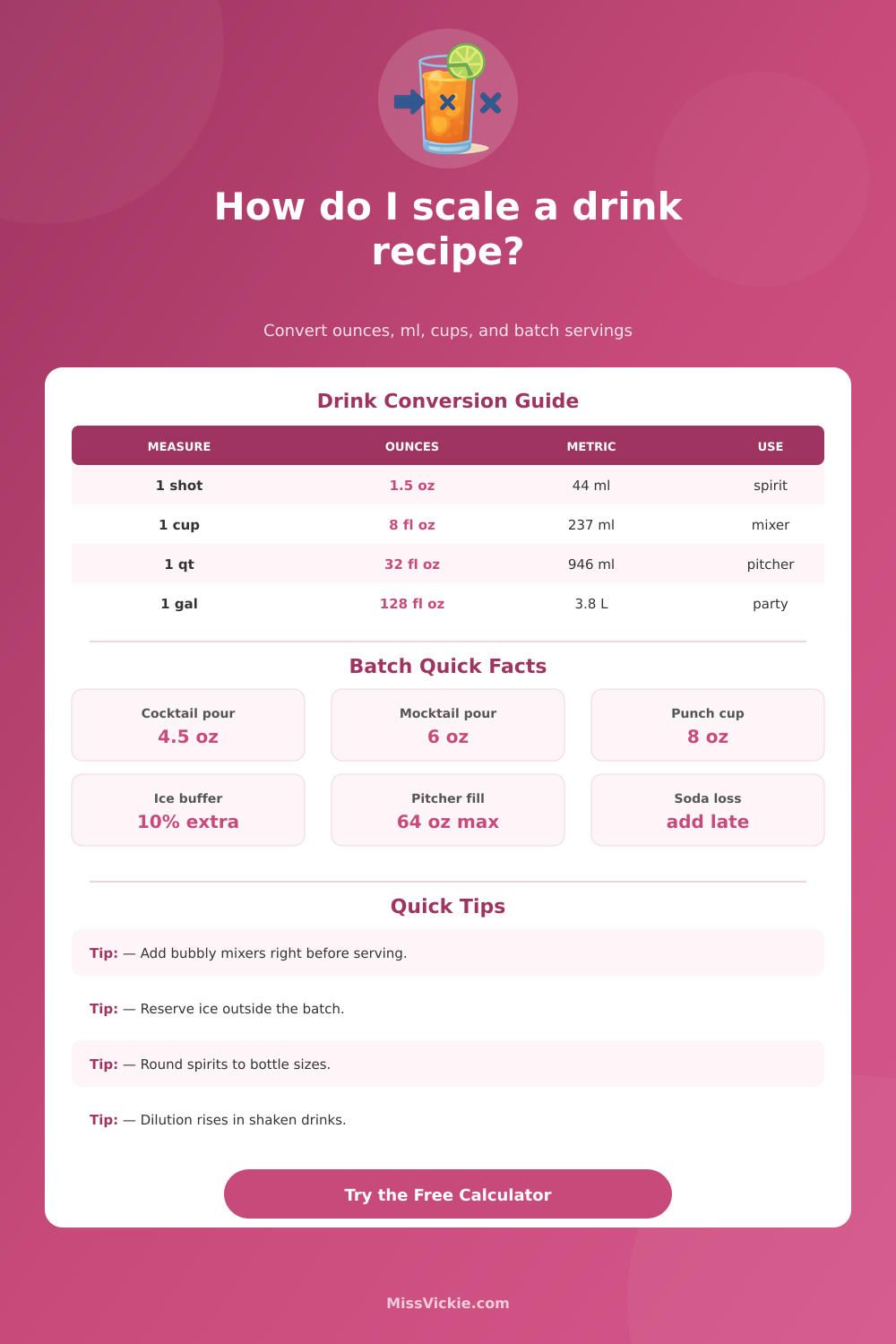
Use these fixed conversions when a recipe flips between bar jiggers, measuring cups, pitcher marks, and metric tools.
| Measure | Fluid Ounces | Milliliters | Typical Use |
|---|---|---|---|
| 1 dash | 0.03 oz | 0.9 ml | Bitters, saline, tincture |
| 1 tsp | 0.17 oz | 4.9 ml | Syrup, grenadine, shrubs |
| 1 tbsp | 0.5 oz | 14.8 ml | Citrus, rich syrup, cream |
| 1 jigger | 1.5 oz | 44 ml | Standard spirit pour |
| 1 cup | 8 oz | 237 ml | Pitcher mixers and juice |
| 1 quart | 32 oz | 946 ml | Party mixer and punch base |
These component assumptions help estimate how a single ingredient behaves inside a finished batch after standard dilution and service loss.
| Component | Density Cue | Service Note | Best Batch Use |
|---|---|---|---|
| Base spirit | Near water | Round to bottle size | Make ahead by volume |
| Citrus juice | Slightly heavy | Fresh flavor fades first | Add day of service |
| Simple syrup | Heavier than water | Sweetness rises fast | Measure carefully |
| Carbonated mixer | Light body | Foam steals volume | Top just before pour |
| Wine | Near water | Protect from oxidation | Cold pitcher batches |
| Fruit puree | Thick and heavy | Settles in storage | Blend before service |
If you know only the guest count, compare these finished batch targets before deciding how much of each ingredient component to scale.
| Guests | 4.5 oz Cocktails | 6 oz Mocktails | 8 oz Punch |
|---|---|---|---|
| 8 | 36 oz / 1.06 L | 48 oz / 1.42 L | 64 oz / 1.89 L |
| 12 | 54 oz / 1.6 L | 72 oz / 2.13 L | 96 oz / 2.84 L |
| 20 | 90 oz / 2.66 L | 120 oz / 3.55 L | 160 oz / 4.73 L |
| 30 | 135 oz / 3.99 L | 180 oz / 5.32 L | 240 oz / 7.1 L |
Use standard package sizes to translate your converted amount into a practical shopping or setup plan before prep starts.
| Target Volume | 750 ml Bottles | 1 L Bottles | 64 oz Pitchers |
|---|---|---|---|
| 1.5 L | 2 bottles | 2 bottles | 1 pitcher |
| 3 L | 4 bottles | 3 bottles | 2 pitchers |
| 4.5 L | 6 bottles | 5 bottles | 3 pitchers |
| 7.5 L | 10 bottles | 8 bottles | 4 pitchers |
This estimate tracks calories, sugar, caffeine, and alcohol markers for the selected component only, helping you judge how a scaled batch shifts balance.
When you make cocktails for a large number of guests, you must adjust the recipe to account for the number of guests who will taste the cocktail. If you are making twelve cocktails of margaritas, and each recipe require one and a half ounces of tequila per cocktail, you cannot simply multiply the number of cocktails by the amount of tequila. You must account for a number of factors that may alter the number of ounces of cocktails that you prepares.
One of the factors to consider is the dilution of cocktails made with ice. If you prepare your cocktails by shaking the ingredients, each cocktail will contain approximately fifteen percent more volume then the amount of the cocktail that you prepared. If you prepare your cocktails in a punch bowl, the dilution can be twenty-two percent due to the fact that the ice in the punch bowl will melt as the guests takes the cocktails from the bowl.
How to Make Enough Cocktails for Many People
Thus, you must add extra liquid to account for this dilution factor, or the cocktails wont provide enough liquid for each guest. Another factor to consider is the need for a buffer in the cocktails. A buffer is a flavoring additive that is use to ensure that there is enough of the cocktail to supply each guest with their desired amount.
A five to ten percent buffer ensure that the cocktail will last for each guest. Without this buffer, it is likely that the pitcher will become empty prior to each guest drink there cocktail. The ingredients that you use in your cocktails will have a certain density.
Spirits like tequila and vodka has a density that is similar to water. Ingredients that is heavy and contain syrups will settle at the bottom of the pitcher if you do not stir the cocktail. Additionally, you should add carbonated liquids to the cocktail at the last minute prior to serving, as the carbonation will vanish if the cocktail is prepared too early.
Knowing the number of guests that will taste the cocktails will help you calculate the number of ounces of cocktails that is needed. If you are preparing cocktails for eight individuals that each drink a four and a half ounce cocktail, there will be thirty-six ounces of cocktails needed. If you are preparing cocktails for twenty individuals, there will be ninety ounces of cocktails needed.
Knowing the number of ounces of cocktails needed will allow you to select pitchers for the cocktail. When you shop for the ingredients for the cocktails, you must account for the number of bottle of each ingredient that are needed. If you calculate that you need one and a half liters of tequila, then one one-point-five-liter bottle will provide the amount of tequila that is needed.
If you calculate that you need three liters of tequila, then you will need two one-point-five liter bottles, or four seven-fifty-milliliter bottles will provide the amount of tequila that is needed. To calculate the number of ounces of ingredients that is needed for the cocktails for large groups of individuals, you must calculate the factors mentioned above. To find the total amount, multiply the original cocktail recipe by the number of guests, add the percentage for dilution, add the percentage for the buffer, and calculate how many ounces of each ingredient are needed.
Following these steps will allow you to ensure that each guest receive the same cocktail recipe, and that there is enough of the cocktails to provide each guest with their desired amount.