
Then you watch as the dough sits in the bowl without rising. While waiting for oven to heat up. Typicaly it’s not the water or the flour. It’s the room temperature.
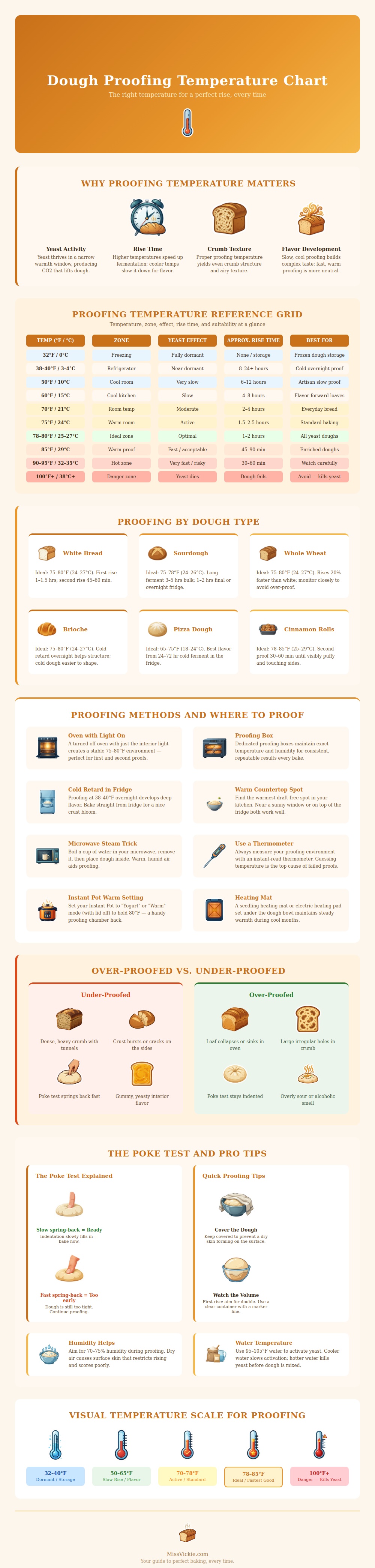
The yeast are a living organism that responds to environment. Treat your yeast well and you will get an airy crumb and a good crusty bread. Ignore the heat, and you gets a dense brick-like loaf. How does temperature affect yeast? Here’s a chart demonstrating how yeast activity vary by temperature.
Why Temperature Matters for Yeast
Lots of novices assume warmer = better. After all, warmer speeds things up, right? Wrong, very wrong. There’s only a limited range of warmth in which yeast work best. Why? It creates carbon dioxide, which then lifts the gluten structure in the dough. Too warm and your yeast dies; no yeast = no lift = no loaf.
For most conventional doughs, the sweet spot is 78-80 degrees fahrenheit. In other words, fermentation move rapidly but isn’t so wild as to prevent flavor compounds from developing. This offer speed and quality.
Everything slow down when it gets cooler. Proofing in your refrigerator or a cool kitchen might take eight hours or more instead of two. It’s a pain in the butt, but that’s what you get with serious baking. The slower fermentation give enzymes time to break down starches into sugars and acids. Those acid produce complex flavors. An hour on the counter will yield mild-tasting dough. Overnight in the fridge yields tangy notes. There is no rushing this process, Time equals depth.
Not all doughs are the same. While white sandwich bread need consistency, it likes its ideal warm zone for doubling in a predictable way. Sourdough require time. Commercial baker’s yeasts work faster then the wild yeasts of sourdough. Cooler final proofs and bulk ferments suits them better.
Then there is pizza. On one hand, it will rise quickly, but on the other, letting it rest in the fridge for a long time can produce best bases. The gluten network get stronger. And the dough won’t overproof in hot wood-fired oven.
Lastly are enriched doughs such as brioche. Here butter coats the gluten strands and slow the rise. Warmth help it conquer this resistance. But too much will melt the fats before the structure has set up.
Location, location, location is the secret to successful baking in the kitchen. Radiators bake it; drafty windows thwart the proof. Oven’s off? Turn on the light. It stabilize conditions. The ideal temperature for most standard doughs are between 78 and 80 degrees. Reliable trick, no cost involved.
Got a chilly kitchen? Fill up a mug with some hot water and nuke it for an instant burst of steam. Humidity count too. Moisture prevents a skin from forming on the dough, which stops it from expanding. This result in poor oven spring. Dampen your plastic wrap or towels over your bowl. A supple surface.”
Use the poke test to tell when it’s ready. With a finger, gently push down into the dough. Is there a quick spring-back? Then the gluten hasn’t relaxed yet. Let it rest longer. Push down and watch, the dent doesn’t fill in? Too late. Structure have broken down. You’re looking for the dough to slowly bounce back and for the dent to fill in halfway, That means it’s ready. Bake right away.
Once you get that timing down, you’ll take the mystery out of baking and you’ll have mastered a precise craft. No more battling the heat; instead you works with it. Each loaf will be another chance to succeed. Heat drive your bread.