
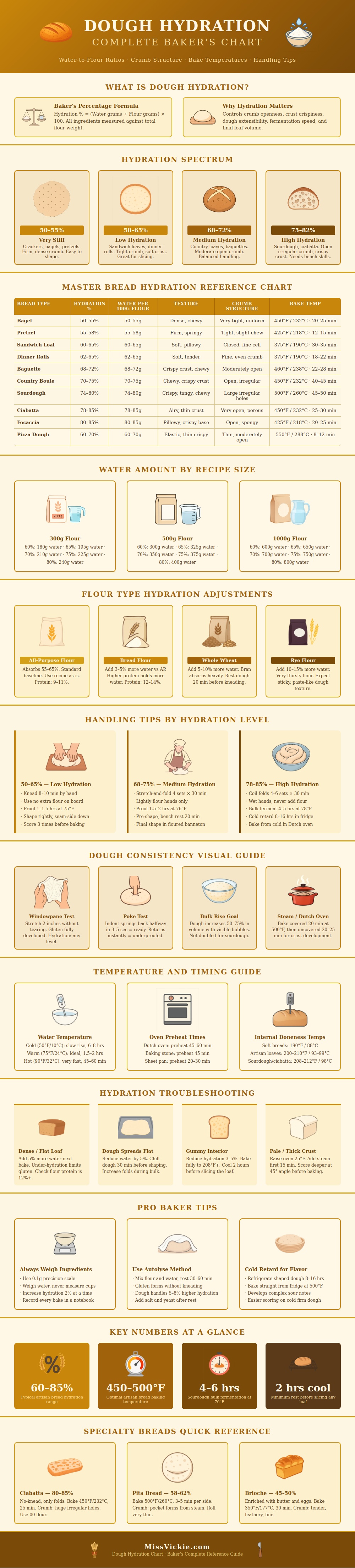
Hydration refer to the ratio of the weight of the water to the weight of the flour in the dough recipe. The hydration level of the dough have a significent impact on the texture of the final baked bread product. Using too little water in the dough will make it stiff and result in a bread product with a dense crumb.
Using too much water will result in sticky dough that is challenging to shape. To calculate the hydration levels of you dough, divide the weight of the water by the weight of the flour and multiply that number by 100. For instance, using 500 gram of flour and 350 grams of water will produce a hydration level of 70 percent.
What Is Dough Hydration and How It Affects Bread
Low hydration doughs has a hydration level of approximately 60 percent, and these doughs are easy to knead and shape. These types of doughs are suitable for sandwich bread and pizza bases as they produce an even crumb. Increasing the hydration levels to 70 percent will make the dough more easier to stretch.
Doughs with 70 percent hydration are used to bake baguettes and country loaves as this hydration level will produce air pockets in the bread. High hydration doughs will have a hydration level of 75 percent or higher. These doughs will contain larger air pockets that are more irregular in size.
Examples of bread types that use high hydration include sourdough bread and ciabatta bread. The dough for these types of bread is very sticky. It is essential not to add extra flour when kneading high hydration bread as this will reduce the hydration levels of the dough and prevent the formation of air pockets in the finished bread product.
The type of flour will impact how much water the dough will absorb. All-purpose flour will absorb water at a steady rate. Bread flour will have a higher protein content and will absorb more water.
Whole wheat and rye flour will absorb more water than white flour as they contain more bran and pentosans. If using whole wheat or rye flour, add more water to the dough. Allow the flour and water to rest together in a process called autolyse.
Autolyse is when flour and water sit together before the addition of other ingredients to the dough. This process allows the flour to absorb water and the gluten to strengthen. The different hydration levels will require different dough handling technique.
Low hydration dough can be kneaded on a flat surface. For medium hydration dough, use the stretch and fold technique. For high hydration dough, use the coil fold technique in a bowl.
Keep your hands wet when kneading high hydration dough to prevent sticking. High hydration dough can be refrigerated overnight to allow a cold retard. Using a cold retard will make the dough easier to shape and will improve the flavor of the finished bread product.
There are test that ensure dough is prepared correctly. Use the windowpane test to ensure that the gluten in the dough is properly developed. Poke the dough to see if it spring back after being poked.
Gently observe the dough for bubbles or increases in the volume of dough. Use a thermometer to ensure the internal temperature of the bread product reaches 200 degree Fahrenheit. Maintaining an internal temperature of 200 degrees will ensure that the center of the bread is not gummy.
If the bread product is flat, the hydration levels may have been too low when mixing the dough or the gluten in the dough may have not developed enough. If the dough pool when kneading, it may have had too high of a hydration level; in this case, decrease the hydration level of the water in the next batch of dough. Always measure the water weight in grams.
Using grams is more accurate than measuring ingredients using measuring cups. By adjusting the hydration levels of the dough, you can control the texture and crumb of the resulting bread product.